Indirect taxes and tax incidence
Introducido| English | Significado |
|---|---|
| indirect tax/ɪndaɪˈrekt tæks/ | A tax on spending or transactions, usually collected by a seller and included in the price paid by a buyer. |
| specific tax/spəˈsɪfɪk tæks/ | impuesto específico |
| tax incidence/tæks ˈɪnsɪdəns/ | incidencia impositiva |
Who really pays a tax on cigarettes?
- The government collects a cigarette tax from the companies that sell them.
- But the companies raise their prices, so smokers pay part of it at the till.
- Who bears how much of a tax is called its incidence — and it is not decided by who hands over the money.
An indirect tax shifts supply
- An indirect tax 间接税 is paid by sellers on each unit sold. It raises their costs.
- A specific tax 从量税 of ¥12 per unit shifts the supply curve up by exactly ¥12 at every quantity.
- The gap between the old and new supply curves is called the tax wedge.
A specific tax of ¥5 per unit is placed on bottled drinks. How does the supply curve move?
Dificultad 1/5 · 100 monedas + un pequeño bono en el primer intento de hoy
Sellers need ¥5 more per unit to supply the same quantity.
Worked example: the tax wedge
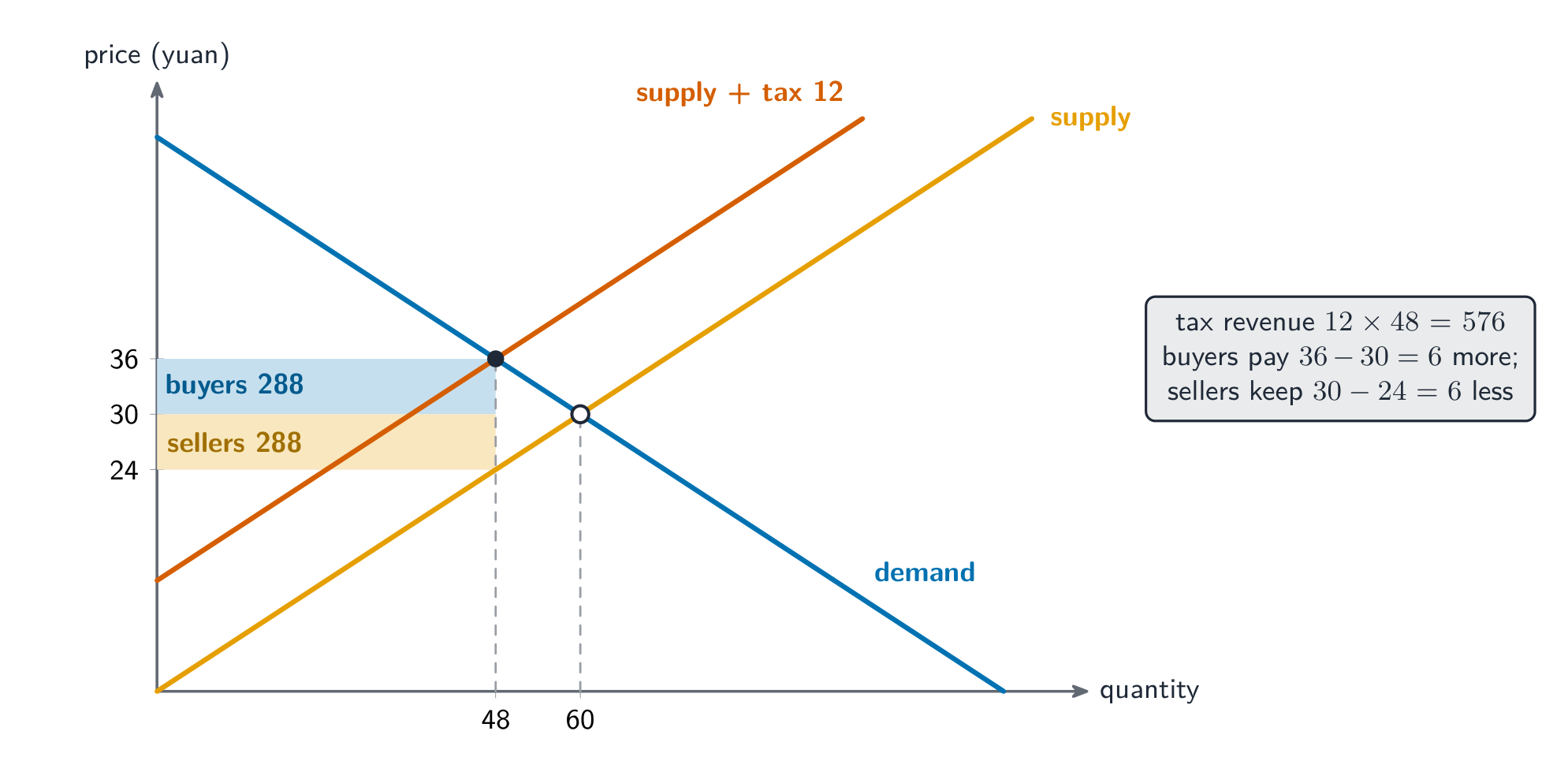
Demand is $P = 60 - 0.5Q$ and supply is $P = 0.5Q$, so before the tax $P = 30$ and $Q = 60$. A tax of ¥12 per unit is added.
- New supply: $P = 0.5Q + 12$. Set equal to demand: $60 - 0.5Q = 0.5Q + 12$, so $Q = 48$.
- Buyers pay $P_b = 60 - 0.5(48) = ¥36$. Sellers keep $P_s = 36 - 12 = ¥24$.
- Tax revenue $= 12 \times 48 = ¥576$.
Tax the new quantity, not the old one
$P_b-P_s=t;\quad R=tQ_{tax}$
A tax of 12 reduces quantity from 60 to 48; buyer price is 36, seller receipt is 24, and revenue is 576.
A tax of ¥4 per unit is placed on a good, and 250 units are sold after the tax. How much tax revenue is raised?
Dificultad 2/5 · 140 monedas + un pequeño bono en el primer intento de hoy
$4 \times 250 = ¥1000$.
Who bears the tax?
- Consumers' share: the price rose from ¥30 to ¥36, so they pay $6 \times 48 = ¥288$.
- Producers' share: the price they keep fell from ¥30 to ¥24, so they pay $6 \times 48 = ¥288$.
- Here the burden is split equally because demand and supply are equally steep.
The price buyers pay rises from ¥20 to ¥23 after a tax of ¥5. Sales are 100 units. What is the consumers' share of the tax?
Dificultad 2/5 · 140 monedas + un pequeño bono en el primer intento de hoy
Buyers pay ¥3 more on 100 units: $3 \times 100 = ¥300$. Producers bear $2 \times 100 = ¥200$.
Elasticity decides the split
- Tax incidence 税负归宿 falls mostly on whichever side is less elastic.
- Demand for cigarettes is very inelastic, so smokers bear most of a cigarette tax.
- If demand is elastic (many substitutes), buyers switch away and producers bear most of the tax.
Demand for petrol is very price inelastic. Who bears most of a petrol tax?
Dificultad 1/5 · 100 monedas + un pequeño bono en el primer intento de hoy
The less elastic side bears more of the tax. Drivers cannot easily switch away.
The side that pays the government is not the side that bears the tax. A tax "on sellers" is still borne mostly by buyers when demand is inelastic. Always show incidence on the diagram: the rise in the buyers' price and the fall in the sellers' price.
If the law says sellers must pay a tax to the government, sellers bear all of the tax.
Dificultad 1/5 · 100 monedas + un pequeño bono en el primer intento de hoy
Sellers pass part of the tax on through a higher price. Incidence depends on elasticities.
Why governments tax
- To raise revenue for public spending.
- To discourage goods that harm others, such as tobacco or petrol.
- Revenue is large when demand is inelastic; the fall in consumption is large when demand is elastic. A government cannot maximise both at once.
A government taxes a good with very elastic demand. What is the likely result?
Dificultad 1/5 · 100 monedas + un pequeño bono en el primer intento de hoy
Buyers switch away strongly, so sales and revenue fall a lot.
An indirect tax shifts supply up by the tax. Buyers pay more, sellers keep less, and quantity falls. The burden falls most on the less elastic side of the market, whoever hands the money to the government.
Explain, with reference to elasticity, why most of a tobacco tax is paid by smokers.
Incidence is shown by the two price changes.