Income and cross elasticity of demand
Introducido| English | Significado |
|---|---|
| income elasticity of demand/ˈɪŋkʌm ɪlæˈstɪsɪti ɒv dɪˈmænd/ | elasticidad ingreso de la demanda |
| normal good/ˈnɔːml ɡʊd/ | A good for which demand increases as consumer income rises, with other factors held constant. |
| luxury/ˈlʌkʃəri/ | In economics, a good whose demand rises more than proportionally as income rises over the relevant range. |
| inferior good/ɪnˈfɪərɪə ɡʊd/ | A good people buy less of when their income rises. |
| cross elasticity of demand/krɒs ɪlæˈstɪsɪti ɒv dɪˈmænd/ | elasticidad cruzada de la demanda |
| substitutes/ˈsʌbstɪtjuːts/ | Goods or services that can be used in place of each other. |
| complements/ˈkɒmplɪmənts/ | Goods or services typically used together, so demand for one is linked to the use of the other. |
Richer, and buying fewer instant noodles
- Instant-noodle sales in China fell by about a sixth between 2013 and 2016, while incomes kept rising.
- Over the same years, people spent more on eating out, air travel and fresh food.
- How demand responds to income and to other goods' prices is measured by two more elasticities.
Income elasticity of demand (YED)
- Normal good 正常品: YED $> 0$ — demand rises with income.
- Luxury 奢侈品: YED $> 1$ — demand rises faster than income.
- Inferior good 劣等品: YED $< 0$ — demand falls as income rises, like instant noodles here.
Match each YED to the type of good.
Dificultad 2/5 · 140 monedas + un pequeño bono en el primer intento de hoy
Below 0 inferior, between 0 and 1 necessity, above 1 luxury.
Worked example: rail travel
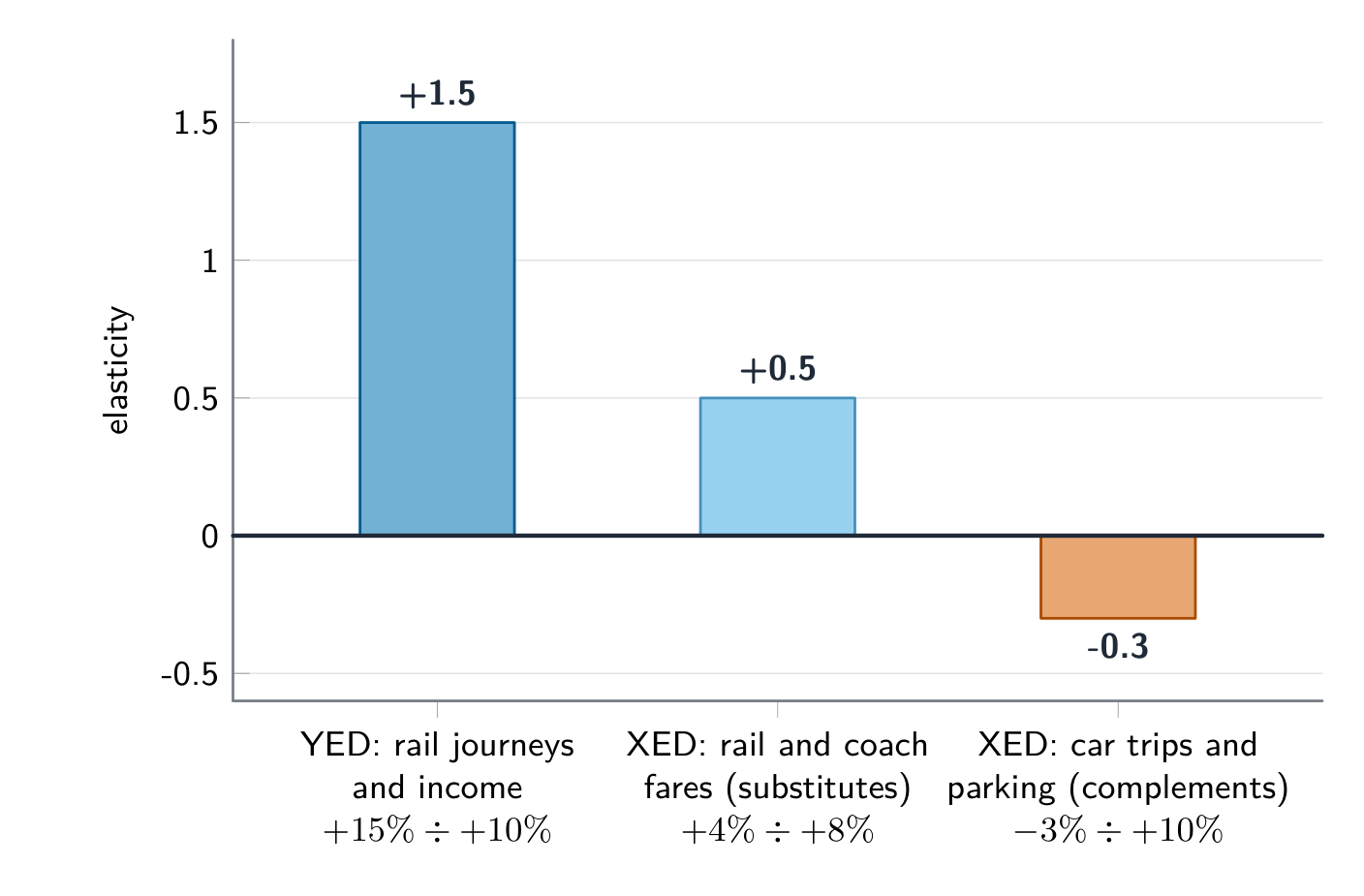
Average income rises from ¥3000 to ¥3300 a month, and rail journeys per person rise from 40 to 46 a year.
- % change in income $= \dfrac{300}{3000} \times 100 = +10\%$.
- % change in journeys $= \dfrac{6}{40} \times 100 = +15\%$.
- YED $= \dfrac{15}{10} = 1.5$: positive and above 1, so rail travel behaves as a luxury here.
An income-elastic service
Income rises 10% from 3000 to 3300 and rail journeys rise 15% from 40 to 46: YED = 15 ÷ 10 = 1.5, an income-elastic normal service in this observation.
Income rises by 8% and demand for restaurant meals rises by 12%. What is the YED?
Dificultad 2/5 · 140 monedas + un pequeño bono en el primer intento de hoy
$\dfrac{12}{8} = 1.5$: a normal good, and a luxury.
Cross elasticity of demand (XED)
- Substitutes 替代品 (tea and coffee): XED $> 0$. Dearer coffee → more tea bought.
- Complements 互补品 (printers and ink): XED $< 0$. Dearer printers → less ink bought.
- Unrelated goods (bread and phones): XED $\approx 0$.
The price of printers rises by 10% and sales of ink cartridges fall by 5%. What is the XED of ink with respect to printer prices?
Dificultad 2/5 · 140 monedas + un pequeño bono en el primer intento de hoy
$\dfrac{-5}{10} = -0.5$: negative, so they are complements.
The XED between two brands of bottled water is +3. What does this show?
Dificultad 1/5 · 100 monedas + un pequeño bono en el primer intento de hoy
A large positive XED means a rival's price rise strongly raises demand for this brand.
The sign matters for YED and XED. For PED we usually ignore the minus sign, but for YED and XED the sign tells you the type of good: a negative YED means inferior; a negative XED means complements. Dropping the sign throws away the answer.
A YED of −0.8 and a YED of +0.8 describe the same kind of good.
Dificultad 1/5 · 100 monedas + un pequeño bono en el primer intento de hoy
−0.8 is an inferior good; +0.8 is a normal good. For YED the sign carries the meaning.
Why firms care
- In a boom, sellers of luxuries (high YED) gain most; in a recession they lose most. Sellers of inferior goods do the opposite.
- A firm watches XED to see how a rival's price cut will hit its sales: the higher the positive XED, the closer the competitor.
- Complements are sold together: games consoles are often sold cheaply so that games can be sold at a profit.
Incomes fall in a recession. Sales of which good are most likely to RISE?
Dificultad 1/5 · 100 monedas + un pequeño bono en el primer intento de hoy
Bus travel is an inferior good here, so demand rises as income falls.
YED measures how demand responds to income: positive for normal goods, above 1 for luxuries, negative for inferior goods. XED measures how demand for one good responds to another's price: positive for substitutes, negative for complements. The sign carries the meaning.
Explain, using XED, why a games company might sell its console at a low price.
Use the sign and the direction of change in your answer.