Marginal utility and the demand curve
Introducido| English | Significado |
|---|---|
| utility/juːˈtɪlɪti/ | The satisfaction or benefit a consumer obtains from consuming goods or services. |
| marginal utility/ˈmɑːdʒɪnl juːˈtɪlɪti/ | utilidad marginal |
| diminishing marginal utility/dɪˈmɪnɪʃɪŋ ˈmɑːdʒɪnl juːˈtɪlɪti/ | utilidad marginal decreciente |
| market demand curve | A curve showing the total quantity all buyers want at each price. |
Why is water cheap and a diamond dear?
- Water keeps us alive; a diamond is only decoration. Yet a diamond costs far more.
- Adam Smith called this the diamond–water paradox.
- The answer is not total usefulness but the value of one more unit.
Utility and marginal utility
- Utility 效用 is the satisfaction a consumer gets from consuming a good.
- Marginal utility 边际效用 is the extra satisfaction from consuming one more unit.
- Water is so plentiful that one more glass adds little. One more diamond is rare, so it adds a lot.
Marginal utility is —
Dificultad 1/5 · 100 monedas + un pequeño bono en el primer intento de hoy
Marginal means "one more".
Diminishing marginal utility
- The first bottle of water on a hot day is worth a lot to you; the fourth is worth much less.
- This is the law of diminishing marginal utility 边际效用递减: each extra unit adds less satisfaction than the one before.
Under diminishing marginal utility, the third slice of pizza gives less extra satisfaction than the second.
Dificultad 1/5 · 100 monedas + un pequeño bono en el primer intento de hoy
Each extra unit adds less satisfaction than the one before.
Worked example: from values to a demand curve
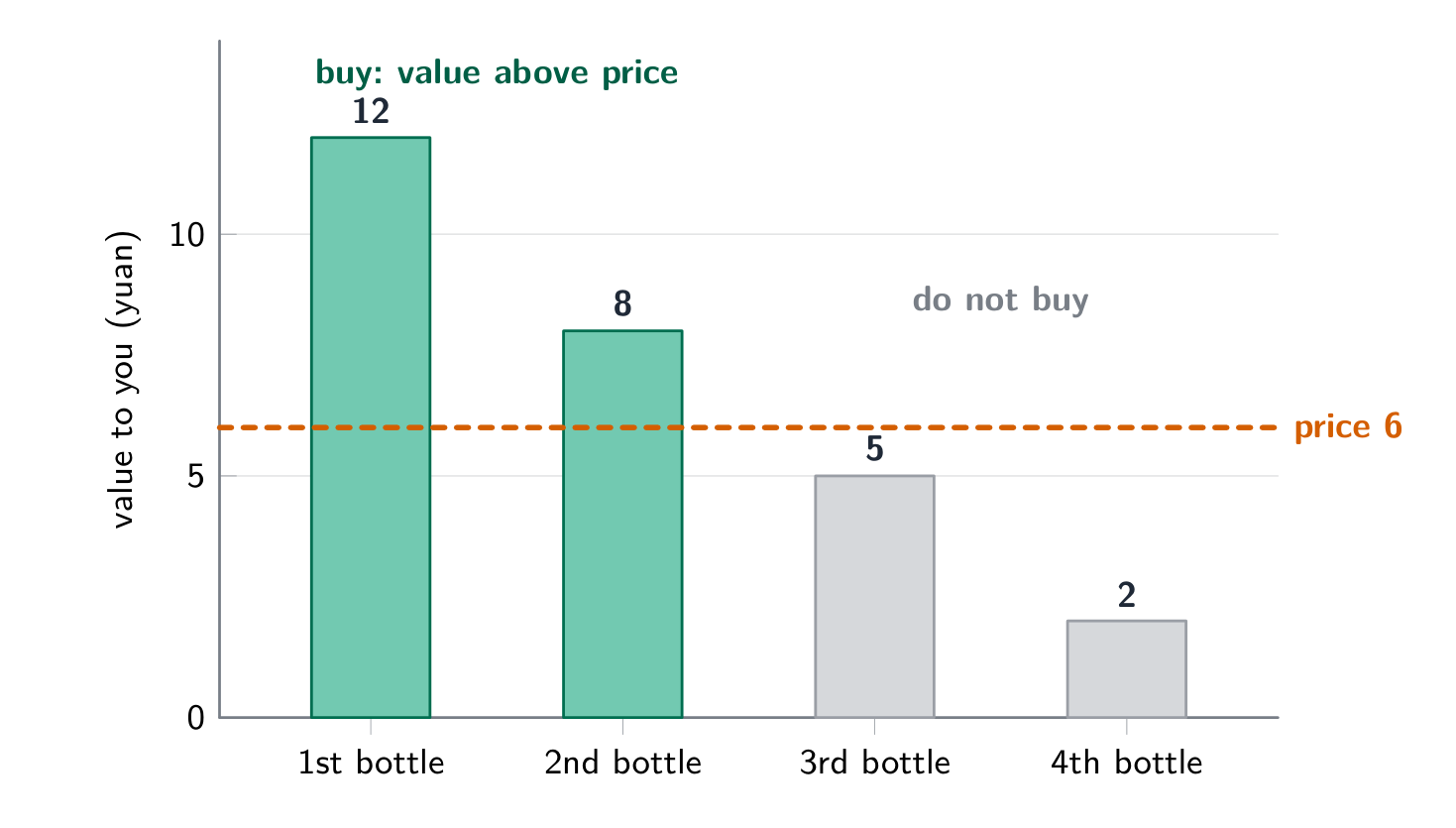
A buyer would pay at most ¥12, ¥8, ¥5 and ¥2 for the first, second, third and fourth bottle.
- Rule: buy another bottle while its value is at least the price.
- At a price of ¥6: bottles 1 (¥12) and 2 (¥8) are worth it; bottle 3 (¥5) is not. Quantity demanded $= 2$.
- At ¥4: bottle 3 is now worth it too. Quantity demanded $= 3$.
- Each price gives a quantity, and together they trace a downward-sloping demand curve.
Willingness to pay builds the demand curve
One buyer values four bottles at 12, 8, 5 and 2 yuan. At a price of 6 only the first two are worth buying: quantity 2, payment 12. At 4 the third bottle is worth buying too.
Values for successive bottles are ¥12, ¥8, ¥5 and ¥2. How many bottles are bought at a price of ¥3?
Dificultad 2/5 · 140 monedas + un pequeño bono en el primer intento de hoy
Bottles worth ¥12, ¥8 and ¥5 are each worth at least ¥3; the fourth (¥2) is not.
Why demand slopes down
- Because marginal utility falls, a buyer will buy more units only if the price falls.
- Add up every buyer's quantity at each price and you get the market demand curve 市场需求曲线.
Why does the demand curve slope downwards?
Dificultad 1/5 · 100 monedas + un pequeño bono en el primer intento de hoy
Each extra unit is worth less to the buyer, so the price must fall to sell it.
Total utility keeps rising while marginal utility falls. After four bottles total utility is higher than after three; it is the extra utility of the fourth that is small. Marginal utility can fall to zero — or below, if the fifth bottle makes you feel sick.
Total utility from 3 cups of tea is 30 and from 4 cups is 34. What is the marginal utility of the fourth cup?
Dificultad 2/5 · 140 monedas + un pequeño bono en el primer intento de hoy
$34 - 30 = 4$. Total utility still rises, but by less.
Back to the paradox
- Price reflects marginal utility, not total utility.
- Water is abundant, so its marginal utility — and price — is low. Diamonds are scarce, so their marginal utility is high.
- In a desert, with no water left, one more bottle would be worth more than a diamond.
Why is water usually cheaper than diamonds?
Dificultad 1/5 · 100 monedas + un pequeño bono en el primer intento de hoy
Price reflects marginal, not total, utility.
Marginal utility is the extra satisfaction from one more unit, and it diminishes as consumption rises. A consumer buys another unit only while its value is at least the price, so a lower price is needed to sell more: demand slopes down.
Use diminishing marginal utility to explain why a cinema offers a cheaper second ticket on the same day.
The link from falling marginal utility to a lower price is the key step.