Tu plan de aprendizaje · Continuar · Revisar →
How BEC writing is marked
IntroducidoTu posición guardada se conserva en este navegador. Continuar no completa la lección ni responde sus preguntas.
En esta lección
| English |
|---|
| content/ˈkɒntent/ |
| subscale |
| communicative achievement |
| irrelevant |
| register/ˈredʒɪstə/ |
| organisation/ˌɔːɡənaɪˈzeɪʃn/ |
| linking word/ˈlɪŋkɪŋ wɜːd/ |
Two letters, the same grammar
- Two candidates write to a customer. Both letters have no grammar mistakes. One gets a high mark; the other a low one.
- Why? The second letter forgot two content points and sounded rude. Examiners don't only count mistakes: they look at four things. Knowing them tells you exactly what to check before you put your pen down.
Two letters have no grammar mistakes, but one gets a much lower mark. What is the most likely reason?
Dificultad 1/5 · 100 monedas + un pequeño bono en el primer intento de hoy
Content and Communicative Achievement are half of the mark.
The four subscales
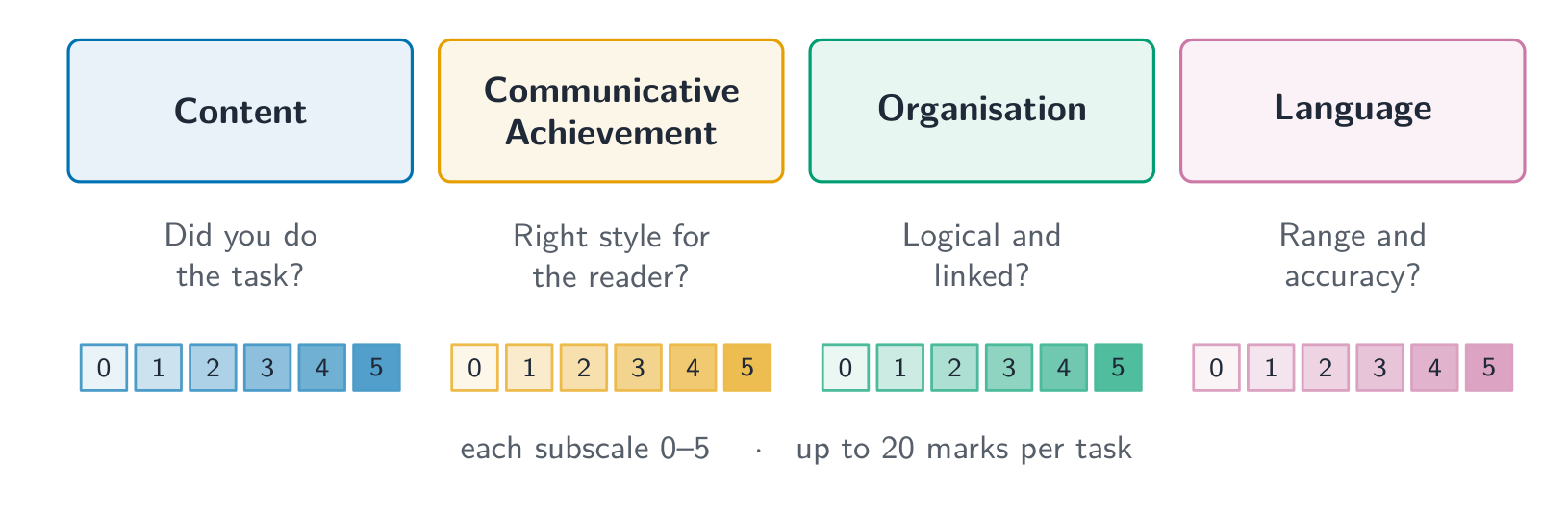
- Each answer gets 0–5 on each subscale, so up to 20 marks per task. At Preliminary, Part 2 counts for twice as much as Part 1.
- The four are equal. Perfect grammar can't make up for a missing content point.
Which are the four writing subscales?
Dificultad 2/5 · 140 monedas + un pequeño bono en el primer intento de hoy
Content, Communicative Achievement, Organisation and Language, each 0–5.
What is the maximum mark one task can get from the four subscales?
Dificultad 2/5 · 140 monedas + un pequeño bono en el primer intento de hoy
Four subscales × 5 marks = 20.
Content and Communicative Achievement
- Content: Did you do what the task asked? All the points, with enough detail, and nothing irrelevant. The reader is fully informed.
- Communicative Achievement: Is the writing right for the reader and the purpose? A letter sounds like a business letter, a report like a report; the register (formal, neutral, friendly) fits; the reader would react the way the writer wants.
- Task point: offer a discount. Answer: "We are sorry." → Content loses: no discount offered.
- Same task, answer: "Sorry dude, here's 10% off." → Content is fine, Communicative Achievement loses: wrong register for a customer.
The task says "offer a discount". The answer says only "We are sorry". Which subscale suffers most?
Dificultad 1/5 · 100 monedas + un pequeño bono en el primer intento de hoy
A task point is missing, so the reader is not fully informed.
Writing "Sorry dude" to a customer mainly lowers the Communicative Achievement mark.
Dificultad 1/5 · 100 monedas + un pequeño bono en el primer intento de hoy
The register is wrong for the reader, even if the content is there.
Organisation and Language
- Organisation: Is it logical and easy to follow? Paragraphs, headings in a report, and linking words (however, as a result, this, which) that join ideas.
- Language: How wide and how accurate are your vocabulary and grammar? Business words used correctly (invoice, deadline, place an order), a mix of simple and complex sentences, and errors that don't block understanding.
- Length matters. Too short usually means missing information and little range; too long often means irrelevant content that tires the reader. Both can lower the relevant subscales.
- Be consistent: British or American spelling (organise or organize), not both.
Which subscale does each weakness hurt most?
Diagnose which writing subscale a weakness affects
A much longer answer than the word limit always gets a higher mark because it shows more language.
Dificultad 1/5 · 100 monedas + un pequeño bono en el primer intento de hoy
Too long often means irrelevant content and a tired reader, which can lower marks.
Which is the best advice about British and American spelling?
Dificultad 1/5 · 100 monedas + un pequeño bono en el primer intento de hoy
Both are accepted; switching between them within one answer is not.
One answer, improved
- Before (Vantage Part 1, only 14 words): "Hi. The training is changed. It is Thursday. Bring laptop. You must come. Thanks." Short, no reason, a bossy tone and choppy sentences.
- After (41 words): "Hi all, the sales training has moved from Tuesday to Thursday at 2 pm, because the trainer's flight was delayed. Please bring your laptops, as we'll practise with the new customer database. Let me know if you can't come. Thanks, Ben"
- Content: a reason and a time are added. Communicative Achievement: Please and Let me know sound friendly, not bossy. Organisation: because and as join the ideas. Language: has moved, was delayed, we'll practise give a range of verb forms.
Match each change in the improved answer with the subscale it helps.
Dificultad 2/5 · 140 monedas + un pequeño bono en el primer intento de hoy
One rewrite can lift all four subscales.
The two-minute final check
| Check | Ask yourself |
|---|---|
| Content | Have I ticked every point in the task? |
| Communicative Achievement | Who is the reader? Does my tone fit? |
| Organisation | Paragraphs or headings? Linking words? |
| Language | Verb tenses, articles, plurals, spelling of business words? |
- Leave two minutes at the end of the writing time for this check. It finds more marks than any new sentence.
Put the final check in the order used in the lesson.
Dificultad 3/5 · 200 monedas + un pequeño bono en el primer intento de hoy
Big things first, small things last.
What the marks reward
- Do the task first. Content and register are half the mark.
- Organise for the reader: paragraphs, headings, linkers.
- Show range with control: a few well-chosen business words and some complex sentences, used correctly, beat many risky ones.
Take your answer to the Part 2 task in lesson 0302 (or any letter you have written). Give it a mark from 0 to 5 on each subscale, then rewrite the weakest part.
Honest self-marking teaches you what examiners see. Fix the lowest subscale first, because it costs the most.
¿Qué salió mal? Solo el equipo del sitio ve esta información.