Tu plan de aprendizaje · Continuar · Revisar →
Writing Part 2: business letters and emails
IntroducidoTu posición guardada se conserva en este navegador. Continuar no completa la lección ni responde sus preguntas.
En esta lección
| English | Significado |
|---|---|
| customer | |
| correspondence | |
| supplier/səˈplaɪə/ | Businesses or people that provide goods, materials or services to another organisation. |
| apologise/əˈpɒlədʒaɪz/ | |
| discount/ˈdɪskaʊnt/ | |
| register/ˈredʒɪstə/ |
An angry customer, a calm reply
- A customer writes: "I ordered 200 printed T-shirts for our sports day on 12 June. They arrived on 14 June, two days late, and 20 had the wrong logo. I am very disappointed."
- Your reply must calm the customer, keep the business and answer every point in the task. That is Writing Part 2 at Preliminary and Vantage: a letter or email to someone outside the company.
Who is the reader of a Preliminary Part 2 letter?
Dificultad 1/5 · 100 monedas + un pequeño bono en el primer intento de hoy
Part 1 is to a colleague; Part 2 correspondence goes outside the company.
Part 2 correspondence at each level
| Preliminary | Vantage | Higher | |
|---|---|---|---|
| You write | a letter or email to a customer, supplier or other outside contact | a letter or email, or a short report or proposal | one task from three: a letter, report or proposal |
| Length | 60–80 words | 120–140 words | 200–250 words |
| Input | a short text (letter, advert) + 4 content points | one or more texts, often with handwritten notes | a rubric, sometimes a short text |
- Part 2 is two thirds of your writing mark. Reports and proposals are in the next lesson; this one is about correspondence.
Match each level with its Part 2 length.
Dificultad 2/5 · 140 monedas + un pequeño bono en el primer intento de hoy
Part 2 is two thirds of the writing mark at every level.
At Higher, you choose one Part 2 task from three options.
Dificultad 1/5 · 100 monedas + un pequeño bono en el primer intento de hoy
Higher Part 2 offers a letter, report or proposal; you write one.
The shape of a business letter or email
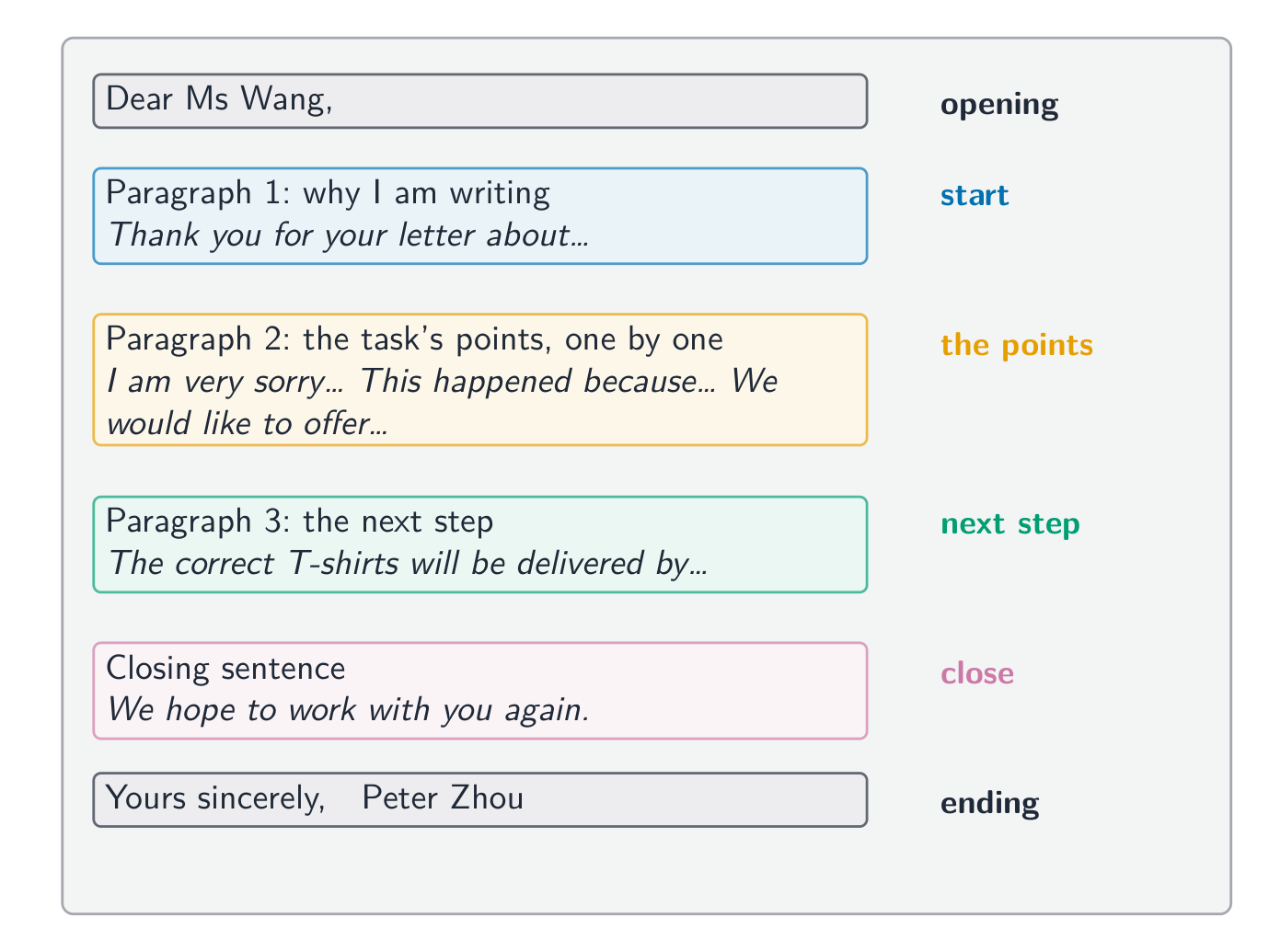
- Opening: Dear Ms Wang, (you know the name) or Dear Sir or Madam, (you don't). Ending: Yours sincerely, after a name; Yours faithfully, after Sir or Madam. In emails, Kind regards, or Best regards, is fine.
- No postal addresses are needed for a letter, and no To/From/Subject lines for an email.
Match each opening with its ending.
Dificultad 2/5 · 140 monedas + un pequeño bono en el primer intento de hoy
Sincerely after a name, faithfully after Sir or Madam; regards is fine in emails.
A model answer (Preliminary, 73 words)
- Task: Reply to the customer. Apologise, explain why the order was late, offer something to make up for it and say when the correct T-shirts will arrive.
Dear Ms Wang,
Thank you for your letter about your order. I am very sorry that the T-shirts arrived late and that some had the wrong logo. The delay happened because one of our machines broke down. To apologise, we would like to offer you a 20% discount on this order. The 20 correct T-shirts will be delivered by Friday 20 June.
We hope to work with you again.
Yours sincerely, Peter Zhou
- Apologise: I am very sorry that… · Explain: The delay happened because… · Offer: we would like to offer you a 20% discount · When: will be delivered by Friday 20 June. Four points, four clear sentences.
Put the model answer's points in the order they appear.
Dificultad 3/5 · 200 monedas + un pequeño bono en el primer intento de hoy
The order follows the task's bullet points, which makes them easy to check.
Phrases that do the work
| Job | Phrases |
|---|---|
| Start | Thank you for your letter/email of 3 May. · I am writing to… |
| Apologise | I am very sorry for… · Please accept our apologies for… |
| Explain | This was because… · Unfortunately, … |
| Offer | We would be happy to… · We would like to offer you… |
| Request | Could you please…? · I would be grateful if you could… |
| Close | I look forward to hearing from you. · Please do not hesitate to contact me. |
- Register: to a customer or supplier you are polite and neutral-to-formal. Full forms (I am, we would) are safest; avoid slang and text-message style.
Which sentence explains a problem politely?
Dificultad 1/5 · 100 monedas + un pequeño bono en el primer intento de hoy
Unfortunately + a clear cause is polite and professional.
Complete the polite request: "I would be ___ if you could send the invoice by Friday."
Dificultad 1/5 · 100 monedas + un pequeño bono en el primer intento de hoy
I would be grateful if you could… is a polite, formal request.
Which sentence has the right register for a letter to a new supplier?
Dificultad 1/5 · 100 monedas + un pequeño bono en el primer intento de hoy
Polite and neutral-to-formal, with full forms.
Where Part 2 marks go missing
- A point left out. With four points, it's easy to forget one. Tick each bullet on the paper as you write it.
- The wrong reader. Writing to a customer as if to a friend (Hi! Sorry about the shirts lol) loses Communicative Achievement marks, even with perfect grammar.
- Copying the input letter. Lifted phrases get no credit. Rephrase: "arrived two days late" → "the delay".
A letter with perfect grammar but a very casual tone to a customer can still lose marks.
Dificultad 1/5 · 100 monedas + un pequeño bono en el primer intento de hoy
Communicative Achievement asks whether the writing suits the reader and purpose.
Before you write: two minutes of planning
- Who is the reader, and what do they want after reading your letter?
- List the content points in order and write one or two sentences for each.
- Choose your opening and ending as a pair: Dear Ms Wang … Yours sincerely or Dear Sir or Madam … Yours faithfully.
Preliminary task (60–80 words). You booked a meeting room at the Riverside Hotel for 10 people on 8 April. Now 15 people are coming. Write an email to the hotel: give your booking details, explain the change, ask for a bigger room and ask about the extra cost.
The model gives one sentence per point inside a clear opening and close. Check yours point by point first, then the register, then the grammar.
¿Qué salió mal? Solo el equipo del sitio ve esta información.