Five rate factors: change the conditions, keep comparisons fair
Introducido| English | Significado |
|---|---|
| surface area/ˈsɜːfɪs ˈeərɪə/ | área superficial |
| catalysts/ˈkætəlɪsts/ | A substance that increases a reaction rate without being used up overall. |
Why flour dust explodes
- A bag of flour burns slowly, if at all. But a cloud of fine flour dust in a mill can explode — it has happened many times since the 1700s.
- Breaking a solid into a powder gives it a huge surface area 表面积. That is one of five factors that change reaction rate.
The five factors
- Concentration of solutions.
- Pressure of gases.
- Surface area of solids.
- Temperature.
- Catalysts 催化剂.
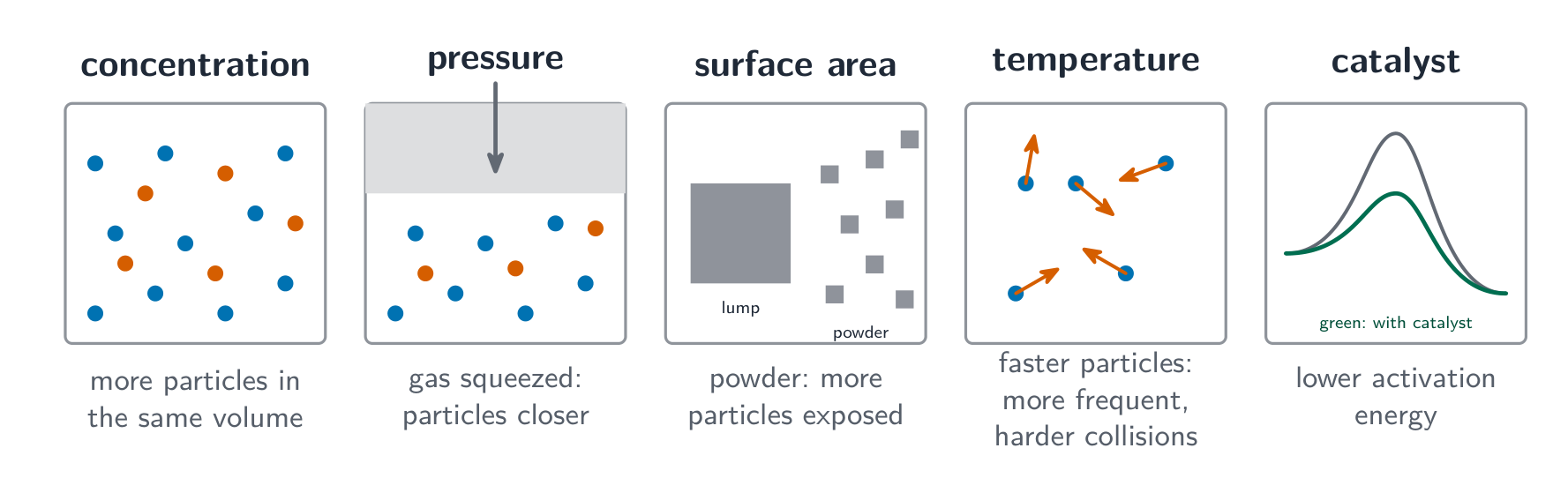
Which changes increase the rate of reaction?
Dificultad 2/5 · 140 monedas + un pequeño bono en el primer intento de hoy
Beaker size does not matter.
Why they work
- Particles must collide with enough energy to react.
- Concentration, pressure and surface area increase how often particles collide.
- Temperature makes collisions more frequent and more energetic; a catalyst lowers the energy needed.
Change one condition at a time
More frequent or more energetic collisions make a reaction faster. Change temperature, concentration or the catalyst one at a time, so the comparison stays fair.
Why does a higher concentration increase the rate?
Dificultad 1/5 · 100 monedas + un pequeño bono en el primer intento de hoy
More particles in the same volume.
Which factor makes collisions both more frequent and more energetic?
Dificultad 1/5 · 100 monedas + un pequeño bono en el primer intento de hoy
Particles move faster.
Worked example: one change at a time
A student wants to show that temperature affects the rate of marble chips with acid.
- Change: temperature only (20, 30, 40 °C).
- Keep the same: acid volume and concentration, mass and size of marble chips.
- Measure: the time to collect 20 cm³ of gas. Otherwise the test is not fair.
In a test of surface area, which should be kept the same?
Dificultad 2/5 · 140 monedas + un pequeño bono en el primer intento de hoy
Chip size is what changes.
Surface area in numbers
- A 1 cm cube has a surface area of 6 cm². Cut it into 1000 cubes of 1 mm and the area becomes 60 cm² — ten times more.
- Ten times more surface means many more collisions per second.
What is the surface area of a cube with 2 cm sides?
Dificultad 2/5 · 140 monedas + un pequeño bono en el primer intento de hoy
$6 \times 2^2 = 24$.
Powder does not make more product. The same mass of calcium carbonate gives the same volume of CO₂, whether in lumps or powder. Only the speed changes.
Powdered calcium carbonate gives more carbon dioxide than the same mass of lumps.
Dificultad 1/5 · 100 monedas + un pequeño bono en el primer intento de hoy
Same amount, faster.
Reaction rate increases with concentration, gas pressure, surface area, temperature and a catalyst. In an investigation, change one factor at a time and keep the others the same.
Explain why fine flour dust can explode but a bag of flour does not.
More surface, more collisions.