Higher Tier: acid strength differs from acid concentration
Introducido| English | Significado |
|---|---|
| acid strength/ˈæsɪd streŋθ/ | fuerza del ácido |
| partial ionisation/ˈpɑːʃl ˌaɪənaɪˈzeɪʃn/ | ionización parcial |
Vinegar on your chips
- Vinegar is about 0.8 mol/dm³ ethanoic acid, yet you can pour it on food. Hydrochloric acid at the same concentration would burn your mouth.
- The difference is acid strength 酸强度, which is not the same as concentration.
- This lesson is Higher Tier.
Strong and weak
- A strong acid is completely ionised in water: every HCl molecule gives H⁺ and Cl⁻. Examples: hydrochloric, sulfuric, nitric.
- A weak acid shows only partial ionisation 部分电离: most molecules stay whole. Examples: ethanoic, citric, carbonic.
Which are strong acids?
Dificultad 2/5 · 140 monedas + un pequeño bono en el primer intento de hoy
Ethanoic acid is weak.
Which shows a strong acid ionising?
Dificultad 1/5 · 100 monedas + un pequeño bono en el primer intento de hoy
Complete ionisation, one-way arrow.
Dilute and concentrated
- Concentration is how much acid is in each dm³ of solution.
- "Dilute" and "concentrated" describe amount; "strong" and "weak" describe ionisation. A dilute strong acid and a concentrated weak acid can have similar pH.
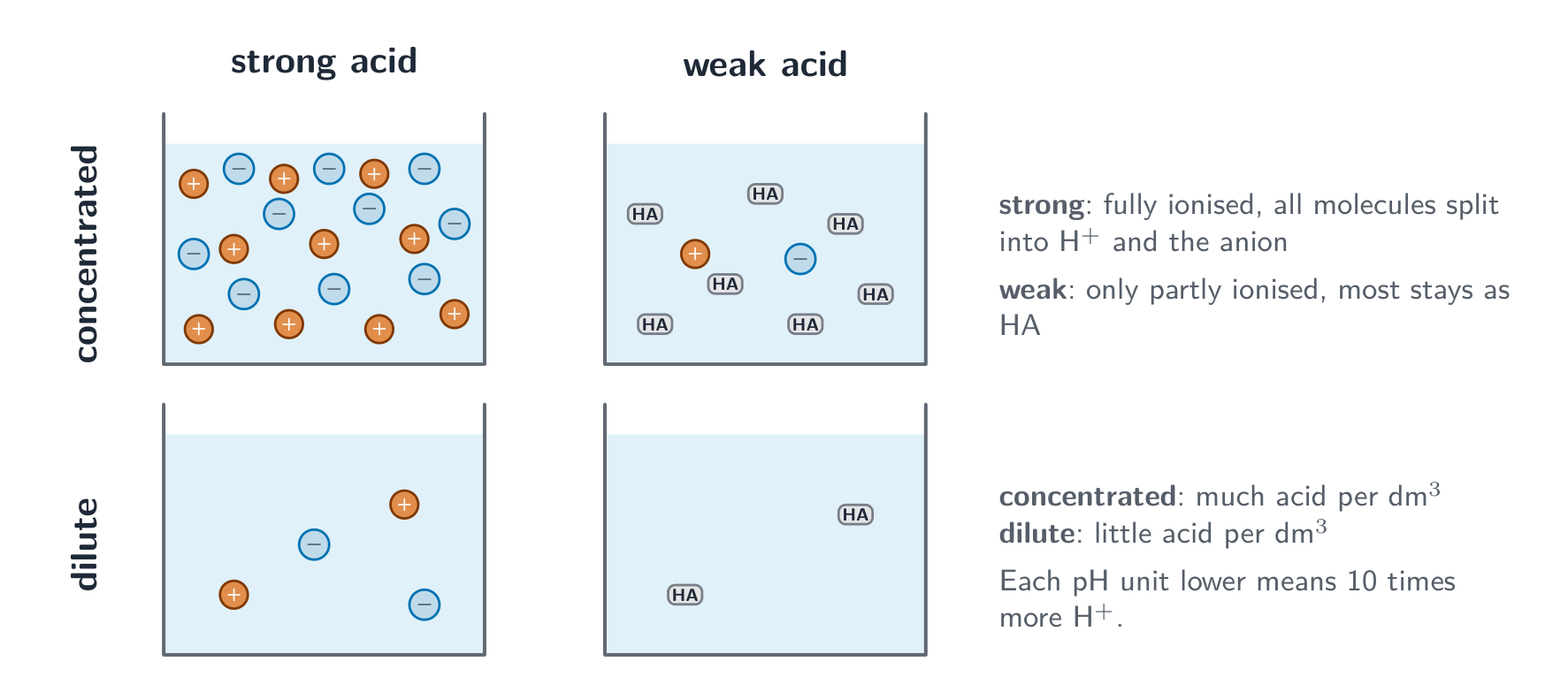
Match each term to its meaning.
Dificultad 2/5 · 140 monedas + un pequeño bono en el primer intento de hoy
Two separate ideas.
Worked example: the factor of ten
Solution A has pH 2 and solution B has pH 5.
- pH difference $= 5 - 2 = 3$.
- H⁺ ratio $= 10^3 = 1000$: A has 1000 times the H⁺ concentration of B.
- pH alone cannot tell you whether A is strong or just more concentrated.
Each pH step is a factor of ten
Solution A at pH 2 has 1,000 times the hydrogen-ion concentration of solution B at pH 5. The pH alone does not say whether an acid is strong or concentrated.
Solution X has pH 3 and solution Y has pH 5. How many times greater is the H⁺ concentration in X?
Dificultad 2/5 · 140 monedas + un pequeño bono en el primer intento de hoy
$10^2 = 100$.
Each pH unit is ×10
- Decreasing the pH by 1 means the H⁺ concentration has increased by a factor of 10.
- Diluting a strong acid 10 times raises its pH by 1.
A strong acid of pH 1 is diluted 100 times. What is its new pH?
Dificultad 2/5 · 140 monedas + un pequeño bono en el primer intento de hoy
Each tenfold dilution raises pH by 1.
"Weak" does not mean "dilute". A concentrated weak acid has lots of molecules but few ions. A dilute strong acid has few molecules, all ionised. Strength and concentration are separate ideas.
A weak acid is the same as a dilute acid.
Dificultad 1/5 · 100 monedas + un pequeño bono en el primer intento de hoy
Weak is about ionisation.
Strong acids are completely ionised in water; weak acids are only partially ionised. Concentration is the amount of acid per dm³. Each decrease of 1 in pH is a tenfold increase in H⁺ concentration.
0.1 mol/dm³ hydrochloric acid has pH 1; 0.1 mol/dm³ ethanoic acid has pH 3. Explain the difference.
Strength, not concentration.