Chemistry-only: percentage yield compares recovered and possible product
Introducido| English | Significado |
|---|---|
| percentage yield/pəˈsentɪdʒ jiːld/ | rendimiento porcentual |
| actual yield/ˈæktʃuːəl jiːld/ | rendimiento real |
Making aspirin in the lab
- Students who make aspirin at school usually expect about 5 g of crystals, but weigh only 3 or 4 g.
- No atoms were destroyed. Some product stayed on the filter paper, some stayed dissolved, and some reactant never reacted.
- Chemists measure this with the percentage yield 产率.
Actual and theoretical
- The actual yield 实际产量 is the mass of product you really collect.
- The theoretical yield is the most product that could form from the reactants.
The mass of product actually collected is called the actual ____.
Dificultad 1/5 · 100 monedas + un pequeño bono en el primer intento de hoy
Compare it with the theoretical yield.
The formula
- Percentage yield $= \dfrac{\text{actual mass of product}}{\text{maximum theoretical mass}} \times 100$.
- It can never be more than 100% for a pure, dry product.
A reaction can make 50 g of product and gives a 60% yield. What mass is collected?
Dificultad 2/5 · 140 monedas + un pequeño bono en el primer intento de hoy
$0.60 \times 50 = 30$ g.
Worked example: crystals from a reaction
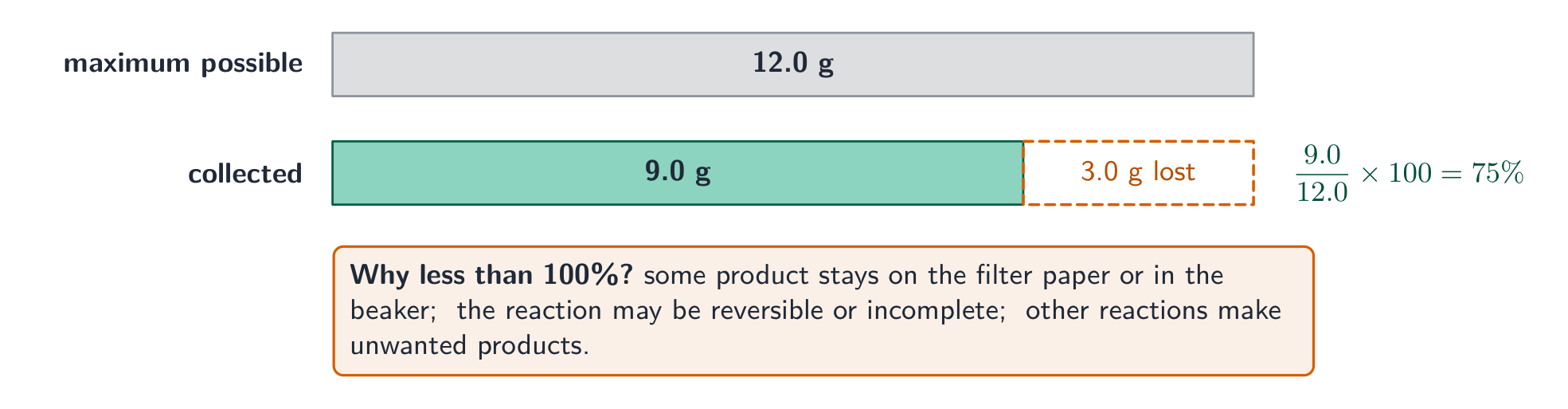
A reaction could make 12.0 g of product. 9.0 g of dry crystals is collected.
- Percentage yield $= \dfrac{9.0}{12.0} \times 100 = 75\%$.
- Product not collected $= 12.0 - 9.0 = 3.0$ g.
Recovered compared with possible
Percentage yield = actual ÷ theoretical × 100: 9.0 g from a possible 12.0 g is 75%.
The theoretical yield is 20 g and 15 g is collected. What is the percentage yield?
Dificultad 2/5 · 140 monedas + un pequeño bono en el primer intento de hoy
$\dfrac{15}{20} \times 100 = 75\%$.
The theoretical yield is 4.0 g and 3.4 g is collected. What is the percentage yield?
Dificultad 2/5 · 140 monedas + un pequeño bono en el primer intento de hoy
$\dfrac{3.4}{4.0} \times 100 = 85\%$.
Why yields are below 100%
- The reaction may be reversible, so it never goes to completion.
- Some product is lost when it is separated — left on filter paper or in solution.
- Some reactants may react in an unexpected way, making other products.
Which are reasons for a percentage yield below 100%?
Dificultad 2/5 · 140 monedas + un pequeño bono en el primer intento de hoy
Atoms are never destroyed.
A yield over 100% means an error, not extra atoms. Usually the product is still wet or contains impurities. Dry it to constant mass and weigh it again.
A student calculates a yield of 108%. What is the most likely reason?
Dificultad 1/5 · 100 monedas + un pequeño bono en el primer intento de hoy
Water adds mass.
Percentage yield is the actual mass of product divided by the theoretical maximum, times 100. Yields fall below 100% because reactions are incomplete, product is lost during separation, or side reactions happen.
A student expected 5.0 g of aspirin but collected 3.5 g. Calculate the percentage yield and give two reasons it is below 100%.
Calculate, then explain.