Relative formula mass and the mass percentage of an element
Introducido| English | Significado |
|---|---|
| relative formula mass/ˈrelətɪv ˈfɔːmjʊlə mæs/ | Masa de fórmula relativa |
| mass percentage/mæs pəˈsentɪdʒ/ | porcentaje en masa |
What is in the fertiliser bag?
- Farmers compare fertilisers by how much nitrogen they contain. Ammonium nitrate, NH₄NO₃, is 35% nitrogen by mass; urea is 46%.
- Those numbers come from one simple calculation, using the formula and relative atomic masses.
Relative formula mass
- The relative formula mass 相对式质量 ($M_r$) of a compound is the sum of the relative atomic masses ($A_r$) of all the atoms in its formula.
- It has no units, because it compares masses with carbon-12.
Calculate $M_r$ of CO₂. ($A_r$: C 12, O 16)
Dificultad 2/5 · 140 monedas + un pequeño bono en el primer intento de hoy
$12 + 2 \times 16 = 44$.
Read the brackets
- A number after a bracket multiplies everything inside it.
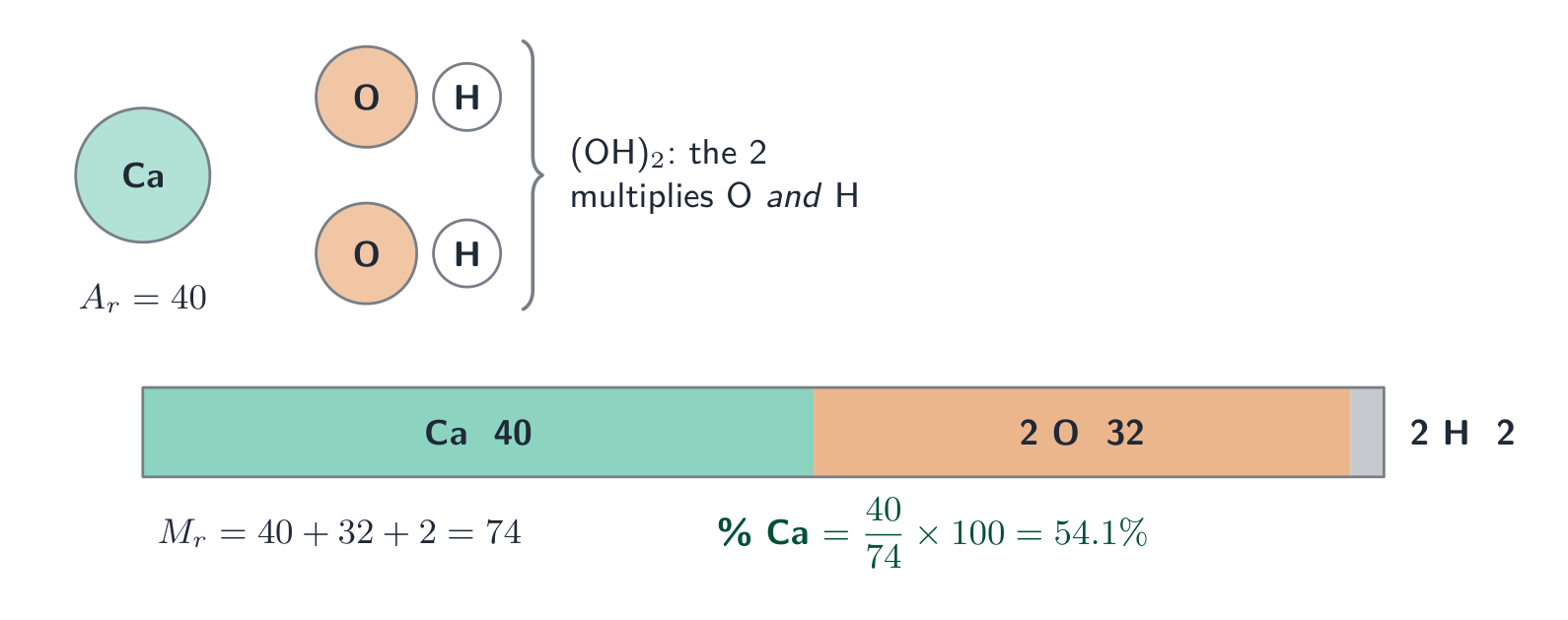
- Ca(OH)₂ contains 1 Ca, 2 O and 2 H — not 1 O and 2 H.
How many oxygen atoms are in one formula unit of Mg(NO₃)₂?
Dificultad 2/5 · 140 monedas + un pequeño bono en el primer intento de hoy
$2 \times 3 = 6$.
Worked example: calcium hydroxide
Find $M_r$ of Ca(OH)₂ and the percentage of calcium. ($A_r$: Ca 40, O 16, H 1)
- $M_r$ $= 40 + 2 \times (16 + 1) = 40 + 34 = 74$.
- % Ca $= \dfrac{40}{74} \times 100 = 54.1\%$.
- Check: the parts add up to $M_r$ (40 + 32 + 2 = 74).
Add the relative atomic masses
Mr is the sum of the Ar values in the formula, counting every atom. The percentage of an element is its total Ar contribution divided by Mr, times 100.
Calculate $M_r$ of Mg(OH)₂. ($A_r$: Mg 24, O 16, H 1)
Dificultad 2/5 · 140 monedas + un pequeño bono en el primer intento de hoy
$24 + 2 \times 17 = 58$.
Mass percentage of an element
- Mass percentage 质量百分比 of an element $= \dfrac{A_r \times \text{number of atoms}}{M_r} \times 100$.
- Example: N in NH₄NO₃ ($M_r$ = 80) $= \dfrac{2 \times 14}{80} \times 100 = 35\%$.
What is the percentage by mass of carbon in CO₂ ($M_r$ 44)? Give your answer to 1 decimal place.
Dificultad 2/5 · 140 monedas + un pequeño bono en el primer intento de hoy
$\dfrac{12}{44} \times 100 = 27.3\%$.
Urea, CO(NH₂)₂, has $M_r$ 60. What is the percentage by mass of nitrogen? ($A_r$ N = 14). Give your answer to the nearest whole number.
Dificultad 2/5 · 140 monedas + un pequeño bono en el primer intento de hoy
$\dfrac{28}{60} \times 100 = 46.7\%$, about 47%.
Forgetting to multiply by the number of atoms is the most common error. In NH₄NO₃ there are two nitrogen atoms, so use $2 \times 14$, not 14 — otherwise you get 17.5% instead of 35%.
A student calculates N in NH₄NO₃ as $\dfrac{14}{80} \times 100 = 17.5\%$. What went wrong?
Dificultad 1/5 · 100 monedas + un pequeño bono en el primer intento de hoy
Count every atom of the element.
Add the $A_r$ of every atom to get $M_r$, multiplying through any brackets. The mass percentage of an element is its total contribution divided by $M_r$, times 100.
Show that iron(III) oxide, Fe₂O₃, is 70% iron by mass. ($A_r$: Fe 56, O 16)
Count both iron atoms.