Dynamic equilibrium: equal rates, continuing reactions
Introducido| English | Significado |
|---|---|
| dynamic equilibrium/daɪˈnæmɪk ˌiːkwɪˈlɪbrɪəm/ | A state in which opposing processes continue at equal rates, so there is no overall change in composition. |
| reversible reaction/rɪˈvɜːsɪbl rɪˈækʃn/ | reacción reversible |
| equilibrium/ˌiːkwɪˈlɪbrɪəm/ | equilibrio |
| closed system/kləʊzd ˈsɪstəm/ | A container in which no substances can enter or leave, so a reversible reaction can reach equilibrium. |
Busy, but nothing changes
- Picture an escalator going up and one going down, with people moving between floors at the same rate. People never stop moving, but the number on each floor stays the same.
- Some reactions behave like this. Both directions keep going, yet the amounts of each substance stop changing. This is dynamic equilibrium 动态平衡.
Reversible reactions
- In a reversible reaction 可逆反应 the products can react to form the reactants again. The symbol $\rightleftharpoons$ shows this: $\text{A}+\text{B}\rightleftharpoons\text{C}+\text{D}$.
- Heating ammonium chloride gives ammonia and hydrogen chloride; on cooling they recombine: $\text{NH}_4\text{Cl}\rightleftharpoons\text{NH}_3+\text{HCl}$. Changing the conditions changes the direction.
Equal rates do not require equal amounts
$A\rightleftharpoons B$
In this closed A ⇌ B model, a catalyst changes how quickly equilibrium is reached, not its final composition.
Which symbol shows a reversible reaction?
Dificultad 1/5 · 100 monedas + un pequeño bono en el primer intento de hoy
The double half-arrow shows the reaction can go both ways.
Energy in one direction, out in the other
- If a reversible reaction is exothermic in one direction, it is endothermic in the other, and the same amount of energy is transferred each way.
- Blue hydrated copper sulfate turns white when heated (endothermic). Add water to the white powder and it turns blue again and gets hot (exothermic).
A reversible reaction transfers 56 kJ to the surroundings in the forward direction. How many kJ does the reverse reaction take in?
Dificultad 2/5 · 140 monedas + un pequeño bono en el primer intento de hoy
The same amount of energy is transferred in each direction.
Water is added to white anhydrous copper sulfate. What do you see?
Dificultad 1/5 · 100 monedas + un pequeño bono en el primer intento de hoy
Rehydration is the exothermic direction, and hydrated copper sulfate is blue.
Reaching equilibrium
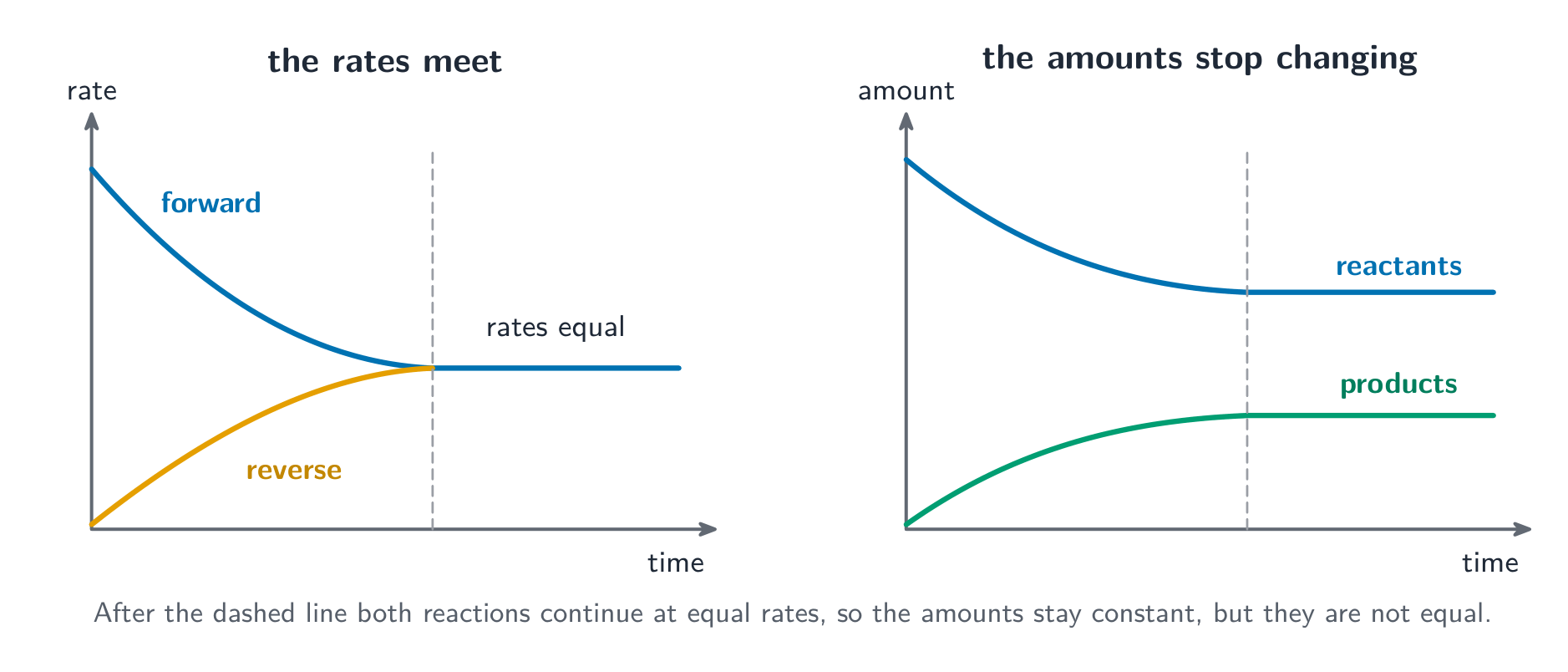
- In a closed system 封闭体系 nothing can get in or out. At the start the forward reaction is fast; as products build up, the reverse reaction speeds up.
- Equilibrium 平衡 is reached when the forward and reverse reactions go at the same rate. From then on the amounts of reactants and products stay constant.
Equal rates, unequal amounts
$\text{A} \rightleftharpoons \text{B};\quad \text{rate}_{\text{forward}}=\text{rate}_{\text{reverse}}$
At equilibrium 18 forward and 18 reverse events a second give no net change, yet 36 reactions still happen. The mixture settles at 70 A to 30 B: equal rates do not need equal amounts.
Constant does not mean equal
- At equilibrium the amounts are constant, but there may be much more reactant than product, or the other way round.
- What is equal is the rate of the two reactions, not the amounts.
At equilibrium the concentrations of reactants and products are always equal.
Dificultad 1/5 · 100 monedas + un pequeño bono en el primer intento de hoy
The rates are equal. The amounts are constant but usually different.
In a closed flask, 18 molecules of A turn into B each second, and 18 molecules of B turn back into A each second.
- Change in B each second $=18-18=0$. The amounts stay the same, so the system is at equilibrium, although 36 reactions happen every second.
- Earlier, 25 A turned into B and 9 B turned into A each second. B grew by $25-9=16$ per second: not yet at equilibrium.
In a closed flask, 30 A molecules become B and 22 B molecules become A each second. By how much does the number of B molecules change each second?
Dificultad 2/5 · 140 monedas + un pequeño bono en el primer intento de hoy
$30-22=8$. B is still increasing, so the system is not yet at equilibrium.
Conditions decide the position
- The relative amounts at equilibrium depend on the conditions: temperature, pressure (for gases) and concentration.
- Higher tier: if you change a condition, the equilibrium shifts to oppose the change (Le Chatelier's principle). The later lessons show how.
"At equilibrium the reaction has stopped" is wrong. Both reactions are still happening, at equal rates. That is why it is called dynamic. Also, equilibrium needs a closed system: if a gas escapes, the reverse reaction cannot happen.
Calcium carbonate is heated in an open test tube and the carbon dioxide escapes. Why can it not reach equilibrium?
Dificultad 1/5 · 100 monedas + un pequeño bono en el primer intento de hoy
Equilibrium needs a closed system so the products can react back.
Equilibrium is called ________ because both reactions keep going.
Dificultad 1/5 · 100 monedas + un pequeño bono en el primer intento de hoy
Particles keep reacting both ways; only the net change is zero.
A reversible reaction can go both ways ($\rightleftharpoons$); the energy transferred is the same size in each direction but opposite in sign. In a closed system it reaches dynamic equilibrium when the forward and reverse rates are equal. The amounts then stay constant, but they are usually not equal.