Biomass transfer: account for losses
Introducido| English | Significado |
|---|---|
| egestion/ɪˈdʒestʃn/ | egestión |
| Transfer efficiency/ˈtrænsfɜː ɪˈfɪʃənsi/ | The percentage of biomass at one trophic level that passes to the next. |
Ten kilograms of grain for one of beef
- It can take around 10 kg of feed to grow 1 kg of beef. Most of the feed's mass never becomes cow.
- Only a small fraction of the biomass at one level passes to the next.
Where the biomass goes
- Not all of an organism is eaten: roots, bones and hair are left.
- Not all that is eaten is absorbed: some is lost in faeces — egestion 排遗.
Losses in the body
- Much absorbed glucose is used in respiration, and lost as CO₂ and water.
- Some is lost as waste: urea in urine, an excretory product.
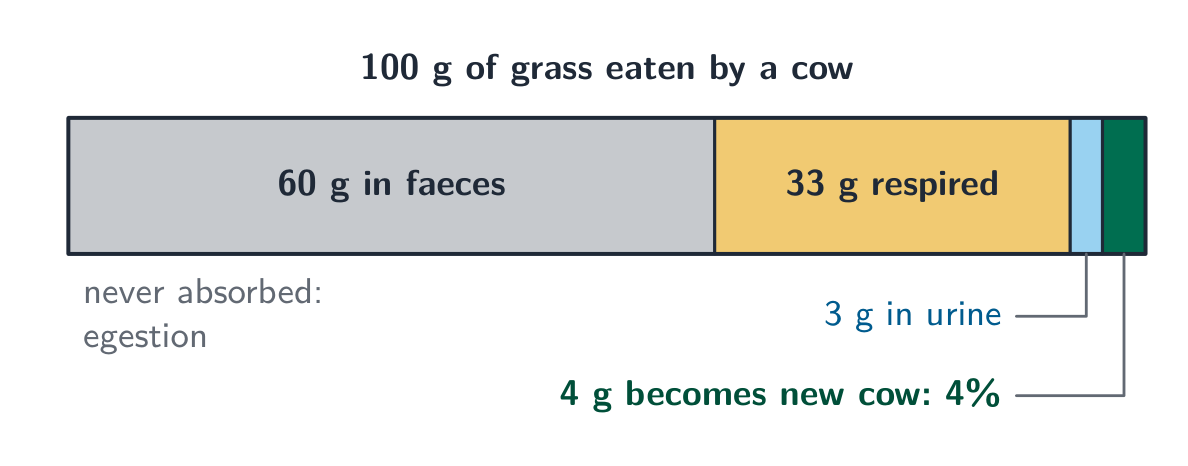
Why is biomass lost between trophic levels?
Dificultad 2/5 · 140 monedas + un pequeño bono en el primer intento de hoy
Respiration and waste.
Worked example: transfer efficiency
A level holds 800 kg; the next level holds 96 kg.
- Transfer efficiency 传递效率 $= \dfrac{96}{800} \times 100 = 12\%$.
- Use 12%, not a rounded "about 10%": the data give the value.
- Next level at the same efficiency: $96 \times 0.12 \approx 11.5$ kg.
Use the measured transfer efficiency
96 kg from 800 kg is 12%, so use 12% rather than a rounded 10%. Change the efficiency and the share reaching each higher level changes with it (the model tracks energy).
Producers 2000 kg, primary consumers 180 kg. What is the transfer efficiency?
Dificultad 2/5 · 140 monedas + un pequeño bono en el primer intento de hoy
180 ÷ 2000 × 100 = 9%.
At 10% efficiency, how much biomass reaches the next level from 500 kg?
Dificultad 2/5 · 140 monedas + un pequeño bono en el primer intento de hoy
500 × 0.10 = 50.
Why chains are short
- With only about 10% passing on each time, there is too little biomass left to support more than four or five levels.
- That is also why eating plants feeds more people per hectare than eating meat.
Why do food chains rarely have more than five levels?
Dificultad 1/5 · 100 monedas + un pequeño bono en el primer intento de hoy
Losses build up.
Exam-style question
Question (5 marks): A rabbit eats 250 g of grass. It egests 140 g in faeces and uses 95 g in respiration. It loses 5 g in urine. (a) Calculate the percentage of the grass that becomes new rabbit tissue. (2) (b) Explain why most of the biomass in the grass does not reach a fox that eats the rabbit. (3)
Model answer
- (a) New tissue $= 250 - 140 - 95 - 5 = 10$ g ✓, so $\dfrac{10}{250} \times 100 = 4\%$ ✓.
- (b) Much of the grass is not absorbed and leaves as faeces. ✓ Much of the absorbed glucose is used in respiration and lost as CO₂ and water. ✓ Some is lost as urea in urine, and only the new tissue (4%) is available to the fox; the fox cannot eat all of the rabbit, such as bones and fur. ✓
Where marks are lost: "energy is used up" or "biomass is destroyed" (it is lost from the chain, not destroyed); dividing by the wrong total (use the 250 g eaten); giving 10 g when the question asks for a percentage.
A caterpillar eats 40 mg of leaf. It egests 22 mg and respires 15 mg. How many mg become new caterpillar tissue? (Ignore other waste.)
Dificultad 2/5 · 140 monedas + un pequeño bono en el primer intento de hoy
$40 - 22 - 15 = 3$ mg, which is $\dfrac{3}{40} \times 100 = 7.5\%$ of what it ate.
The lost biomass is not destroyed. Faeces and dead remains feed decomposers; CO₂ from respiration goes back to the air. It just does not reach the next trophic level.
Biomass lost between levels is destroyed.
Dificultad 1/5 · 100 monedas + un pequeño bono en el primer intento de hoy
It goes to decomposers or the air.
Biomass is lost between trophic levels because not everything is eaten or absorbed, and much is respired or excreted. Efficiency = biomass at the next level ÷ biomass at this level × 100. Use the value the data give.
Explain why more people can be fed from a hectare of wheat than a hectare of cattle pasture.
Efficiency of transfer.