Trophic levels and extracellular decomposition
Introducido| English | Significado |
|---|---|
| trophic level/ˈtrəʊfɪk ˈlevl/ | nivel trófico |
| extracellular digestion/ˌekstrəˈseljʊlə daɪˈdʒestʃn/ | digestión extracelular |
The hawk at the top
- A sparrowhawk eats songbirds, which eat insects, which eat grass. The hawk depends on the grass, though it never eats any.
- Each feeding level in the chain is a trophic level 营养级.
Numbering the levels
- Level 1: producers (plants and algae make their own food).
- Level 2: primary consumers (herbivores). Level 3: secondary consumers. Level 4: tertiary consumers, often apex predators with no predators of their own.
In grass → insect → bird → hawk, match each organism to its trophic level.
Dificultad 2/5 · 140 monedas + un pequeño bono en el primer intento de hoy
Count from the producer.
What is an apex predator?
Dificultad 1/5 · 100 monedas + un pequeño bono en el primer intento de hoy
It sits at the top.
Counting transfers
- In grass → insect → bird → hawk there are 4 levels.
- There are 3 feeding transfers: always one fewer than the number of levels.
Worked example: a longer chain
Algae → water flea → small fish → large fish → heron.
- Levels: 5. The heron is at level 5.
- Transfers $= 5 - 1 = 4$.
- Water flea: primary consumer, level 2.
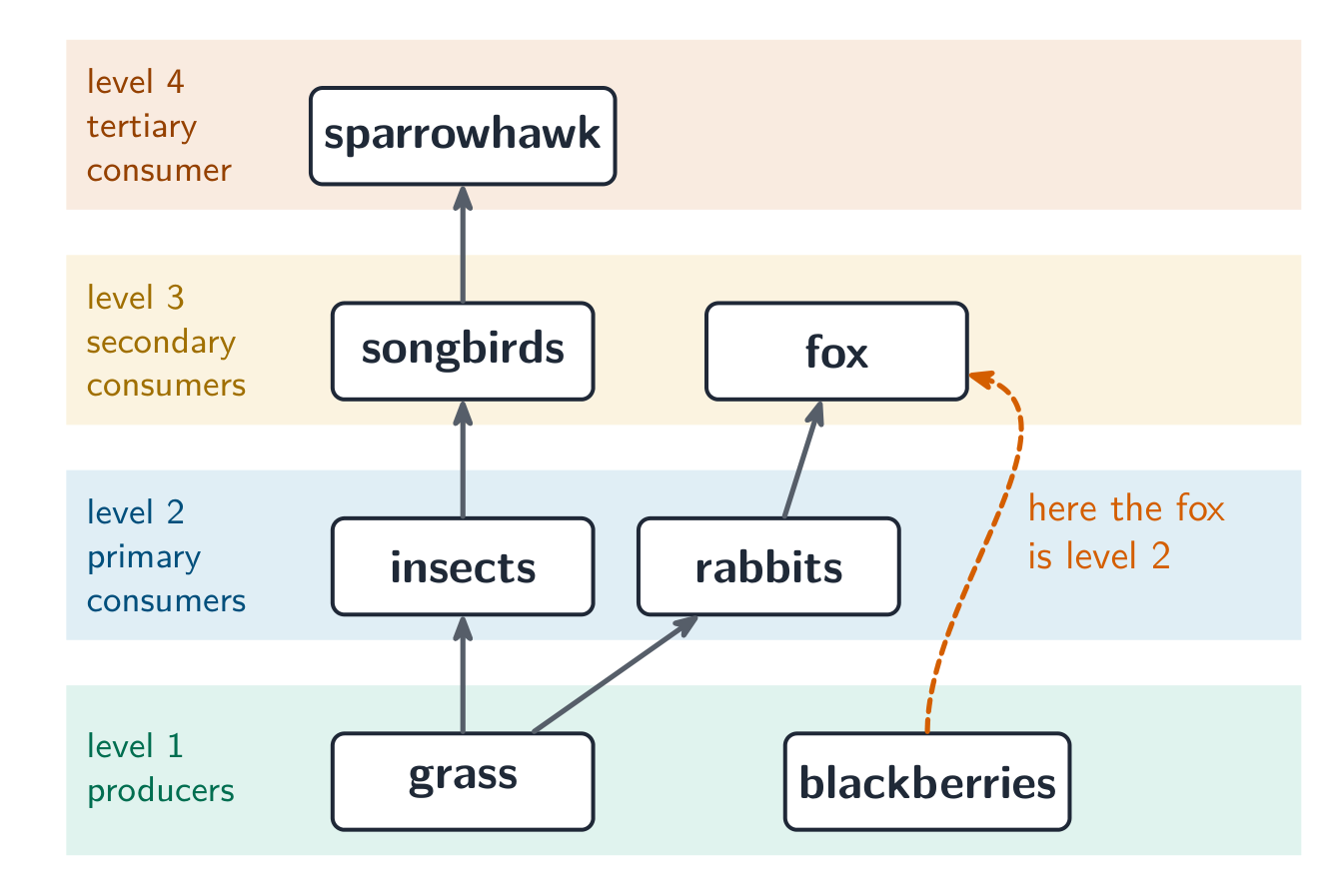
Feeding levels and transfers in a food chain
In grass → insect → bird → hawk, the hawk is at level 4 and three feeding transfers separate it from the grass: one fewer transfer than there are levels.
A food chain has 6 trophic levels. How many feeding transfers are there?
Dificultad 2/5 · 140 monedas + un pequeño bono en el primer intento de hoy
One fewer than the levels.
In the food web, the fox eats rabbits and also eats blackberries. Which statement is correct?
Dificultad 1/5 · 100 monedas + un pequeño bono en el primer intento de hoy
A trophic level depends on what the animal eats in that chain: blackberries (level 1) → fox puts the fox at level 2.
Decomposers
- Decomposers (bacteria and fungi) break down dead plant and animal matter.
- They secrete enzymes onto the food and absorb the small soluble molecules: extracellular digestion 细胞外消化.
How do decomposers digest food?
Dificultad 1/5 · 100 monedas + un pequeño bono en el primer intento de hoy
Extracellular digestion.
Exam-style question
Question (5 marks): Use the food web above. (a) Give the trophic level of the sparrowhawk, and name the primary consumers. (2) (b) A disease kills most of the insects. Explain the effect on the sparrowhawk population. (2) (c) Describe how fungi feed on a dead rabbit. (1)
Model answer
- (a) Level 4 ✓; insects and rabbits ✓.
- (b) Fewer insects means less food for the songbirds, so fewer songbirds survive. ✓ The sparrowhawks have fewer songbirds to eat, so their population falls. ✓
- (c) The fungi secrete enzymes onto the rabbit and absorb the small soluble molecules made: extracellular digestion. ✓
Where marks are lost: in (b), jumping from "insects die" to "hawks die" without the songbird link; in (c), "the fungi eat the rabbit" (they digest it outside their cells, then absorb).
An animal's trophic level depends on what it eats in that chain. A fox eating rabbits is level 3; a fox eating blackberries is level 2. Many animals feed at more than one level.
An animal always stays at the same trophic level.
Dificultad 1/5 · 100 monedas + un pequeño bono en el primer intento de hoy
It depends on what it eats.
Producers are level 1; consumers go up one level per feeding transfer, and the number of transfers is one fewer than the number of levels. Decomposers digest dead matter outside their cells and absorb the products.
Explain why a hawk depends on plants even though it never eats them.
Energy flows up.