Global warming: biological effects and evidence
Introducido| English | Significado |
|---|---|
| greenhouse gases/ˈɡriːnhaʊs ˈɡæsɪz/ | Atmospheric gases that absorb and emit infrared radiation and contribute to the greenhouse effect. |
| scientific consensus/saɪənˈtɪfɪk kənˈsensəs/ | consenso científico |
Earlier springs
- Records kept in Britain since 1736 show that oak trees now come into leaf more than a week earlier than they did a century ago.
- Rising temperatures are changing when and where living things grow.
The cause
- Carbon dioxide and methane are greenhouse gases 温室气体: they absorb heat radiated from the Earth and keep the lower atmosphere warm.
- Burning fossil fuels, deforestation, cattle and rice fields have raised their levels, and the mean global temperature has risen.
Which are greenhouse gases?
Dificultad 2/5 · 140 monedas + un pequeño bono en el primer intento de hoy
Oxygen and nitrogen do not absorb heat this way.
Biological effects
- Species' ranges shift towards the poles or uphill; some species can no longer survive where they are.
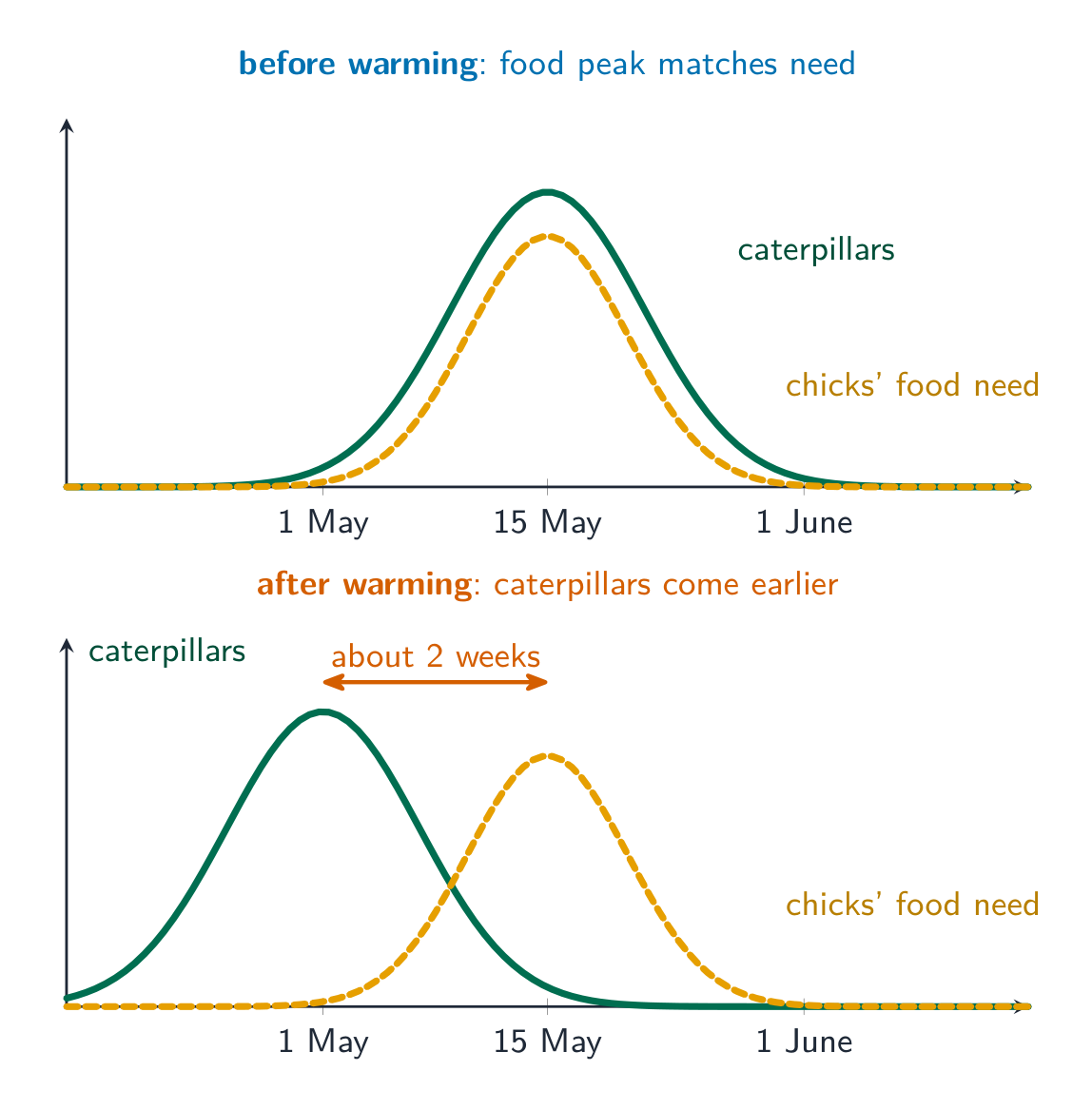
- Timing changes: if caterpillars hatch earlier but birds lay eggs at the same time, chicks miss the food peak. Sea levels rise and flood habitats.
Which are biological effects of global warming?
Dificultad 2/5 · 140 monedas + un pequeño bono en el primer intento de hoy
Many species suffer.
Warming makes caterpillars hatch two weeks earlier, but birds still lay eggs at the same time. What is the main problem for the chicks?
Dificultad 1/5 · 100 monedas + un pequeño bono en el primer intento de hoy
The food peak and the chicks' need no longer line up, so less food is there when it matters most. Fewer chicks survive.
Worked example: rate of warming
A region's mean temperature rose from 12.0 °C to 13.2 °C over 30 years.
- Change $= 13.2 - 12.0 = 1.2$ °C.
- Mean rate $= \dfrac{1.2}{30} = 0.04 \, \dfrac{\text{°C}}{\text{year}}$.
- Do not give a percentage: 0 °C is not "no temperature", so a percentage change in °C has no meaning.
Mean annual change in temperature
A mean temperature rising from 12.0 to 13.2 °C over 30 years changes by 1.2 °C, an average of 1.2 ÷ 30 = 0.04 °C per year. A percentage change of a Celsius value has no meaning.
A lake warms from 8.0 °C to 9.0 °C over 25 years. What is the mean rate in °C per year?
Dificultad 2/5 · 140 monedas + un pequeño bono en el primer intento de hoy
1.0 ÷ 25 = 0.04.
Why not give the change as a percentage of the Celsius temperature?
Dificultad 1/5 · 100 monedas + un pequeño bono en el primer intento de hoy
The Celsius scale has an arbitrary zero.
The evidence
- Long-term temperature records, ice cores and tree rings all show the warming. Thousands of studies agree: there is a scientific consensus 科学共识 that human activity is the main cause.
- Evidence must be peer-reviewed. Local or short-term data alone carry more uncertainty.
Exam-style question
Question (4 marks): Great tits feed their chicks on caterpillars that eat oak leaves. In warmer springs, oak leaves and caterpillars appear earlier, but the great tits lay their eggs at about the same time. (a) Explain how this could affect the great tit population. (3) (b) Suggest one other way a rise in temperature could affect the distribution of a species. (1)
Model answer
- (a) The caterpillar peak comes before the chicks hatch, so there is less food when the chicks need it most. ✓ Fewer chicks get enough food, so fewer survive. ✓ Fewer young birds join the population, so the great tit population falls. ✓
- (b) The species may move towards the poles or to higher ground, where it is cooler (or it may die out where it is now too warm). ✓
Where marks are lost: "the birds die from the heat" (the question is about food timing); stopping at "less food" without linking it to fewer chicks surviving.
Weather is not climate. One cold winter does not disprove global warming. Climate is the average over decades, across the whole planet.
A very cold winter proves global warming is not happening.
Dificultad 1/5 · 100 monedas + un pequeño bono en el primer intento de hoy
Weather is not climate.
Rising CO₂ and methane trap more heat, raising global temperature. Biological effects include shifting distributions, mistimed food supplies and lost habitats. Peer-reviewed long-term evidence gives a scientific consensus.
Explain how global warming could reduce the number of chicks a bird raises.
Timing matters.