How Similar Were the Cold War's Effects?
Introducido| English | Significado |
|---|---|
| proxy wars/ˈprɒksi wɔːz/ | proxy wars |
| decolonisation/dɪˌkɒlənaɪˈzeɪʃn/ | decolonisation |
| Non-Aligned Movement/nɒn əˈlaɪnd ˈmuːvmənt/ | An association of states seeking an independent position outside the major rival military blocs, originating during the Cold War. |
One year, two hemispheres, 1954
- In June 1954, a CIA-backed force overthrew Guatemala's elected president, Jacobo Árbenz, who had taken unused land from the American United Fruit Company. A month later, at Geneva, Vietnam was divided into a communist north and an anti-communist south.
- The Cold War reached Latin America and Southeast Asia in the same year. Were its effects the same on both sides of the world?
Why was Guatemala's president overthrown in 1954?
Dificultad 1/5 · 100 monedas + un pequeño bono en el primer intento de hoy
The coup was backed by the CIA.
Similar: pressure to choose a side
- In both hemispheres, the United States and the Soviet Union pushed governments to join their side, with aid, weapons, advisers and sometimes coups.
- Both hemispheres had proxy wars 代理战争, in which the superpowers supported opposing sides without fighting each other directly: Vietnam and Angola in the East, Nicaragua and El Salvador in the West.
Wars in which the superpowers supported opposing sides without fighting each other are called ____ wars.
Dificultad 1/5 · 100 monedas + un pequeño bono en el primer intento de hoy
Vietnam, Angola and Nicaragua are examples.
Similar: the state and the economy
- In both hemispheres, many governments directed their economies, either by communist planning or by state-led development, such as Mexico's state oil company and India's five-year plans.
- Military governments came to power in both, often claiming to fight communism: in Chile (1973), Argentina (1976) and Indonesia (1965).
Where did military governments take power claiming to fight communism?
Dificultad 2/5 · 140 monedas + un pequeño bono en el primer intento de hoy
In both hemispheres.
Different: independence came at the same time
- In much of Asia and Africa, the Cold War arrived together with decolonisation 非殖民化. New states had to build governments and choose sides at once.
- Latin American states had been independent for over a century, so the Cold War there ran through elections, coups and land reform inside existing states.
In Latin America, the Cold War came together with independence from European empires.
Dificultad 1/5 · 100 monedas + un pequeño bono en el primer intento de hoy
Latin America had been independent since the 1820s.
Worked example: an extent judgement. "The effects of the Cold War were similar to a large extent in their methods: both hemispheres saw proxy wars, superpower-backed coups and state-directed economies. But they differed in context. In Vietnam and Angola, the Cold War was tangled with wars of independence; in Guatemala and Chile, it ran through the politics of states that had been independent since the 1820s."
Which judgement gives a degree?
Dificultad 1/5 · 100 monedas + un pequeño bono en el primer intento de hoy
It weighs similarity against difference.
Some states refused to choose
- Leaders such as India's Nehru, Egypt's Nasser and Indonesia's Sukarno founded the Non-Aligned Movement 不结盟运动 (1961), which tried to stay out of both blocs. Cuba was a member, although it was close to the Soviet Union.
- Non-alignment let some states accept aid from both sides.
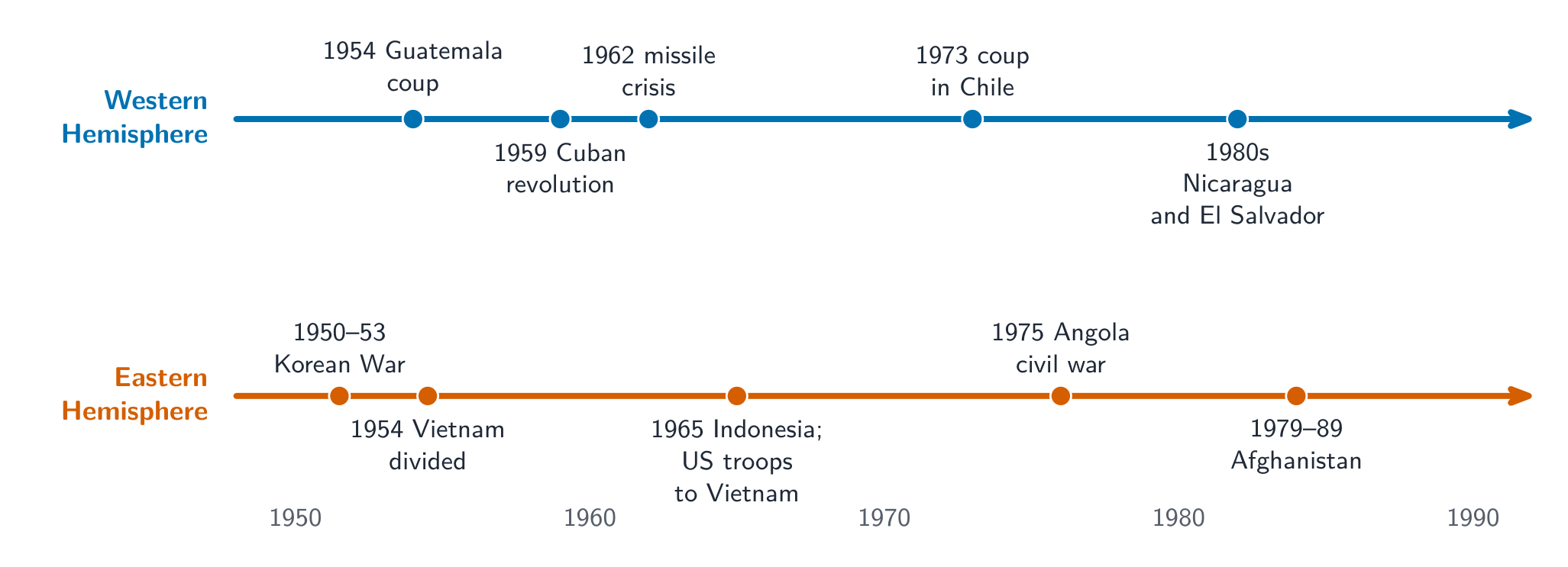
Which hemisphere?
Sort each Cold War event by hemisphere.
The Non-Aligned Movement tried to stay out of both Cold War blocs.
Dificultad 1/5 · 100 monedas + un pequeño bono en el primer intento de hoy
Founded in 1961.
"Similar" questions still need differences. Say what was the same, then what differed, then give a degree, such as "similar in methods, different in context".
A question about similarity needs no differences.
Dificultad 1/5 · 100 monedas + un pequeño bono en el primer intento de hoy
Give both, then a degree.
The Cold War's effects were similar in both hemispheres in their methods: pressure to align, proxy wars, coups and state-directed economies. They differed in context: in Asia and Africa the Cold War came together with decolonisation, while in Latin America it worked through long-independent states, as in Guatemala (1954) and Chile (1973). Some states chose non-alignment.
To what extent were the effects of the Cold War similar in the Eastern and Western Hemispheres?
Same tools, different settings.