How the Superpowers Kept Influence
Introducido| English | Significado |
|---|---|
| NATO/ˈneɪtəʊ/ | OTAN |
| Warsaw Pact/ˈwɔːsɔː pækt/ | Pacto de Varsovia |
| nuclear proliferation/ˈnjuːklɪə prəˌlɪfəˈreɪʃn/ | The spread of nuclear weapons to more and more countries. |
| deterrence/dɪˈtɜːrəns/ | Preventing an attack by making sure the attacker would suffer unacceptable damage in return. |
| proxy war | A war in which powerful states support opposing sides with money, weapons or advisers instead of fighting each other directly. |
Thirteen days, October 1962
- On 14 October 1962, an American U-2 spy plane photographed Soviet nuclear missile sites being built in Cuba, about 150 km from Florida. For thirteen days, the US blockaded Cuba and the world feared nuclear war. On 28 October, Soviet leader Nikita Khrushchev agreed to remove the missiles; in secret, the US agreed to remove its missiles from Turkey.
- The superpowers kept influence through alliances, nuclear weapons and wars fought by others.
What did the US secretly agree to in the Cuban Missile Crisis?
Dificultad 1/5 · 100 monedas + un pequeño bono en el primer intento de hoy
The Soviets removed their missiles from Cuba.
Alliances on both sides
- NATO 北约 (1949) united the US, Canada and Western European states for mutual defence.
- The Warsaw Pact 华沙条约组织 (1955) united the Soviet Union and Eastern European states.
Match each alliance to its year and leader.
Dificultad 2/5 · 140 monedas + un pequeño bono en el primer intento de hoy
Alliances and deterrence.
Nuclear proliferation
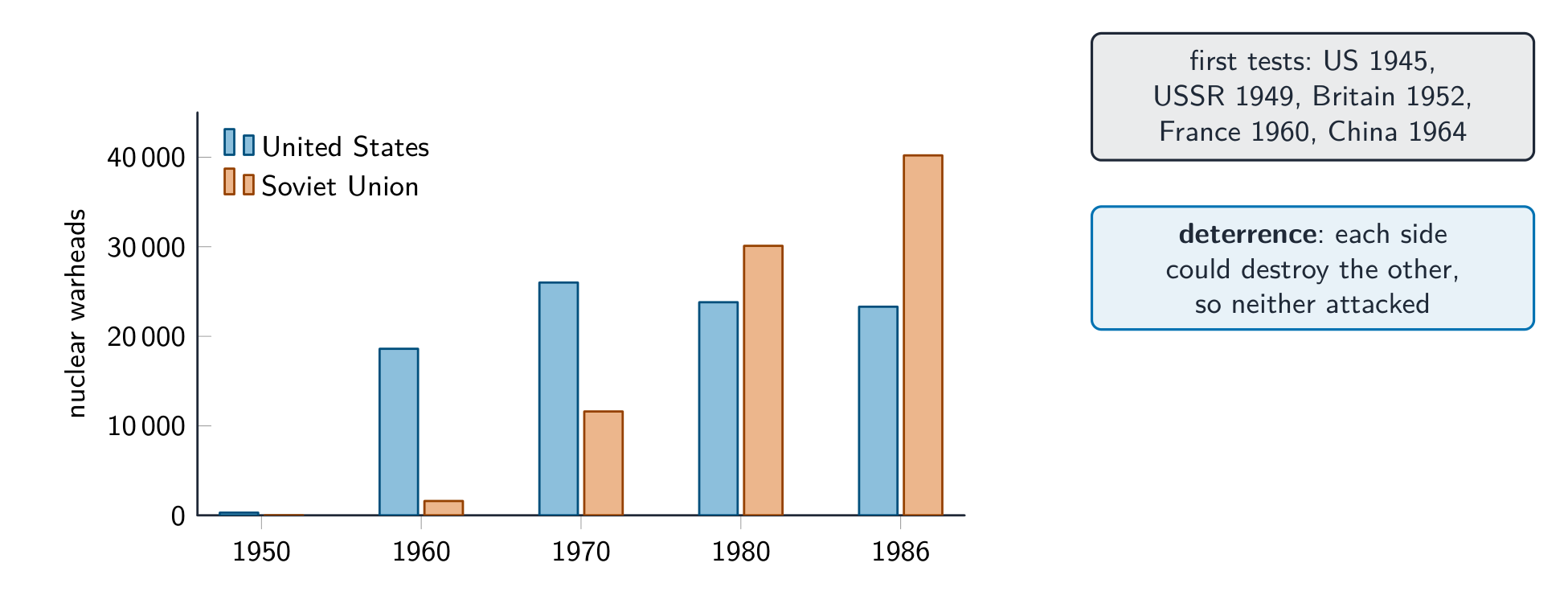
- The US (1945), the Soviet Union (1949), Britain (1952), France (1960) and China (1964) built nuclear weapons — nuclear proliferation 核扩散.
- The aim was deterrence 威慑: making an attack too costly to try.
Alliance, proliferation, or proxy war?
Sort each Cold War development.
Put these nuclear powers in order of their first test.
Dificultad 3/5 · 200 monedas + un pequeño bono en el primer intento de hoy
1945, 1949, 1952, 1964.
Worked example: a proxy war in Angola
- Setting: after Angola's independence from Portugal in 1975, rival groups fought a civil war.
- Sponsors: the Soviet Union and Cuba (with about 30 000 troops by the early 1980s) backed the MPLA government; the US and South Africa backed UNITA.
- Result: in this proxy war 代理人战争, the superpowers never fought each other directly, but the war lasted until 2002 and killed hundreds of thousands of Angolans.
Match each to its category.
Dificultad 2/5 · 140 monedas + un pequeño bono en el primer intento de hoy
Three instruments.
The Angolan civil war ran from 1975 to 2002. How many years?
Dificultad 2/5 · 140 monedas + un pequeño bono en el primer intento de hoy
2002 − 1975.
Other proxy wars
- The Korean War (1950–53) and the Vietnam War involved superpower troops on one side and support for the other.
- In Afghanistan (1979–89), the US armed fighters against Soviet forces.
Comparing the instruments
- Alliances and nuclear weapons kept peace between the superpowers in Europe.
- Proxy wars moved the fighting to Asia, Africa and Latin America, where most of the Cold War's dead lived.
The Cold War was not "cold" everywhere. The superpowers avoided fighting each other, but proxy wars killed millions in Korea, Vietnam, Angola and Afghanistan.
The Cold War involved no fighting anywhere.
Dificultad 1/5 · 100 monedas + un pequeño bono en el primer intento de hoy
Proxy wars killed millions.
The superpowers kept influence through NATO and the Warsaw Pact, nuclear weapons for deterrence, and proxy wars such as Angola. The Cuban Missile Crisis of 1962 showed how close deterrence came to failing; the proxy wars moved the killing to the developing world.
Compare how the superpowers used alliances and proxy wars to keep influence.
Comparison.