Graphs of Polar Functions · Gráficas de funciones polares
| English | Español |
|---|---|
| polar function/ˈpəʊlə ˈfʌŋkʃn/ | función polar |
| rose/rəʊz/ | rose |
| cardioid/ˈkɑːdɪəʊɪd/ | cardioide |
| polar coordinates/ˈpəʊlə kəʊˈɔːdɪnəts/ | coordenadas polares |
Curves that bloom
- In rectangular graphs, $y$ depends on $x$. In polar graphs, the radius depends on the angle.
- As the angle sweeps around, the radius grows and shrinks, tracing surprising shapes.
- Flowers, hearts, and spirals all appear from simple polar rules.
- These curves are hard to write with $x$ and $y$, but easy with $r$ and $\theta$.
Curvas que florecen
- En gráficos rectangulares, $y$ depende de $x$. En gráficos polares, el radio depende del ángulo.
- A medida que el ángulo barre alrededor, el radio crece y decrece, trazando formas sorprendentes.
- Flores, corazones y espirales aparecen todos a partir de reglas polares simples.
- Estas curvas son difíciles de escribir con $x$y $y$, pero fáciles con $r$ y $\theta$.
What a polar function is
- A polar function 极坐标函数 has the form $r = f(\theta)$: a radius for each angle.
- To plot it, sweep $\theta$ around and mark the point at distance $r$ in that direction.
- Where $r$ is large the curve reaches far out; where $r = 0$ it touches the origin.
- The whole graph is built one angle at a time.
Qué es una función polar
- Una función polar 极坐标函数 tiene la forma $r = f(\theta)$: un radio para cada ángulo.
- Para graficarla, barre $\theta$ alrededor y marca el punto a distancia $r$ en esa dirección.
- Donde $r$ es grande, la curva se aleja mucho; donde $r = 0$ toca el origen.
- Toda la gráfica se construye un ángulo a la vez.
A polar function $r = f(\theta)$ gives, for each angle, the… · Una función polar $r = f(\theta)$ da, para cada ángulo, la…
A polar function outputs a radius for each input angle; plotting $(f(\theta), \theta)$ traces the curve. · Una función polar produce un radio para cada ángulo de entrada; graficar $(f(\theta), \theta)$ traza la curva.
The simple polar equation $r = 3$ (constant) is a circle. · La ecuación polar simple $r = 3$ (constante) es un círculo.
A constant radius at every angle traces a circle of that radius around the origin. · Un radio constante en cada ángulo traza un círculo de ese radio alrededor del origen.
Roses and other shapes
- $r = a\sin(k\theta)$ or $a\cos(k\theta)$ traces a rose 玫瑰线 — a flower of petals.
- With $k$ odd there are $k$ petals; with $k$ even there are $2k$.
- $r = a(1 + \sin\theta)$ traces a heart-shaped cardioid 心形线.
- A constant $r = a$ is simply a circle of radius $a$.
Rosas y otras formas
- $r = a\sin(k\theta)$ o $a\cos(k\theta)$ traza una rosa 玫瑰线 — una flor de pétalos.
- Con $k$ impar hay $k$ pétalos; con $k$ par hay $2k$.
- $r = a(1 + \sin\theta)$ traza un cardioide 心形线 en forma de corazón.
- Un constante $r = a$ es simplemente un círculo de radio $a$.
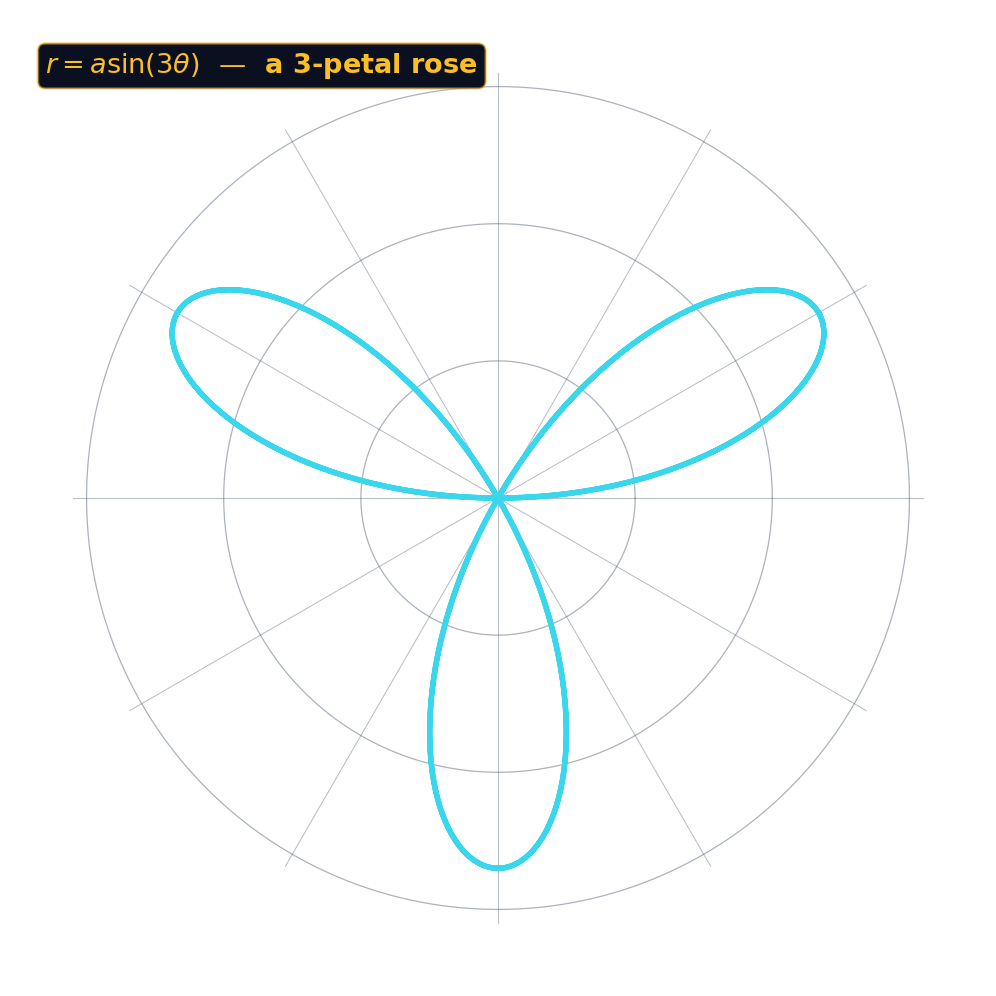
Draw a polar curve petal by petal · Dibuje una curva polar pétalo a pétalo
A polar function sets r for each angle theta. Sweep theta around and the radius traces a rose, circle, or spiral. · Una función polar establece r para cada ángulo theta. Al hacer barrer theta alrededor, el radio traza una rosa, un círculo o una espiral.
The curve $r = a\sin(3\theta)$ is a rose with how many petals? · La curva $r = a\sin(3\theta)$ es una rosa con cuántos pétalos?
For · A favor $r = a\sin(k\theta)$ with $k$ odd, the rose has exactly $k$ petals — here $3$. · Para $r = a\sin(k\theta)$ con $k$ impar, la rosa tiene exactamente $k$ pétalos — aquí $3$.
The heart-shaped polar curve $r = 1 + \sin\theta$ is called a ____. · La curva polar con forma de corazón $r = 1 + \sin\theta$ se llama ____.
A cardioid ("heart-shaped") is a classic polar curve of the form $r = a(1 + \sin\theta)$. · Un cardioide ("con forma de corazón") es una curva polar clásica de la forma $r = a(1 + \sin\theta)$.
Select all · todos true statements about polar graphs. · Seleccione todas las afirmaciones verdaderas sobre gráficas polares.
Polar graphs include circles, roses, cardioids, and spirals — rarely straight lines. The other three are correct. · Las gráficas polares incluyen círculos, rosas, cardióides y espirales — rara vez líneas rectas. Las otras tres son correctas.
Plotting point by point
- Make a table: choose angles, compute $r$ at each, and mark the points.
- Watch for where $r = 0$ (the curve passes through the origin) and where $r$ peaks.
- Join the points smoothly in order of increasing $\theta$.
- The pattern usually repeats after one full turn (or half, for even roses).
Graficando punto por punto
- Haz una tabla: elige ángulos, calcula $r$ en cada uno, y marca los puntos.
- Observa dónde $r = 0$ (la curva pasa por el origen) y dónde $r$ alcanza su máximo.
- Une los puntos suavemente en orden de aumento de $\theta$.
- El patrón generalmente se repite después de una vuelta completa (o media, para rosas pares).
Symmetry helps
- Many polar curves are symmetric about an axis, which halves the plotting work.
- A $\sin$ curve is often symmetric about the vertical axis; a $\cos$ curve about the horizontal.
- Spotting the symmetry lets you sketch one part and mirror the rest.
- Converting back to polar coordinates 极坐标 confirms exactly where each feature sits.
La simetría ayuda
- Muchas curvas polares son simétricas respecto a un eje, lo que reduce a la mitad el trabajo de graficar.
- Una curva $\sin$ suele ser simétrica respecto al eje vertical; una curva $\cos$ respecto al horizontal.
- Identificar la simetría te permite bosquejar una parte y reflejar el resto.
- Convertir de nuevo a coordenadas polares 极坐标 confirma exactamente dónde se ubica cada característica.
Do not read a polar graph like a rectangular one. A "loop" back to the origin means $r$ passed through $0$, not that the function is undefined. And a single point can be reached at several different angles, so the same curve may be traced more than once.
No leas una gráfica polar como si fuera rectangular. Un "bucle" hacia el origen significa que $r$ pasó por $0$, no que la función está indefinida. Y un solo punto puede alcanzarse en varios ángulos diferentes, por lo que la misma curva puede trazarse más de una vez.
Sketch $r = 2\cos\theta$ over $0 \le \theta \le \pi$.
- At $\theta = 0$: $r = 2$ (a point $2$ units right).
- At $\theta = \tfrac{\pi}{2}$: $r = 0$ (the origin).
- The points trace a circle of diameter $2$ sitting to the right of the origin.
Bosqueja $r = 2\cos\theta$ sobre $0 \le \theta \le \pi$.
- En $\theta = 0$: $r = 2$ (un punto $2$ unidades a la derecha).
- En $\theta = \tfrac{\pi}{2}$: $r = 0$ (el origen).
- Los puntos trazan un círculo de diámetro $2$ situado a la derecha del origen.
A polar function $r = f(\theta)$ gives a radius for each angle. Sweeping $\theta$ traces circles, roses ($r = a\sin k\theta$), cardioids ($r = a(1+\sin\theta)$), and spirals. Plot point by point using polar coordinates, and use symmetry to speed up the sketch.
Una función polar $r = f(\theta)$ proporciona un radio para cada ángulo. Al barrer $\theta$ se trazan círculos, rosas ($r = a\sin k\theta$), cardioides ($r = a(1+\sin\theta)$) y espirales. Grafique punto por punto utilizando coordenadas polares, y emplee la simetría para agilizar el boceto.