The Welfare State and Its Critics
Introducido| English | Significado |
|---|---|
| welfare state/ˈwelfeə steɪt/ | A state that provides broad social security, health care, and education. |
| stagflation/stæɡˈfleɪʃn/ | A combination of inflation with stagnant economic activity and high unemployment. |
| privatization/ˌpraɪvətaɪˈzeɪʃn/ | Selling state-owned industries or services to private owners. |
| neoliberalism | Ideas favouring free markets, lower taxes, less regulation and a smaller role for the state. |
The NHS opens, 1948
- On 5 July 1948, Britain's National Health Service began. For the first time, every person in the country could see a doctor, go to hospital or get glasses without paying at the point of use. In its first year, opticians gave out over 5 million pairs of free glasses.
- After 1945, Western European governments built welfare states. From the 1970s, critics argued they had gone too far.
Building the welfare state
- Britain's Beveridge Report (1942) promised to defeat "five giants": want, disease, ignorance, squalor and idleness.
- A welfare state 福利国家 provides health care, pensions, unemployment pay, housing and education for all, paid for by taxes. Postwar growth made these benefits affordable.
Which were among Beveridge's "five giants"?
Dificultad 2/5 · 140 monedas + un pequeño bono en el primer intento de hoy
The others were squalor and idleness.
Growth stops
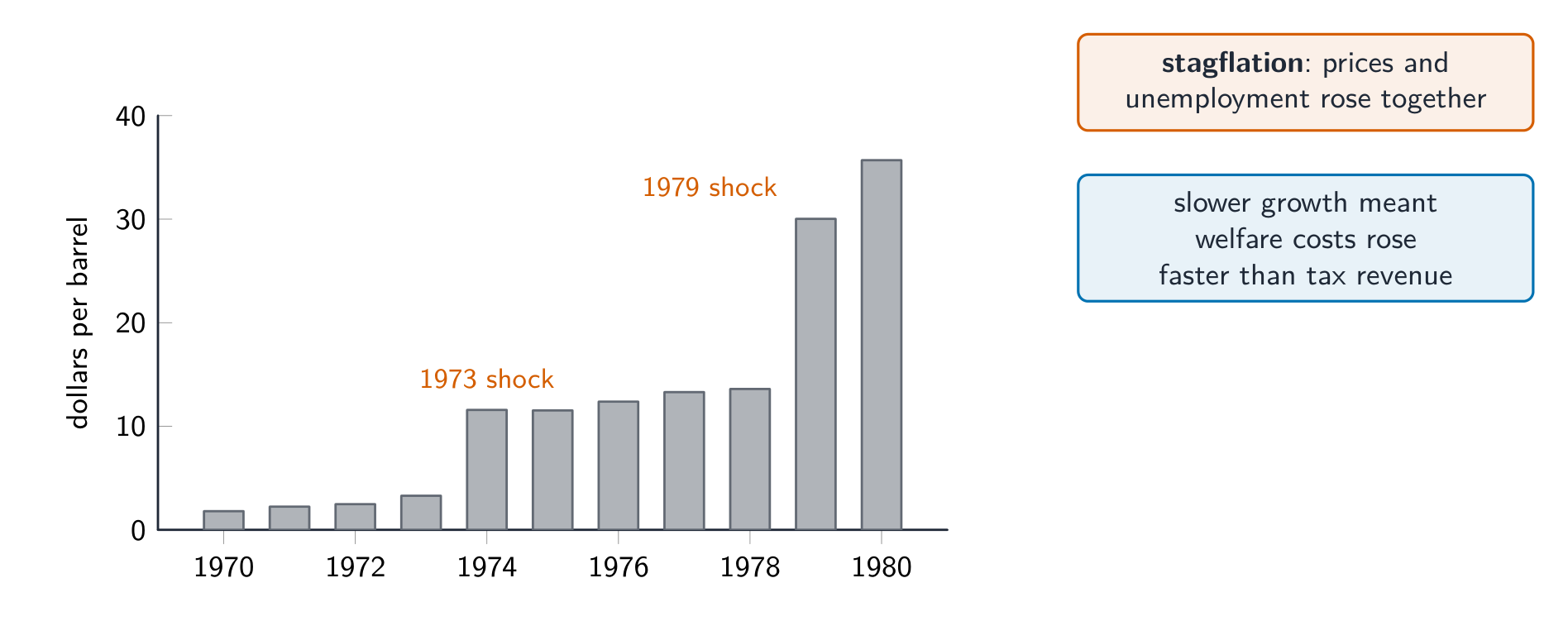
- The oil shock of 1973 quadrupled oil prices. Europe faced stagflation 滞胀 — high inflation and high unemployment together — which Keynesian policy struggled to fix.
- With slower growth, welfare costs rose faster than tax revenues.
What is stagflation?
Dificultad 1/5 · 100 monedas + un pequeño bono en el primer intento de hoy
After the 1973 oil shock.
Worked example: Thatcher's response
- The critique: Margaret Thatcher, British prime minister from 1979, argued that high taxes, state-owned industries and strong unions held back growth.
- The measures: privatization 私有化 sold state firms such as British Telecom (1984) and British Gas (1986); union power was cut, and the year-long miners' strike of 1984–85 was defeated.
- The limit: the NHS and state pensions survived. The welfare state was reduced and reshaped, not abolished.
The growth phase, the stagnation phase, or the accurate verdict?
Sort each statement about the welfare state.
Match each measure to its example.
Dificultad 2/5 · 140 monedas + un pequeño bono en el primer intento de hoy
Reduced, not abolished.
Liberalism shifts again
- Neoliberalism 新自由主义 — free markets, lower taxes, less regulation — echoed nineteenth-century laissez-faire.
- Other leaders followed parts of it: France's socialist president Mitterrand reversed his spending plans in 1983, and West Germany under Kohl cut some spending.
Which ideas are part of neoliberalism?
Dificultad 1/5 · 100 monedas + un pequeño bono en el primer intento de hoy
A return to market ideas.
Defenders
- Supporters of the welfare state argued it reduced poverty and made societies fairer and more stable.
- In Scandinavia, high taxes and generous welfare continued alongside strong economies.
Scandinavian countries kept generous welfare states alongside strong economies.
Dificultad 1/5 · 100 monedas + un pequeño bono en el primer intento de hoy
High taxes, high welfare.
The welfare state was limited, not abolished. Even Thatcher kept the NHS. Describe the change as a reduction and reshaping of welfare, not its end.
Thatcher abolished Britain's welfare state.
Dificultad 1/5 · 100 monedas + un pequeño bono en el primer intento de hoy
She reduced and reshaped it.
Postwar growth funded welfare states such as Britain's NHS. After the 1973 oil shock and stagflation, critics such as Thatcher privatized industries and cut union power, and neoliberal ideas spread. Welfare states were reduced and reformed, but most of their core survived.
Explain why the welfare state came under attack in Western Europe after 1973.
Causation.