Why the Second War Came
Introducido| English | Significado |
|---|---|
| Lebensraum | "Living space": Hitler's aim of conquering land in eastern Europe for German settlement. |
| appeasement | Giving in to an aggressor's demands to avoid war, as Britain and France did with Hitler. |
| non-aggression pact | An agreement between states not to attack each other, such as the Nazi-Soviet Pact of 1939. |
Into the Rhineland, 7 March 1936
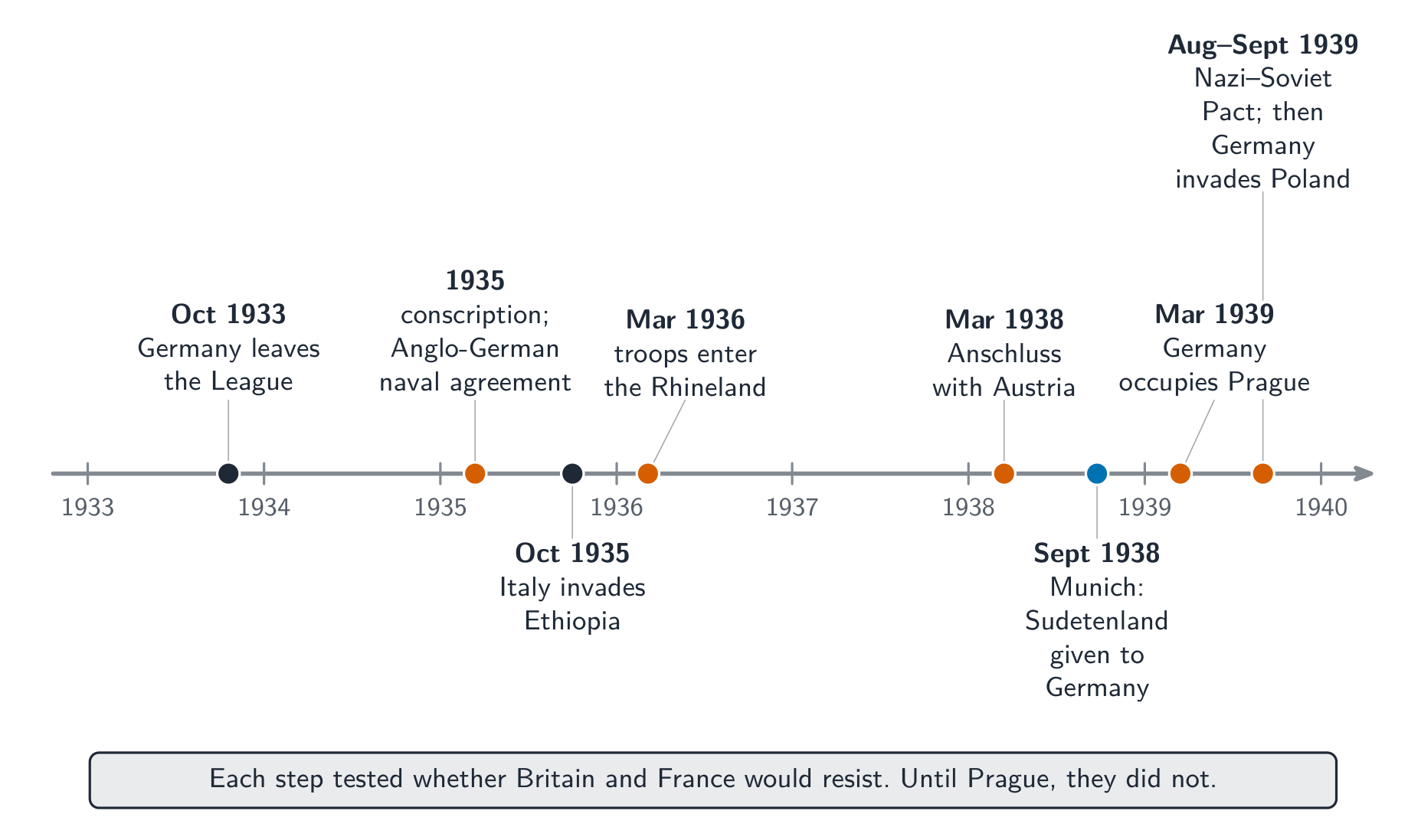
- On 7 March 1936, about 20 000 German soldiers marched into the Rhineland, which the Treaty of Versailles had demilitarized. Their officers carried orders to retreat if the French army resisted. France did nothing; Britain said Germany was only walking into "its own back garden". Hitler later called those 48 hours the most nerve-racking of his life.
- The Second World War came because Nazi Germany wanted war, and other states failed to stop it in time.
Why was the Rhineland remilitarization a gamble?
Dificultad 1/5 · 100 monedas + un pequeño bono en el primer intento de hoy
France did nothing.
Four ingredients
- Hitler's aims: overturn Versailles, unite all Germans and conquer Lebensraum 生存空间 ("living space") in the east.
- A weak League of Nations, Western reluctance to fight, and the Depression, which turned governments inward.
What allowed rearmament
- Germany rebuilt its army openly from 1935 and introduced conscription. Britain signed a naval agreement with Germany the same year.
- The League failed to stop Japan in Manchuria (1931) or Italy in Ethiopia (1935–36), so aggressors saw it was weak.
Assemble the causes of the second war
The CED names four, and the settlement is only one of them.
Where did the League fail to stop aggression?
Dificultad 2/5 · 140 monedas + un pequeño bono en el primer intento de hoy
The Sudetenland was given away at Munich, outside the League.
Worked example: appeasement
- The policy: appeasement 绥靖政策 — giving in to some demands to avoid war. At Munich (September 1938), Britain and France let Germany take the Sudetenland from Czechoslovakia.
- The reasons: memories of the First World War, the belief that Versailles had been unfair, unready armed forces and fear of communism.
- The failure: in March 1939, Germany took the rest of Czechoslovakia. Britain and France then promised to defend Poland.
What is appeasement?
Dificultad 1/5 · 100 monedas + un pequeño bono en el primer intento de hoy
Munich, 1938.
Match each reason for appeasement to its type.
Dificultad 2/5 · 140 monedas + un pequeño bono en el primer intento de hoy
Several reasons.
The Nazi-Soviet Pact
- On 23 August 1939, Germany and the Soviet Union, ideological enemies, signed a non-aggression pact 互不侵犯条约 that secretly divided Poland between them.
- Germany invaded Poland on 1 September; Britain and France declared war on 3 September.
Put these events in order.
Dificultad 3/5 · 200 monedas + un pequeño bono en el primer intento de hoy
1936, 1938, March 1939, August 1939.
Weighing ideology
- Nazi racial ideology and the goal of Lebensraum made war in the east part of Hitler's plan, not an accident.
- Western leaders' fear of communism made them slow to ally with the Soviet Union.
Appeasement did not cause the war on its own. Hitler's aims were the main cause. Appeasement explains why he was not stopped earlier.
Appeasement was the main cause of the Second World War.
Dificultad 1/5 · 100 monedas + un pequeño bono en el primer intento de hoy
Hitler's aims were.
Hitler's aims of overturning Versailles and conquering Lebensraum drove Germany toward war. A weak League, Western reluctance and appeasement — the Rhineland, Munich — let Germany rearm and expand, and the Nazi-Soviet Pact cleared the way for the invasion of Poland in September 1939.
Explain why Britain and France followed a policy of appeasement in the 1930s.
Motives.