The Great Depression
Introducido| English | Significado |
|---|---|
| gold standard | A system in which a currency can be exchanged for a fixed amount of gold. |
| austerity | Government policy of cutting spending and raising taxes to reduce a budget deficit. |
| Keynesian economics | The ideas of John Maynard Keynes: in a slump, governments should spend and borrow to replace missing demand. |
A bank fails in Vienna, 1931
- In May 1931 the Creditanstalt, Austria's largest bank, collapsed. Panic spread to German banks, which closed their doors in July. In September, Britain abandoned the gold standard 金本位, no longer promising to exchange pounds for gold. The American crash of 1929 had become a European catastrophe.
- The Great Depression damaged Europe's economies and its democracies.
From Wall Street to Europe
- After the Wall Street Crash of October 1929, American banks called back the loans that had supported Germany's recovery since the Dawes Plan (1924).
- World trade fell by about two-thirds between 1929 and 1933 as countries raised tariffs to protect their industries.
How did the Wall Street Crash spread to Germany?
Dificultad 1/5 · 100 monedas + un pequeño bono en el primer intento de hoy
Dawes Plan loans were recalled.
The orthodox answer: austerity
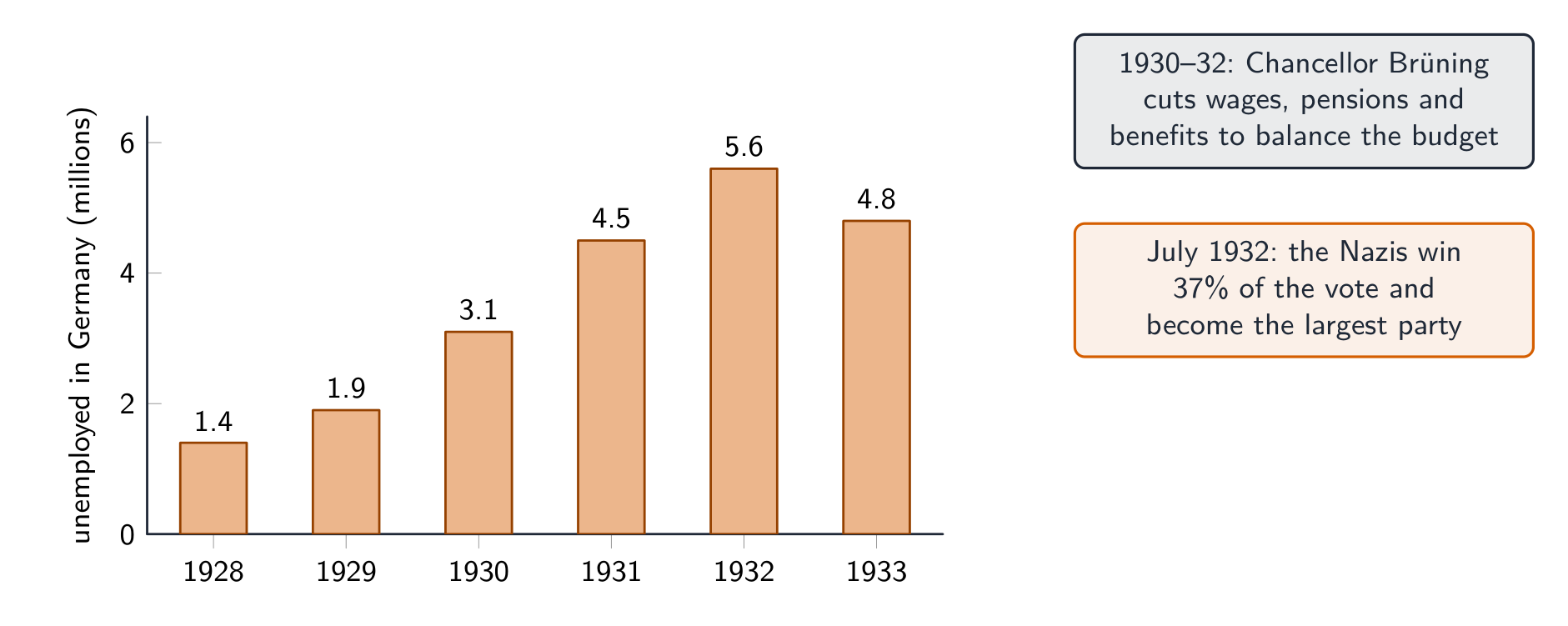
- Most governments believed budgets must balance, so in a slump they cut spending and raised taxes. In Germany, Chancellor Brüning cut wages, pensions and benefits in 1930–32.
- This austerity 紧缩政策 reduced demand further, and unemployment rose.
What did orthodox economics tell governments to do in the slump?
Dificultad 1/5 · 100 monedas + un pequeño bono en el primer intento de hoy
Austerity.
Worked example: the Depression and the Nazis
- Unemployment: about 6 million Germans — roughly a third of the workforce — were unemployed by early 1932.
- Votes: the Nazi share of the vote rose from 2.6% in 1928 to 18.3% in 1930 and 37.3% in July 1932. The Communists grew too.
- Link: voters who had lost jobs and savings turned from the democratic parties that seemed to offer only cuts. In January 1933 Hitler became chancellor.
Follow the Depression into radical politics
The conditions are the environment; the claim is that the existing order had already failed twice.
The Nazi vote rose from 2.6% in 1928 to 37.3% in July 1932. By how many percentage points did it rise?
Dificultad 2/5 · 140 monedas + un pequeño bono en el primer intento de hoy
37.3 − 2.6.
A new theory
- John Maynard Keynes's General Theory (1936) argued that in a slump, governments should spend more and borrow, to replace missing demand.
- Keynesian economics 凯恩斯主义经济学 shaped European policy after 1945.
Keynes argued that governments should spend and borrow more in a slump.
Dificultad 1/5 · 100 monedas + un pequeño bono en el primer intento de hoy
The General Theory, 1936.
Other responses
- Sweden's Social Democrats used public works and welfare to fight unemployment from 1932.
- France's Popular Front (1936) under Léon Blum introduced a 40-hour week and paid holidays; Italy and Germany expanded state control and rearmament.
Match each country to its response.
Dificultad 2/5 · 140 monedas + un pequeño bono en el primer intento de hoy
Different responses.
The Depression did not destroy democracy everywhere. Britain, France, Sweden and the Netherlands remained democracies. It undermined democracy where it was already weak, as in Germany and Austria.
The Great Depression ended democracy in every European country.
Dificultad 1/5 · 100 monedas + un pequeño bono en el primer intento de hoy
Britain, France and Sweden stayed democratic.
The American crash and the recall of loans spread depression across Europe. Orthodox austerity deepened it, and mass unemployment helped fascists and communists, above all the Nazis in Germany. Keynes offered a new answer, and countries such as Sweden and France tried different responses.
Explain how the Great Depression helped the Nazis come to power.
Causation.