Recognizing Methods of Development
Introducido| English | Significado |
|---|---|
| narration/nəˈreɪʃn/ | narración |
| cause-effect/kɔːz ɪˈfekt/ | causa-efecto |
| methods of development/ˈmeθədz ɒv dɪˈveləpmənt/ | common approaches for organising reasoning, such as narration, cause-effect and comparison |
"The Whistle", 1779
- In a letter of 1779, Benjamin Franklin told a childhood story. At seven, he gave all the coins in his pocket for a whistle he heard another boy blowing. His family told him he had paid four times its worth, and he cried with vexation.
- He then reflected: all his life, he saw people who "paid too much for their whistle" — giving up health, liberty or friends for things not worth the price. The story became an argument through narration 叙述 and reflection. Narration, cause-effect 因果 and comparison are methods of development 展开方法.
What lesson does Franklin draw from the whistle?
Dificultad 1/5 · 100 monedas + un pequeño bono en el primer intento de hoy
The reflection makes it an argument.
Narration
- Narration gives details of a real experience and the writer's reflection on it.
- The reflection makes it an argument rather than a story.
Narration becomes argument through the writer's reflection.
Dificultad 1/5 · 100 monedas + un pequeño bono en el primer intento de hoy
Otherwise it is only a story.
Why choose a story
- An anecdote is a close-up: it makes an abstract claim concrete and memorable, and builds a personal voice.
- A statistic is a wide shot; choose the one the audience needs.
Narration, cause-effect, or neither?
Sort each paragraph move by the method it uses.
What can an anecdote do in an argument?
Dificultad 2/5 · 140 monedas + un pequeño bono en el primer intento de hoy
Statistics show scale.
Worked example: Franklin's whistle
- Story: a child overpays for a toy and is mocked — trivial, comic, familiar to every reader.
- Reflection: the whistle becomes a measure for adult choices: the courtier who sacrifices his time and virtue for favour; the miser who gives up all comfort for wealth.
- Effect: "Franklin's small story makes a moral claim feel like common experience: by laughing at his younger self, the reader accepts a test — what did this cost? — to apply to their own life."
What test does Franklin give the reader?
Dificultad 1/5 · 100 monedas + un pequeño bono en el primer intento de hoy
The whistle measures adult choices.
Cause-effect
- Cause-effect develops reasoning by tracing why something happens or what it leads to.
- Mary Wollstonecraft's A Vindication of the Rights of Woman (1792) argues that women's apparent weakness is an effect of their education, not of their nature.
What causal argument does Wollstonecraft make?
Dificultad 1/5 · 100 monedas + un pequeño bono en el primer intento de hoy
Cause-effect traces why.
Testing a causal chain
- Each link must be supported: does A really cause B, or do they just appear together?
- Strong writers address other possible causes.
Two things appearing together always proves one caused the other.
Dificultad 1/5 · 100 monedas + un pequeño bono en el primer intento de hoy
Test each link.
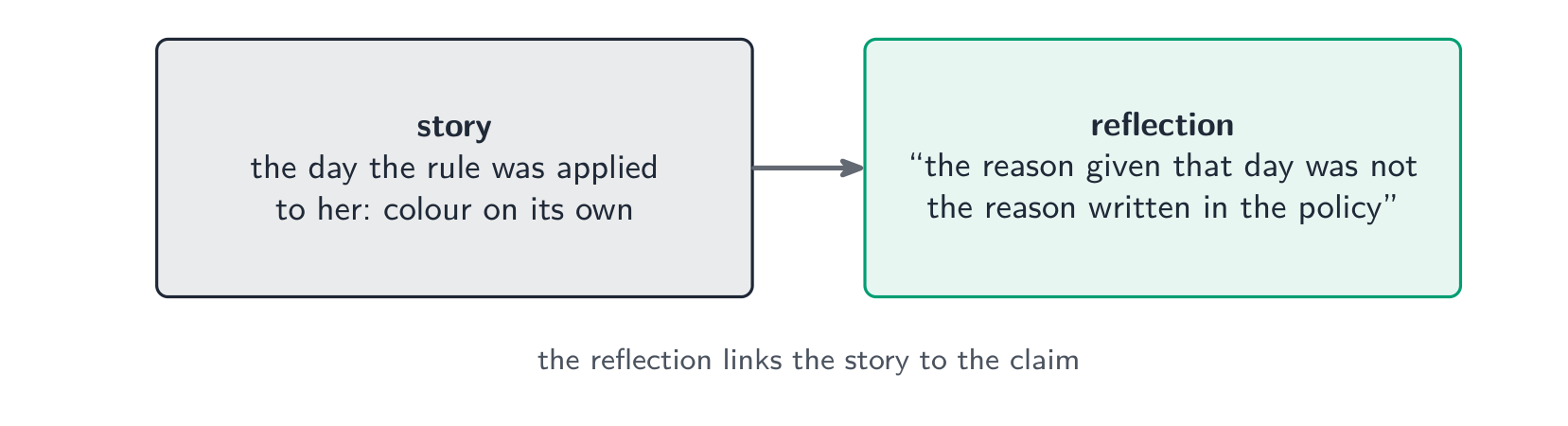
Narration without reflection is not an argument. A vivid story that never returns to a claim supplies colour, not reasoning.
A vivid story with no return to a claim is still a strong argument.
Dificultad 1/5 · 100 monedas + un pequeño bono en el primer intento de hoy
It supplies colour, not reasoning.
Methods of development shape reasoning. Narration gives an experience plus reflection; cause-effect traces why and what follows. Ask why the writer chose this method for this audience and test every causal link.
Write a short anecdote and a reflection that turns it into an argument.
Story, reflection, claim.