Defining Limits and Using Limit Notation · Definiendo Límites y Usando la Notación de Límite
| English | Español |
|---|---|
| limit/ˈlɪmɪt/ | límite |
| approaches/əˈprəʊtʃɪz/ | aproximaciones |
| one-sided limit/wʌn ˈsaɪdɪd ˈlɪmɪt/ | límite unilateral |
| left-hand/left hænd/ | por la izquierda |
| right-hand/raɪt hænd/ | por la derecha |
| two-sided limit/tuː ˈsaɪdɪd ˈlɪmɪt/ | límite bilateral |
Where is the graph heading?
- Forget the single point for a moment — ask where the curve is heading as you slide $x$ toward a value.
- Follow $f(x)=\dfrac{x^2-1}{x-1}$ as $x$ gets close to $1$. Plug in $x=1$ and you get $\tfrac{0}{0}$ — undefined.
- Yet the outputs march steadily toward $2$: $f(0.9)=1.9$, $f(0.99)=1.99$, $f(1.01)=2.01$.
- The function has a hole at $x=1$, but it is clearly aiming at $2$. That target value is the limit 极限.
¿Hacia dónde se dirige la gráfica?
- Olvida el punto único por un momento — pregúntate hacia dónde se dirige la curva mientras deslizas $x$ hacia un valor.
- Sigue a $f(x)=\dfrac{x^2-1}{x-1}$ conforme $x$ se acerca a $1$. Si sustituyes $x=1$, obtienes $\tfrac{0}{0}$ — indefinido.
- Sin embargo, las salidas avanzan de manera constante hacia $2$: $f(0.9)=1.9$, $f(0.99)=1.99$, $f(1.01)=2.01$.
- La función tiene un agujero en $x=1$, pero claramente está apuntando a $2$. Ese valor objetivo es el límite 极限.
Watch where the curve heads · Observa hacia dónde se dirige la curva
y = ax² + bx + c
Drag the coefficients and pick an input $c$ in your mind — the limit is the height the curve approaches near $c$, not the point itself. · Arrastra los coeficientes y elige una entrada $c$ en tu mente — el límite es la altura a la que la curva se aproxima cerca de $c$, no el punto mismo.
Writing it down: limit notation
- We write $\displaystyle\lim_{x \to c} f(x) = L$ and read it "the limit of $f$ of $x$, as $x$ approaches 趋近 $c$, equals $L$."
- $c$ is the input we creep toward; $L$ is the output the function heads for.
- Crucially, $x \to c$ means "gets close to $c$" — never "equals $c$." We stay off the point itself.
- For our example: $\displaystyle\lim_{x \to 1}\dfrac{x^2-1}{x-1} = 2$, even though $f(1)$ does not exist.
Escribiéndolo: notación de límite
- Escribimos $\displaystyle\lim_{x \to c} f(x) = L$ y lo leemos "el límite de $f$ de $x$, cuando $x$ se acerca 趋近 $c$, es igual a $L$."
- $c$ es la entrada a la que nos acercamos; $L$ es la salida hacia la que se dirige la función.
- Crucialmente, $x \to c$ significa "se acerca a $c$" — nunca "es igual a $c$". Nos mantenemos fuera del propio punto.
- Para nuestro ejemplo: $\displaystyle\lim_{x \to 1}\dfrac{x^2-1}{x-1} = 2$, aunque $f(1)$ no existe.
The notation $\lim_{x \to c} f(x) = L$ means that as $x$... · La notación $\lim_{x \to c} f(x) = L$ significa que cuando $x$...
$x \to c$ means $x$ approaches $c$ without touching it, and $f(x)$ heads toward $L$. · $x \to c$ significa que $x$ se aproxima a $c$ sin tocarlo, y $f(x)$ se dirige hacia $L$.
Evaluate · Evaluación $\displaystyle\lim_{x \to 3}\dfrac{x^2-9}{x-3}$. · Evalúa $\displaystyle\lim_{x \to 3}\dfrac{x^2-9}{x-3}$.
Factor: $\frac{(x-3)(x+3)}{x-3}=x+3$ for $x\neq3$, which heads to $3+3=6$. · Factoriza: $\frac{(x-3)(x+3)}{x-3}=x+3$ para $x\neq3$, lo cual se dirige a $3+3=6$.
Coming from the left and the right
- You can approach $c$ from two directions, and each has its own one-sided limit 单侧极限.
- From below ($x$ slightly less than $c$): the left-hand 左侧 limit, $\displaystyle\lim_{x \to c^-} f(x)$.
- From above ($x$ slightly more than $c$): the right-hand 右侧 limit, $\displaystyle\lim_{x \to c^+} f(x)$.
- The small $-$ and $+$ signs sit up high on $c$ to show the direction of travel.
Llegando desde la izquierda y desde la derecha
- Puedes acercarte a $c$ desde dos direcciones, y cada una tiene su propio límite lateral 单侧极限.
- Desde abajo ($x$ ligeramente menor que $c$): el límite lateral izquierdo 左侧, $\displaystyle\lim_{x \to c^-} f(x)$.
- Desde arriba ($x$ ligeramente mayor que $c$): el límite lateral derecho 右侧, $\displaystyle\lim_{x \to c^+} f(x)$.
- Los pequeños signos $-$ y $+$ se sitúan en la parte superior de $c$ para indicar la dirección del recorrido.
Which expression is the right-hand limit of $f$ at $c$? · ¿Cuál expresión es el límite lateral derecho de $f$ en $c$?
The · El $+$ superscript on $c$ means $x$ approaches from above — the right-hand side. · El superíndice $+$ en $c$ significa que $x$ se aproxima desde arriba — el lado derecho.
The two sides must agree
- The ordinary two-sided limit 双侧极限 $\displaystyle\lim_{x \to c} f(x)$ exists only when both one-sided limits exist and are equal.
-
$$\lim_{x \to c^-} f(x) = \lim_{x \to c^+} f(x) = L \iff \lim_{x \to c} f(x) = L$$
- If the left side heads for one value and the right side for another, the two-sided limit does not exist (DNE).
Ambos lados deben estar de acuerdo
- El límite bidireccional 双侧 ordinario $\displaystyle\lim_{x \to c} f(x)$ existe solo si ambos límites laterales existen y son iguales.
-
$$\lim_{x \to c^-} f(x) = \lim_{x \to c^+} f(x) = L \iff \lim_{x \to c} f(x) = L$$
- Si el lado izquierdo se dirige hacia un valor y el lado derecho hacia otro, el límite bidireccional no existe (DNE).
A two-sided limit at $c$ exists only when the left-hand and right-hand limits are both present and ____. · Un límite bilateral en $c$ existe solo cuando los límites laterales izquierdo y derecho están ambos presentes y ____.
The two one-sided limits must agree on a single value $L$. · Los dos límites laterales deben coincidir en un único valor $L$.
Select all · todos situations in which $\lim_{x\to c} f(x)$ does · hace not · no exist. · Selecciona todas las situaciones en las que $\lim_{x\to c} f(x)$ no existe.
A limit fails when the sides disagree, the value is unbounded, or it oscillates. A mismatch with $f(c)$ alone does not · no kill the limit — it only breaks continuity. · Un límite falla cuando los lados no coinciden, el valor es ilimitado o oscila. Una discrepancia con $f(c)$ sola no elimina el límite — solo rompe la continuidad.
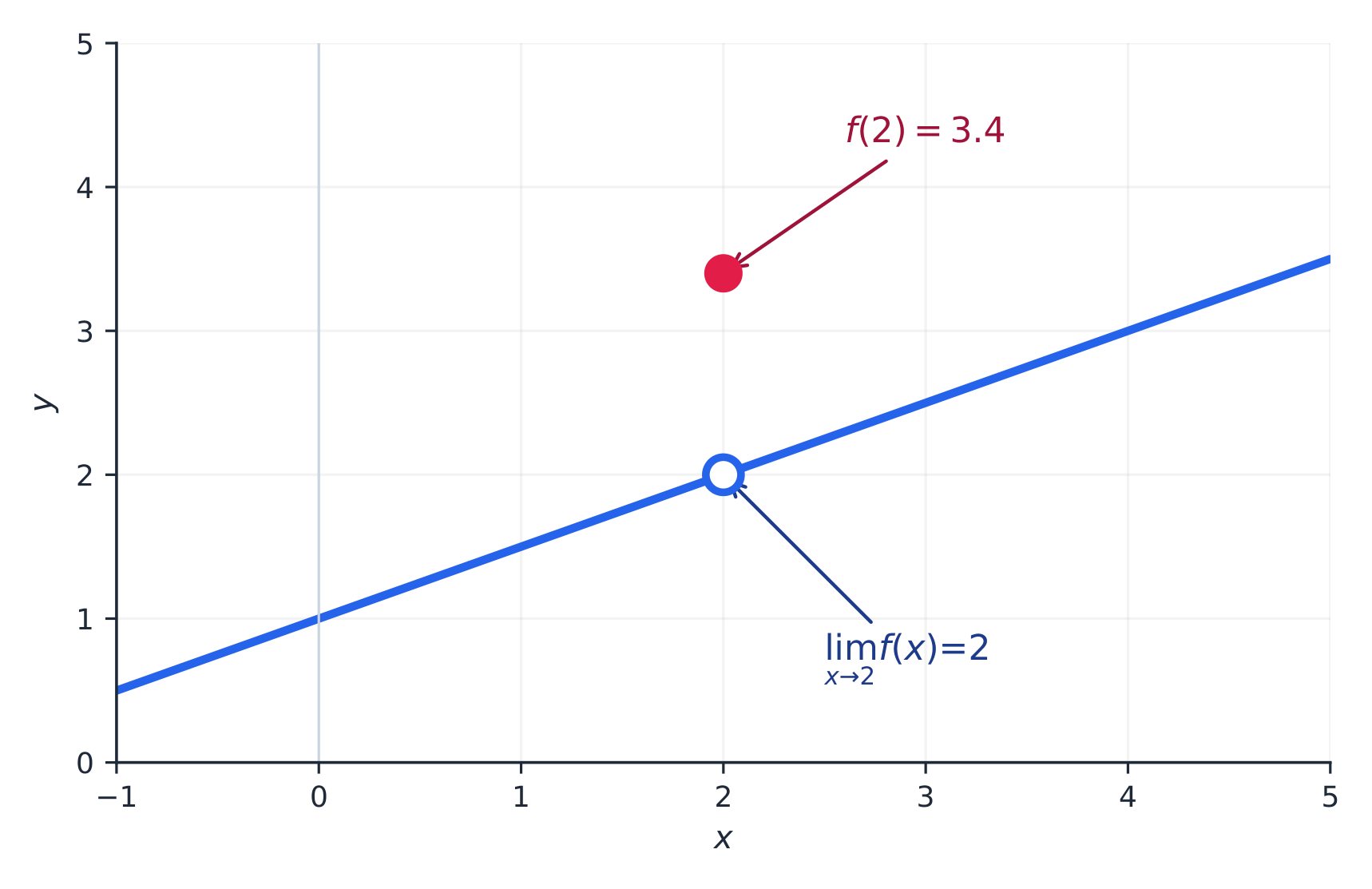
The limit is about the journey, not the destination point. $\lim_{x \to c} f(x)$ can exist even when $f(c)$ is undefined, and it can differ from $f(c)$ when the point is plotted somewhere off the curve. Never assume $\lim_{x\to c} f(x)=f(c)$ — that is a special case (continuity), not a rule.
El límite trata sobre el recorrido, no el punto de destino. $\lim_{x \to c} f(x)$ puede existir incluso cuando $f(c)$ está indefinido, y puede diferir de $f(c)$ cuando el punto está graficado en algún lugar fuera de la curva. Nunca asumas que $\lim_{x\to c} f(x)=f(c)$ — eso es un caso especial (continuidad), no una regla.
If $f(c)$ is undefined, then $\lim_{x \to c} f(x)$ cannot exist. · Si $f(c)$ no está definido, entonces $\lim_{x \to c} f(x)$ no puede existir.
The limit is about the approach, not the point. $\lim_{x\to 1}\frac{x^2-1}{x-1}=2$ even though $f(1)$ is undefined. · El límite trata sobre la aproximación, no sobre el punto. $\lim_{x\to 1}\frac{x^2-1}{x-1}=2$ aunque $f(1)$ no esté definido.
For a piecewise function, $\displaystyle\lim_{x\to 2^-} f(x) = 3$ and $\displaystyle\lim_{x\to 2^+} f(x) = 5$.
- The left side heads for $3$; the right side heads for $5$.
- They disagree, so $\displaystyle\lim_{x \to 2} f(x)$ does not exist — the graph jumps at $x=2$.
- This is true no matter what value (if any) is plotted at $x=2$.
Para una función a trozos, $\displaystyle\lim_{x\to 2^-} f(x) = 3$ y $\displaystyle\lim_{x\to 2^+} f(x) = 5$.
- El lado izquierdo se dirige hacia $3$; el lado derecho se dirige hacia $5$.
- No están de acuerdo, por lo que $\displaystyle\lim_{x \to 2} f(x)$ no existe — la gráfica salta en $x=2$.
- Esto es cierto sin importar qué valor (si alguno) se grafique en $x=2$.
$\displaystyle\lim_{x\to c} f(x)=L$ says $f(x)$ heads toward $L$ as $x$ nears $c$ from both sides — without ever touching $c$. The two-sided limit exists iff the left-hand and right-hand limits both exist and are equal. The limit describes where the function is going, which need not equal $f(c)$.
$\displaystyle\lim_{x\to c} f(x)=L$ indica que $f(x)$ se dirige hacia $L$ conforme $x$ se acerca a $c$ desde ambos lados — sin tocar nunca $c$. El límite bidireccional existe si y solo si los límites laterales izquierdo y derecho existen y son iguales. El límite describe hacia dónde se está yendo la función, lo cual no necesariamente es igual a $f(c)$.