Hubble's law and the Big Bang · La ley de Hubble y el Big Bang
| English | Español |
|---|---|
| redshift/ˈredʃɪft/ | corrimiento al rojo |
| Hubble's law/ˈhʌblz lɔː/ | Ley de Hubble |
| Big Bang/bɪɡ bæŋ/ | Big Bang |
| Doppler effect/ˈdɒplə ɪˈfekt/ | Efecto Doppler |
| recession/rɪˈseʃn/ | recesión |
| blueshifted/ˈbluːʃɪftɪd/ | corrimiento hacia el azul |
| Hubble constant/ˈhʌbl ˈkɒnstənt/ | constante de Hubble |
| cosmic microwave background/ˈkɒzmɪk ˈmaɪkrəʊweɪv ˈbækɡraʊnd/ | radiación cósmica de fondo de microondas |
The fingerprint is right, but stretched
- Hydrogen in a laboratory always emits a line at $656.3\ \text{nm}$. In the light of a distant galaxy the same line arrives at $660.9\ \text{nm}$.
- The pattern of lines is unmistakably hydrogen. Every line has simply moved to a longer wavelength, by the same fraction.
- Something has stretched the light on its way here, and doing that arithmetic on galaxy after galaxy produced the largest conclusion in physics.
- This lesson is redshift 红移, Hubble's law 哈勃定律, and how they lead to the Big Bang 大爆炸.
La huella dactilar es correcta, pero estirada
- El hidrógeno en un laboratorio siempre emite una línea en $656.3\ \text{nm}$. En la luz de una galaxia distante, esa misma línea llega a $660.9\ \text{nm}$.
- El patrón de líneas es inconfundiblemente de hidrógeno. Cada línea se ha movido simplemente a una longitud de onda más larga, en la misma fracción.
- Algo ha estirado la luz en su camino hacia aquí, y al realizar esos cálculos galaxia tras galaxia se produjo la conclusión más grande en física.
- Esta lección trata sobre el corrimiento al rojo 红移, la ley de Hubble 哈勃定律, y cómo conducen al Big Bang 大爆炸.
Redshift
- The observed wavelength of the radiation from a source is longer than the wavelength emitted, because the source is moving away from the observer.
- It is the Doppler effect 多普勒效应 for light. For $v \ll c$:
- $\Delta\lambda = \lambda_{\text{observed}} - \lambda_{\text{emitted}}$, and $v$ is the speed of recession 退行.
- Divide by the emitted, laboratory wavelength, not the observed one. At small $v/c$ the difference is slight, but the mark scheme is specific.
The same pattern, slid to the right
Corrimiento al rojo
- La longitud de onda observada de la radiación procedente de una fuente es más larga que la longitud de onda emitida, porque la fuente se está alejando del observador.
- Es el efecto Doppler 多普勒效应 para la luz. Para $v \ll c$:
- $\Delta\lambda = \lambda_{\text{observed}} - \lambda_{\text{emitted}}$, y $v$ es la velocidad de recesión 退行.
- Divida por la longitud de onda emitida, de laboratorio, no por la observada. A pequeñas $v/c$ la diferencia es leve, pero el esquema de corrección es específico.

El mismo patrón, desplazado hacia la derecha
Redshift means a galaxy's spectral lines are shifted to: · El corrimiento al rojo significa que las líneas espectrales de una galaxia se desplazan hacia:
A receding source stretches the wavelengths — a redshift, with $\dfrac{\Delta\lambda}{\lambda} \approx \dfrac{v}{c}$. · Una fuente en recesión estira las longitudes de onda: un corrimiento al rojo, con $\dfrac{\Delta\lambda}{\lambda} \approx \dfrac{v}{c}$.
In $\Delta\lambda/\lambda \approx v/c$, the $\lambda$ on the bottom is the observed wavelength. · En $\Delta\lambda/\lambda \approx v/c$, la $\lambda$ en el denominador es la longitud de onda observada.
It is the EMITTED, laboratory wavelength. At small v/c the difference is slight, but the mark scheme is specific about it. · Es la longitud de onda emitida en el laboratorio. A pequeñas v/c la diferencia es leve, pero el esquema de corrección es específico al respecto.
Worked example: how fast, and how far
- A hydrogen line at $656.3\ \text{nm}$ in the laboratory is observed at $660.9\ \text{nm}$. Find the recession speed and, with $H_0 = 2.3\times10^{-18}\ \text{s}^{-1}$, the distance.
- $\Delta\lambda = 660.9 - 656.3 = 4.6\ \text{nm}$.
- $v = c\dfrac{\Delta\lambda}{\lambda} = (3.00\times10^{8})\dfrac{4.6}{656.3} = 2.1\times10^{6}\ \text{m/s}$.
- $d = \dfrac{v}{H_0} = \dfrac{2.1\times10^{6}}{2.3\times10^{-18}} = 9.1\times10^{23}\ \text{m}$, about $100$ million light years.
- The nanometres cancel inside the ratio, so there is no need to convert them, as long as both wavelengths are in the same unit.
Ejercicio resuelto: qué tan rápido y a qué distancia
- Una línea de hidrógeno a $656.3\ \text{nm}$ en el laboratorio se observa en $660.9\ \text{nm}$. Calcule la velocidad de recesión y, con $H_0 = 2.3\times10^{-18}\ \text{s}^{-1}$, la distancia.
- $\Delta\lambda = 660.9 - 656.3 = 4.6\ \text{nm}$.
- $v = c\dfrac{\Delta\lambda}{\lambda} = (3.00\times10^{8})\dfrac{4.6}{656.3} = 2.1\times10^{6}\ \text{m/s}$.
- $d = \dfrac{v}{H_0} = \dfrac{2.1\times10^{6}}{2.3\times10^{-18}} = 9.1\times10^{23}\ \text{m}$, aproximadamente $100$ millones de años luz.
- Los nanómetros se cancelan dentro de la proporción, por lo que no es necesario convertirlos, siempre que ambas longitudes de onda estén en la misma unidad.
A galaxy's lines show $\dfrac{\Delta\lambda}{\lambda} = 0.020$. What is its recession speed, as a fraction of $c$? · Las líneas de una galaxia muestran $\dfrac{\Delta\lambda}{\lambda} = 0.020$. ¿Cuál es su velocidad de recesión como fracción de $c$?
For · A favor $v \ll c$, $\dfrac{v}{c} = \dfrac{\Delta\lambda}{\lambda} = 0.020$. · Para $v \ll c$, $\dfrac{v}{c} = \dfrac{\Delta\lambda}{\lambda} = 0.020$.
Worked example: the other way round
- A galaxy recedes at $21400\ \text{km/s}$. At what wavelength is its $656.3\ \text{nm}$ hydrogen line seen?
- $\Delta\lambda = \lambda\dfrac{v}{c} = 656.3 \times \dfrac{2.14\times10^{7}}{3.00\times10^{8}} = 46.8\ \text{nm}$.
- So the line appears at $656.3 + 46.8 = 703\ \text{nm}$, moved out of the red and almost into the infrared.
- Every line and the continuous spectrum are stretched by the same factor $(1 + v/c) = 1.071$. Redshift moves the whole spectrum, not one line.
- Convert $\text{km/s}$ to $\text{m/s}$ first. A factor of $1000$ here is a very visible wrong answer.
Ejercicio resuelto: al revés
- Una galaxia se aleja a $21400\ \text{km/s}$. ¿A qué longitud de onda se ve su línea de $656.3\ \text{nm}$ del hidrógeno?
- $\Delta\lambda = \lambda\dfrac{v}{c} = 656.3 \times \dfrac{2.14\times10^{7}}{3.00\times10^{8}} = 46.8\ \text{nm}$.
- Por lo tanto, la línea aparece en $656.3 + 46.8 = 703\ \text{nm}$, desplazada fuera del rojo y casi hacia el infrarrojo.
- Todas las líneas y el espectro continuo se estiran por el mismo factor $(1 + v/c) = 1.071$. El corrimiento al rojo desplaza todo el espectro, no solo una línea.
- Convierta $\text{km/s}$ a $\text{m/s}$ primero. Un factor de $1000$ aquí sería una respuesta incorrecta muy visible.
A galaxy recedes at 21400 km/s. At what wavelength is its 656.3 nm hydrogen line observed, in nm? · Una galaxia se aleja a 21400 km/s. ¿A qué longitud de onda se observa su línea de hidrógeno de 656.3 nm, en nm?
delta lambda = lambda v/c = 46.8 nm, so the line appears at 703 nm. Convert km/s to m/s first; a factor of 1000 here is a very visible wrong answer. · delta lambda = lambda v/c = 46.8 nm, por lo que la línea aparece a 703 nm. Convierta primero km/s a m/s; un factor de 1000 aquí es una respuesta incorrecta muy visible.
Why this means the Universe is expanding
- The three-mark argument runs: (1) the spectral lines from almost all distant galaxies are shifted to longer wavelengths; (2) so by the Doppler effect those galaxies are moving away from us; (3) and the further away a galaxy is, the greater its redshift and so its speed.
- The third point is what makes it cosmological rather than local. That pattern is what an observer in any galaxy would see if the space between all galaxies were stretching.
- So the Universe as a whole is expanding, rather than everything fleeing from the Earth in particular.
- A few nearby galaxies are blueshifted 蓝移 by their own local motion, which is consistent: the expansion shows in the average over large distances.
Por qué esto significa que el Universo se está expandiendo
- El argumento de tres puntos funciona así: (1) las líneas espectrales de casi todas las galaxias distantes están desplazadas a longitudes de onda más largas; (2) entonces, por el efecto Doppler, esas galaxias se están alejando de nosotros; (3) y cuanto más lejos está una galaxia, mayor es su corrimiento al rojo y, por tanto, su velocidad.
- El tercer punto es lo que lo hace cosmológico en lugar de local. Ese patrón es lo que vería un observador en cualquier galaxia si el espacio entre todas las galaxias estuviera estirándose.
- Por lo tanto, el Universo en su conjunto se está expandiendo, en lugar de que todo huya específicamente de la Tierra.
- Algunas galaxias cercanas están corridas al azul 蓝移 debido a su propio movimiento local, lo cual es consistente: la expansión se muestra en el promedio a grandes distancias.
Almost all distant galaxies are redshifted, which shows the Universe is expanding. · Casi todas las galaxias distantes están correlacionadas al rojo, lo que muestra que el Universo se está expandiendo.
They are moving apart on average — the space between them is stretching. · Se están separando en promedio: el espacio entre ellas se está estirando.
Put the three-mark argument that the Universe is expanding in order. · Ordene el argumento de tres puntos sobre la expansión del Universo.
The third point is what makes it cosmological. Without it you have only shown that things are moving away from the Earth in particular. · El tercer punto es lo que lo hace cosmológico. Sin él, solo habrías demostrado que las cosas se alejan de la Tierra en particular.
The trap with Wien's law
- If you feed the observed peak wavelength of a receding galaxy straight into Wien's law, the temperature comes out too low, because the observed peak is longer than the emitted one.
- Correct it first: $\lambda_{\text{emitted}} = \lambda_{\text{observed}}/(1 + v/c)$, then use Wien's law on the emitted peak.
- In the standard exam version, emitted $4.62\times10^{-7}\ \text{m}$ and observed $4.91\times10^{-7}\ \text{m}$ give $T = 6300\ \text{K}$ from the emitted peak. Using the observed one gives $5900\ \text{K}$: too low by $400\ \text{K}$.
- Asked to sketch the observed spectrum against the emitted one, draw the same shape shifted to longer wavelengths, peak included.
The whole curve slides, so the peak lies
La trampa con la ley de Wien
- Si introduces la longitud de onda del pico observada de una galaxia que se aleja directamente en la ley de Wien, la temperatura resulta demasiado baja, porque el pico observado es más largo que el emitido.
- Corrígela primero: $\lambda_{\text{emitted}} = \lambda_{\text{observed}}/(1 + v/c)$, luego usa la ley de Wien sobre el pico emitido.
- En la versión estándar del examen, el pico emitido $4.62\times10^{-7}\ \text{m}$ y el observado $4.91\times10^{-7}\ \text{m}$ dan lugar a $T = 6300\ \text{K}$ a partir del pico emitido. Usar el observado da como resultado $5900\ \text{K}$: demasiado bajo por $400\ \text{K}$.
- Se te pide dibujar el espectro observado frente al emitido; dibuja la misma forma desplazada hacia longitudes de onda mayores, incluido el pico.
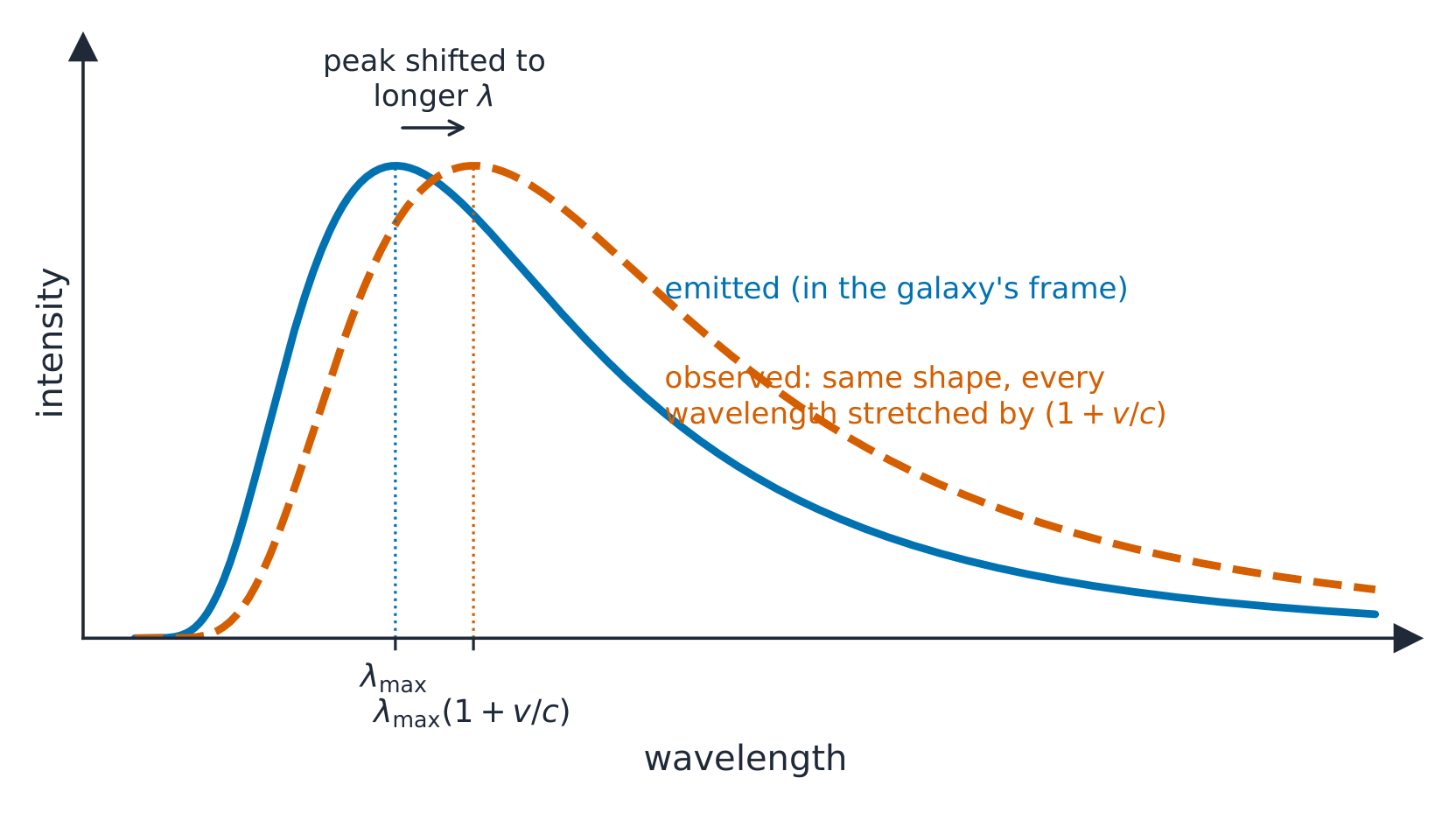
La curva completa se desplaza, por lo que el pico queda
Hubble's law · Ley de Hubble
v = H₀·d
Recession speed is proportional to distance — the gradient is Hubble's constant. · La velocidad de recesión es proporcional a la distancia —la pendiente es la constante de Hubble.
Using the observed peak wavelength of a receding galaxy in Wien's law gives a temperature that is: · Usar la longitud de onda del pico observada en una galaxia en recesión mediante la ley de Wien da una temperatura que es:
Correct the peak first with lambda_emitted = lambda_observed/(1 + v/c). In the standard version this is the difference between 6300 K and 5900 K. · Corrija primero el pico usando lambda_emitted = lambda_observed/(1 + v/c). En la versión estándar, esta es la diferencia entre 6300 K y 5900 K.
Hubble's law
- The speed of recession of a galaxy is directly proportional to its distance from the observer:
- $v$ is the recession speed, $d$ the distance, and $H_0$ the Hubble constant 哈勃常数, about $2.3\times10^{-18}\ \text{s}^{-1}$.
- Identify every symbol when asked. The exam quotes $H_0$ in SI units, so $v$ must be in $\text{m/s}$ and $d$ in metres, never kilometres per second per megaparsec.
- On a graph of $v$ against $d$ the data lie on a straight line through the origin of gradient $H_0$.
Further means faster, in proportion
Ley de Hubble
- La velocidad de recesión de una galaxia es directamente proporcional a su distancia respecto al observador:
- $v$ es la velocidad de recesión, $d$ la distancia, y $H_0$ la constante de Hubble, aproximadamente $2.3\times10^{-18}\ \text{s}^{-1}$.
- Identifica cada símbolo cuando se te pida. El examen cita $H_0$ en unidades del SI, por lo que $v$ debe estar en $\text{m/s}$ y $d$ en metros, nunca en kilómetros por segundo por megapársec.
- En un gráfico de $v$ frente a $d$, los datos se alinean en una línea recta que pasa por el origen con una pendiente de $H_0$.

Further means faster, in proportion
Hubble's law: recession speed $= H_0 \times$ ____. · Ley de Hubble: velocidad de recesión $= H_0 \times$ ____.
$v = H_0 d$ — speed grows in proportion to distance. · $v = H_0 d$ — la velocidad crece proporcionalmente a la distancia.
Galaxy B is 3 times as far away as galaxy A. By Hubble's law, B recedes how many times as fast? · La galaxia B está 3 veces más lejos que la galaxia A. Según la ley de Hubble, ¿a cuántas veces la velocidad se aleja B?
$v \propto d$, so 3 times the distance means 3 times the recession speed. · $v \propto d$, por lo que 3 veces la distancia implica 3 veces la velocidad de recesión.
Which are required when using $v = H_0 d$ with $H_0$ in per second? Select all · todos that apply. · ¿Cuáles son requeridas al usar $v = H_0 d$ con $H_0$ en por segundo? Seleccione todas las que correspondan.
The exam quotes H0 in SI units, so everything must be SI. Kilometres per second per megaparsec belongs to the astronomy literature, not to this paper. · El examen cita H0 en unidades SI, por lo que todo debe estar en SI. Kilómetros por segundo por megaparsec pertenece a la literatura astronómica, no a este examen.
From Hubble's law to the Big Bang
- If speed is proportional to distance, then running the expansion backwards brings every galaxy together at the same moment.
- All distances shrink to zero at $t = -1/H_0$: the Universe was once a tiny, enormously dense, hot point. That is the Big Bang.
- For steady expansion the age of the Universe is
- The main evidence, worth listing: the expansion itself, the redshift of galaxies, the cosmic microwave background 宇宙微波背景, and the observed hydrogen and helium abundances.
De la ley de Hubble al Big Bang
- Si la velocidad es proporcional a la distancia, entonces invertir la expansión hacia atrás hace que todas las galaxias se junten en el mismo instante.
- Todas las distancias se reducen a cero en $t = -1/H_0$: el Universo fue en algún momento un punto diminuto, enormemente denso y caliente. Ese es el Big Bang.
- Para una expansión constante, la edad del Universo es
- La principal evidencia, que vale la pena enumerar: la propia expansión, el corrimiento al rojo de las galaxias, el fondo cósmico de microondas y las abundancias observadas de hidrógeno y helio.
The approximate age of the Universe is: · La edad aproximada del Universo es:
Running the expansion back at a steady rate, all distances reach zero after a time $\dfrac{1}{H_0} \approx 14$ billion years. · Rebotando la expansión a una tasa constante, todas las distancias llegan a cero después de un tiempo $\dfrac{1}{H_0} \approx 14$ mil millones de años.
Which are evidence for the Big Bang? Select all · todos that apply. · ¿Cuáles son evidencias para el Big Bang? Seleccione todas las que correspondan.
Standard candles are a measuring tool, not evidence. 1/H0 is an ESTIMATE of the age assuming a steady rate of expansion, and the assumption should be stated. · Las velas estándar son una herramienta de medición, no evidencia. 1/H0 es una ESTIMACIÓN de la edad asumiendo una tasa de expansión constante, y la suposición debería enunciarse.
Marks that slip away
- Divide $\Delta\lambda$ by the emitted wavelength, and put $v$ in $\text{m/s}$ and $d$ in metres for $H_0$ in $\text{s}^{-1}$.
- The expansion argument needs the third point: further galaxies recede faster. Without it you have only shown things are moving away from us.
- Correct a receding galaxy's peak wavelength before using Wien's law.
- Space itself is stretching. The galaxies are not flying through space away from a centre, and the Earth is not at one.
- $1/H_0$ is an estimate of the age assuming a steady rate of expansion. Say the assumption.
Puntos que se pierden fácilmente
- Divide $\Delta\lambda$ por la longitud de onda emitida, y coloca $v$ en $\text{m/s}$ y $d$ en metros para $H_0$ en $\text{s}^{-1}$.
- El argumento de expansión requiere el tercer punto: las galaxias más distantes se alejan más rápido. Sin esto, solo has demostrado que las cosas se alejan de nosotros.
- Corrige la longitud de onda pico de una galaxia recedente antes de usar la ley de Wien.
- El propio espacio se está estirando. Las galaxias no se desplazan a través del espacio alejándose de un centro, y la Tierra no está en uno.
- $1/H_0$ es una estimación de la edad asumiendo una tasa de expansión constante. Plantea el supuesto.
You've got it
- redshift is an observed wavelength longer than the emitted one, with $\Delta\lambda/\lambda \approx \Delta f/f \approx v/c$ for a receding source
- almost every distant galaxy is redshifted and the further ones more, which is what an observer in any galaxy would see if space were expanding
- Hubble's law is $v \approx H_0 d$ in SI units, a straight line through the origin of gradient $H_0$
- running the expansion backwards gives the Big Bang and an age of about $1/H_0 \approx 4.3\times10^{17}\ \text{s}$, supported also by the cosmic microwave background
Lo has entendido
- El corrimiento al rojo es una longitud de onda observada más larga que la emitida, con $\Delta\lambda/\lambda \approx \Delta f/f \approx v/c$ para una fuente que se aleja
- casi todas las galaxias lejanas muestran corrimiento al rojo y las más lejanas lo hacen en mayor medida, lo cual es lo que vería un observador en cualquier galaxia si el espacio estuviera expandiéndose
- La ley de Hubble es $v \approx H_0 d$ en unidades SI, una línea recta que pasa por el origen con pendiente $H_0$
- llevar la expansión hacia atrás da lugar al Big Bang y a una edad de aproximadamente $1/H_0 \approx 4.3\times10^{17}\ \text{s}$, respaldado también por la radiación cósmica de fondo de microondas