Mass defect and nuclear binding energy · Defecto de masa y energía de enlace nuclear
| English | Español |
|---|---|
| energy/ˈenədʒi/ | energía |
| nucleus/ˈnjuːklɪəs/ | núcleo |
| mass-energy equivalence/mæs ˈenədʒi ɪˈkwɪvələns/ | equivalencia masa-energía |
| mass defect/mæs ˈdiːfekt/ | defecto de masa |
| binding energy/ˈbaɪndɪŋ ˈenədʒi/ | energía de enlace |
| luminosity/ˌluːmɪˈnɒsɪti/ | luminosidad |
| nuclear reaction/ˈnjuːklɪə rɪˈækʃn/ | reacción nuclear |
| nucleon number/ˈnjuːklɪən ˈnʌmbə/ | número nucleónico |
| conservation of charge/ˌkɒnsəˈveɪʃn ɒv tʃɑːdʒ/ | conservación de la carga |
| positron/ˈpɒzɪtrɒn/ | positrón |
| neutrino/njuːˈtriːnəʊ/ | neutrino |
| protons/ˈprəʊtɒnz/ | protones |
| neutrons/ˈnjuːtrɒnz/ | neutrones |
| binding energy per nucleon/ˈbaɪndɪŋ ˈenədʒi pɜː ˈnjuːklɪən/ | energía de enlace por nucleón |
The Sun is four million tonnes lighter than a second ago
- Every second the Sun radiates $3.8\times10^{26}\ \text{J}$, and every second it is about four million tonnes lighter.
- Nothing is leaking out of it. The mass has become the energy, at the exchange rate $E = mc^2$.
- On the nuclear scale the same trade explains why a nucleus weighs less than the parts it is made of, and where the energy of a reactor comes from.
- This lesson is mass-energy equivalence 质能等价, mass defect 质量亏损 and binding energy 结合能.
El Sol es cuatro millones de toneladas más ligero que hace un segundo
- Cada segundo el Sol irradia $3.8\times10^{26}\ \text{J}$, y cada segundo se vuelve aproximadamente cuatro millones de toneladas más ligero.
- Nada se está escapando de él. La masa se ha convertido en energía, a la tasa de cambio $E = mc^2$.
- En la escala nuclear, el mismo intercambio explica por qué un núcleo pesa menos que las partes de las que está compuesto, y de dónde proviene la energía de un reactor.
- Esta lección trata sobre la equivalencia masa-energía 质能等价, el defecto de masa 质量亏损 y la energía de enlace 结合能.
Mass and energy are the same currency
- $E = mc^2$, with $c = 3.00\times10^{8}\ \text{m/s}$. For a change of mass:
- In nuclear physics the mass changes are tiny and $c^2$ is enormous, so a minute mass change is a large energy 能量.
- Learn the conversion, because almost every question uses it:
One quantity, two units
La masa y la energía son la misma moneda
- $E = mc^2$, con $c = 3.00\times10^{8}\ \text{m/s}$. Para un cambio de masa:
- En la física nuclear los cambios de masa son diminutos y $c^2$ es enorme, por lo que un cambio mínimo de masa implica una gran cantidad de energía 能量.
- Aprende la conversión, porque casi todas las preguntas la utilizan:

Una cantidad, dos unidades
The mass-energy relation is: · La relación masa-energía es:
Mass and energy are equivalent: $E = mc^{2}$, so a mass change $\Delta m$ releases $c^{2}\Delta m$. · La masa y la energía son equivalentes: $E = mc^{2}$, por lo que un cambio de masa $\Delta m$ libera $c^{2}\Delta m$.
A mass change of $1\ \text{u}$ corresponds to about how many MeV? · Un cambio de masa de $1\ \text{u}$ corresponde aproximadamente a cuántos MeV?
$1\ \text{u} = 1.66 \times 10^{-27}\ \text{kg}$ gives $\Delta E = c^{2}\Delta m \approx 931\ \text{MeV}$. · $1\ \text{u} = 1.66 \times 10^{-27}\ \text{kg}$ da como resultado $\Delta E = c^{2}\Delta m \approx 931\ \text{MeV}$.
Worked example: weighing the output of a star
- Sirius loses mass by fusion at $1.09\times10^{11}\ \text{kg/s}$. Find the power it radiates.
- $P = c^2 \times (\text{mass lost per second}) = (3.00\times10^{8})^2(1.09\times10^{11}) = 9.8\times10^{27}\ \text{W}$.
- That is its luminosity 光度, and it is about $26$ times the Sun's $3.8\times10^{26}\ \text{W}$.
- The same sum backwards: a $1\ \text{GW}$ power station running for a year converts $E/c^2 = 3.2\times10^{16}/9.0\times10^{16} = 0.35\ \text{kg}$ of mass. That is why the spent fuel weighs almost exactly what it did going in.
Ejemplo resuelto: pesar la salida de una estrella
- Sirius pierde masa por fusión a razón de $1.09\times10^{11}\ \text{kg/s}$. Encuentre la potencia que irradia.
- $P = c^2 \times (\text{mass lost per second}) = (3.00\times10^{8})^2(1.09\times10^{11}) = 9.8\times10^{27}\ \text{W}$.
- Esa es su luminosidad 光度, y es aproximadamente $26$ veces la luminosidad del Sol $3.8\times10^{26}\ \text{W}$.
- La misma suma al revés: una central eléctrica de potencia $1\ \text{GW}$ funcionando durante un año convierte $E/c^2 = 3.2\times10^{16}/9.0\times10^{16} = 0.35\ \text{kg}$ de masa. Por eso el combustible gastado pesa casi exactamente lo mismo que entró.
Nuclear equations balance twice
- A nuclear reaction 核反应 conserves nucleon number 核子数 (the top numbers) and charge (the bottom numbers), which is conservation of charge 电荷守恒:
- Alpha decay: $A$ falls by $4$, $Z$ by $2$. Beta-minus: a neutron becomes a proton, so $A$ is unchanged and $Z$ rises by $1$, with an electron and an antineutrino.
- Beta-plus: a proton becomes a neutron, $Z$ falls by $1$, emitting a positron 正电子 and a neutrino 中微子. Gamma changes neither number.
- The neutrino is in the mark scheme. Leaving it out of a beta equation costs a mark every time.
Las ecuaciones nucleares se equilibran dos veces
- Una reacción nuclear 核反应 conserva el número másico 核子数 (los números superiores) y la carga (los números inferiores), lo cual es la conservación de la carga 电荷守恒:
- Desintegración alfa: $A$ disminuye en $4$, $Z$ aumenta en $2$. Beta menos: un neutrón se convierte en un protón, por lo que $A$ permanece sin cambios y $Z$ aumenta en $1$, con un electrón y un antineutrino.
- Beta-plus: un protón se convierte en un neutrón, $Z$ disminuye en $1$, emitiendo un positrón 正电子 y un neutrino 中微子. Gamma no cambia ninguno de los números.
- El neutrino aparece en el esquema de corrección. Omitirlo en una ecuación beta cuesta una marca cada vez.
In alpha decay the nucleon number falls by 4 and the proton number falls by ____. · En la desintegración alfa, el número de nucleones disminuye en 4 y el número de protones disminuye en ____.
An alpha particle is a helium-4 nucleus, 2 protons and 2 neutrons. Beta-minus leaves A unchanged and raises Z by 1, and the antineutrino must be written too. · Una partícula alfa es un núcleo de helio-4, compuesto por 2 protones y 2 neutrones. La beta menos deja A sin cambios y eleva Z en 1, y también se debe escribir el antineutrino.
Mass defect and binding energy
- A nucleus 原子核 has less mass than its separate protons 质子 and neutrons 中子. The difference is the mass defect:
- The mass defect is the difference between the total mass of the separate nucleons and the mass of the nucleus.
- The binding energy is the minimum energy required to separate the nucleus into its individual nucleons, and $B = \Delta m\, c^2$.
- Say "separate nucleons" or "individual protons and neutrons". "The energy holding the nucleus together" scores nothing.
- Binding energy is released when the nucleus forms, not stored in it. The nucleus has less energy than its parts, which is exactly why it stays together.
Assemble it and mass goes missing
Defecto de masa y energía de enlace
- Un núcleo 原子核 tiene menos masa que sus protones 质子 y neutrones 中 neutrones separados. La diferencia es el defecto de masa:
- El defecto de masa es la diferencia entre la masa total de los nucleones individuales y la masa del núcleo.
- La energía de enlace es la energía mínima necesaria para separar el núcleo en sus nucleones individuales, y $B = \Delta m\, c^2$.
- Di "nucleones separados" o "protones y neutrones individuales". "La energía que mantiene unido al núcleo" no obtiene ninguna marca.
- La energía de enlace se libera cuando se forma el núcleo, no se almacena en él. El núcleo tiene menos energía que sus partes, lo cual es precisamente la razón por la que permanece unido.

Ensámblalo y la masa desaparece
A nucleus has ____ mass than its separate protons and neutrons added together. · Un núcleo tiene ____ masa que sus protones y neutrones separados sumados juntos.
That missing mass (the mass defect) was released as energy when the nucleus formed. · Esa masa faltante (el defecto de masa) fue liberada como energía cuando se formó el núcleo.
The binding energy is the energy needed to pull a nucleus completely apart. · La energía de enlace es la energía necesaria para desarmar completamente un núcleo.
$B = \Delta m\,c^{2}$ — the energy released on forming the nucleus, which must be returned to separate it. · $B = \Delta m\,c^{2}$ — la energía liberada al formar el núcleo, que debe devolverse para separarlo.
Match each term to the definition the examiner marks. · Asocie cada término con la definición marcada por el examinador.
"The energy holding the nucleus together" scores nothing. The marked phrase is separating it into individual nucleons. · "La energía que mantiene unido al núcleo" no obtiene puntos. La frase marcada es separarlo en nucleones individuales.
Worked example: helium-4
- A helium-4 nucleus has a mass defect of $0.0304\ \text{u}$. Find its binding energy.
- $B = 0.0304 \times 931 = 28\ \text{MeV}$.
- Per nucleon that is $28/4 = 7.1\ \text{MeV}$, already high for such a light nucleus, which is why helium-4 shows as a spike on the curve.
- Binding energy per nucleon 比结合能 is $B/A$, and it is the fair way to compare two nuclides of very different size.
Ejemplo resuelto: helio-4
- Un núcleo de helio-4 tiene un defecto de masa de $0.0304\ \text{u}$. Encuentre su energía de enlace.
- $B = 0.0304 \times 931 = 28\ \text{MeV}$.
- Por nucleón es $28/4 = 7.1\ \text{MeV}$, ya alto para un núcleo tan ligero, por lo que el helio-4 aparece como un pico en la curva.
- Energía de enlace por nucleón 比结合能 es $B/A$, y es la forma adecuada de comparar dos núclidos de tamaños muy diferentes.
Worked example: polonium-212
- Proton $1.007276\ \text{u}$, neutron $1.008665\ \text{u}$, $^{212}_{84}\text{Po}$ nucleus $211.9454\ \text{u}$. Find the mass defect and the binding energy per nucleon.
- $Z = 84$ protons and $N = 212 - 84 = 128$ neutrons: $84(1.007276) + 128(1.008665) = 213.7203\ \text{u}$.
- $\Delta m = 213.7203 - 211.9454 = 1.7749\ \text{u}$.
- $B = 1.7749 \times 931.5 = 1653\ \text{MeV}$, so $B/A = 1653/212 = 7.80\ \text{MeV}$ per nucleon, on the falling part of the curve.
- Keep every decimal place until the subtraction. The defect is a small difference between two large numbers, and rounding early destroys it.
Ejemplo resuelto: polonio-212
- Protón $1.007276\ \text{u}$, neutrón $1.008665\ \text{u}$, núcleo $^{212}_{84}\text{Po}$ $211.9454\ \text{u}$. Encuentre el defecto de masa y la energía de enlace por nucleón.
- $Z = 84$ protones y $N = 212 - 84 = 128$ neutrones: $84(1.007276) + 128(1.008665) = 213.7203\ \text{u}$.
- $\Delta m = 213.7203 - 211.9454 = 1.7749\ \text{u}$.
- $B = 1.7749 \times 931.5 = 1653\ \text{MeV}$, por lo tanto $B/A = 1653/212 = 7.80\ \text{MeV}$ por nucleón, en la parte descendente de la curva.
- Conserve todas las cifras decimales hasta la resta. El defecto de masa es una pequeña diferencia entre dos números grandes, y redondear antes destruye ese valor.
Polonium-212 has a mass defect of 1.7749 u. What is its binding energy per nucleon, in MeV? (Use 931.5 MeV per u.) · El polonio-212 tiene un defecto de masa de 1.7749 u. ¿Cuál es su energía de enlace por nucleón, en MeV? (Use 931.5 MeV por u.)
B = 1.7749 x 931.5 = 1653 MeV, then divide by A = 212 to get 7.80 MeV per nucleon, on the falling side of the curve. · B = 1.7749 x 931.5 = 1653 MeV, luego divida por A = 212 para obtener 7.80 MeV por nucleón, en el lado descendente de la curva.
The curve everything hangs on
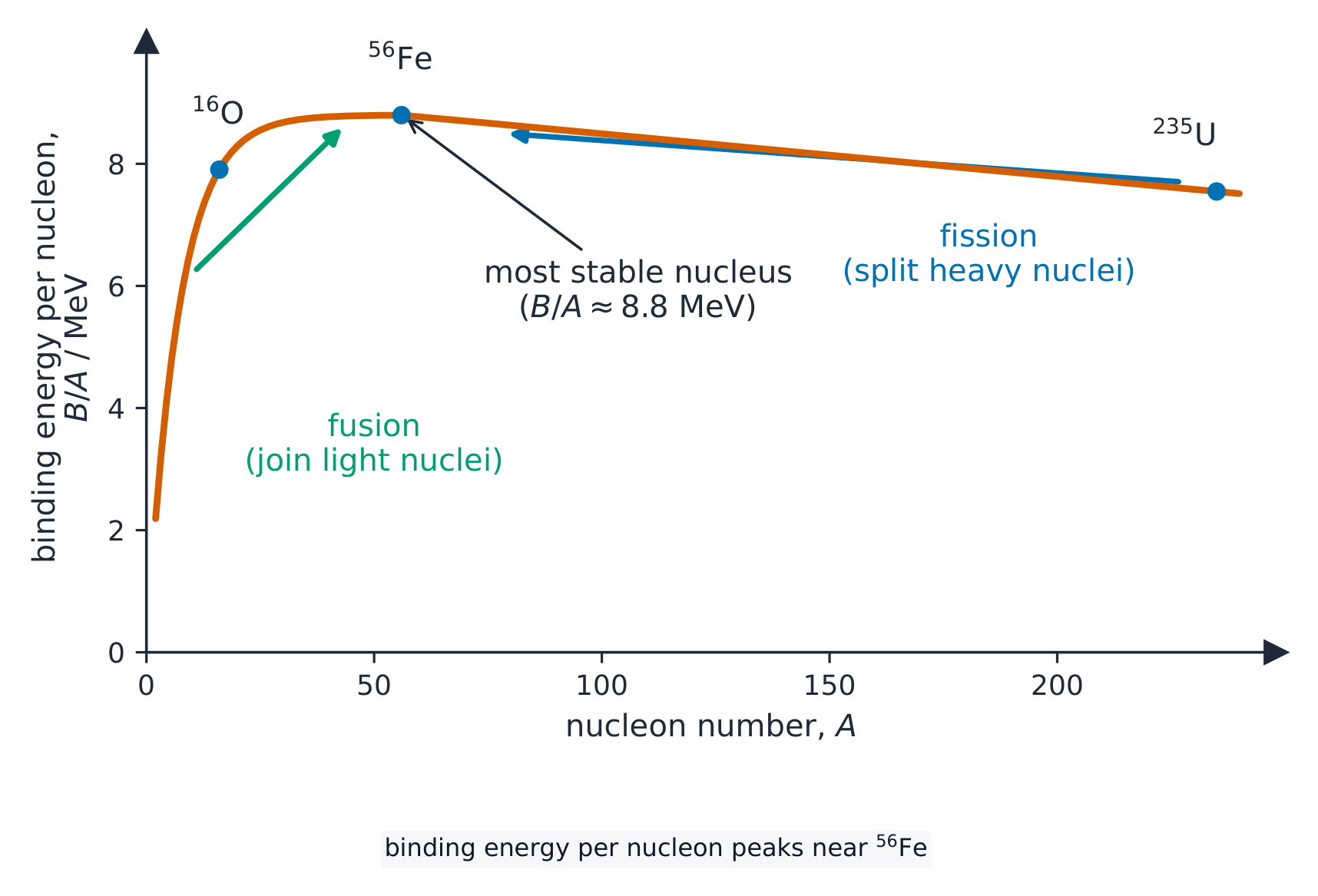
- Plot $B/A$ against $A$ and you get a dome: a steep rise for light nuclei, a maximum near $A = 56$ (iron) at about $8.8\ \text{MeV}$, then a slow fall to about $7.5\ \text{MeV}$ at uranium.
- Iron-56 is the most stable nucleus, and everything else can release energy by moving towards it.
- Sketching rules the exam marks: do not start at the origin, do not make the fall as steep as the rise, and do not let the curve reach zero on the right.
- Mark a nucleus that alpha decays on the far right ($A > 200$), and one that fuses on the far left ($A < 10$). Both sit low and both move up the curve when they react.
Everything climbs towards iron
La curva sobre todo depende
- Grafique $B/A$ contra $A$ y obtendrá una cúpula: un subida pronunciada para núcleos ligeros, un máximo cerca de $A = 56$ (hierro) en aproximadamente $8.8\ \text{MeV}$, seguido de una caída lenta hasta unos $7.5\ \text{MeV}$ en uranio.
- El hierro-56 es el núcleo más estable, y todo lo demás puede liberar energía moviéndose hacia él.
- Dibujar correctamente rige los puntos del examen: no comience en el origen, no haga la caída tan pronunciada como la subida, y no permita que la curva llegue a cero en el lado derecho.
- Marque un núcleo que decae alfa en el extremo derecho ($A > 200$), y uno que funde en el extremo izquierdo ($A < 10$). Ambos se sitúan bajo y ambos se mueven hacia arriba en la curva cuando reaccionan.
Todos ascienden hacia el hierro
Mass defect energy lab · Laboratorio de energía del defecto de masa
E = delta m c^2
Change mass defect and see binding energy rise with E = mc^2. · Cambie el defecto de masa y observe cómo aumenta la energía de enlace con E = mc^2.
The binding energy per nucleon is greatest for: · La energía de enlace por nucleón es mayor para:
Iron ($A \approx 56$) sits at the peak — the most tightly bound, most stable nucleus. · El hierro ($A \approx 56$) se sitúa en el pico: el núcleo más fuertemente unido y más estable.
Which are true of the binding-energy-per-nucleon curve? Select all · todos that apply. · ¿Cuáles son verdaderas sobre la curva de energía de enlace por nucleón? Seleccione todas las que correspondan.
It falls only to about 7.5 MeV at uranium. Drawing it back down to zero is a marked error, as is starting the curve exactly at the origin. · Solo desciende hasta aproximadamente 7.5 MeV en el uranio. Dibujarla volviendo a cero es un error marcado, así como comenzar la curva exactamente en el origen.
Sketch the curve: put the features in order from left to right. · Dibuje la curva: coloque las características en orden de izquierda a derecha.
A fusing nucleus is marked at the far left and an alpha emitter at the far right. Both are low on the curve and both move up it when they react. · Se marca un núcleo fusionándose en el extremo izquierdo y un emisor alfa en el extremo derecho. Ambos están bajos en la curva y ambos suben por ella cuando reaccionan.
Marks that slip away
- Binding energy is the energy to pull the nucleus apart into separate nucleons, not "the energy holding it together".
- Keep full precision until you subtract. A mass defect is a small difference of large numbers.
- $1\ \text{u} \leftrightarrow 931\ \text{MeV}$ works only when $\Delta m$ is in u. In kilograms you must use $c^2$ and you get joules.
- Balance both lines of a nuclear equation, and include the neutrino in beta decay.
- The nucleus is lighter than its parts. Writing the mass defect the other way round makes the binding energy negative.
Puntos que se pierden fácilmente
- La energía de enlace es la energía necesaria para separar el núcleo en nucleones individuales, no "la energía que lo mantiene unido".
- Conserve toda la precisión hasta realizar la resta. Un defecto de masa es una pequeña diferencia entre números grandes.
- $1\ \text{u} \leftrightarrow 931\ \text{MeV}$ solo funciona cuando $\Delta m$ está en u. En kilogramos debe usar $c^2$ y obtendrá joules.
- Equilibre ambas líneas de una ecuación nuclear, e incluya el neutrino en la desintegración beta.
- El núcleo es más ligero que sus partes. Escribir el defecto de masa al revés hace que la energía de enlace sea negativa.
You've got it
- $\Delta E = c^2 \Delta m$, and $1\ \text{u} \leftrightarrow 931\ \text{MeV}$ is the conversion nearly every question needs
- a nuclear equation conserves nucleon number and charge, and beta decay emits a neutrino or antineutrino
- the mass defect is the mass of the separate nucleons minus the mass of the nucleus, and the binding energy $B = \Delta m c^2$ is the minimum energy to separate it into individual nucleons
- binding energy per nucleon peaks near iron-56 at about $8.8\ \text{MeV}$, so light nuclei fusing and heavy nuclei splitting both climb the curve
Lo has entendido
- $\Delta E = c^2 \Delta m$, y $1\ \text{u} \leftrightarrow 931\ \text{MeV}$ es la conversión que casi cada pregunta necesita
- una ecuación nuclear conserva el número de nucleones y la carga, y la desintegración beta emite un neutrino o antineutrino
- el defecto de masa es la masa de los nucleones separados menos la masa del núcleo, y la energía de enlace $B = \Delta m c^2$ es la energía mínima para separar el núcleo en sus nucleones individuales
- la energía de enlace por nucleón alcanza su máximo cerca del hierro-56 a aproximadamente $8.8\ \text{MeV}$, por lo que tanto la fusión de núcleos ligeros como la fisión de núcleos pesados ascienden por la curva