Alternating currents · Corrientes alternas
| English | Español |
|---|---|
| peak value/piːk ˈvæljuː/ | valor de pico |
| root-mean-square/ruːt miːn skweə/ | cuadrático medio |
| alternating current/ˈɔːltəneɪtɪŋ ˈkʌrənt/ | corriente alternante |
| sinusoidal/ˌsaɪnəˈsɔɪdl/ | senoidal |
| angular frequency/ˈæŋɡjʊlə ˈfriːkwənsi/ | frecuencia angular |
| radians/ˈreɪdɪənz/ | radianes |
| cathode-ray oscilloscope/ˈkæθəʊd reɪ ɒˈsɪləskəʊp/ | osciloscopio de rayos catódicos |
| time-base/taɪm beɪs/ | base de tiempo |
The 230 volts that is never 230 volts
- A mains socket is labelled $230\ \text{V}$, yet an oscilloscope shows the voltage swinging up to about $325\ \text{V}$ and down to $-325\ \text{V}$, fifty times a second.
- Neither number is a mistake. The mains voltage really does reach $325\ \text{V}$, and it really does behave like a steady $230\ \text{V}$ battery when it heats a kettle.
- Reconciling those two facts is what this lesson is about.
- The tools are the peak value 峰值, the root-mean-square 均方根 value, and the fact that average a.c. power is half the peak power.
Los 230 voltios que nunca son 230 voltios
- Un enchufe de red está etiquetado con $230\ \text{V}$, pero un osciloscopio muestra que el voltaje sube hasta aproximadamente $325\ \text{V}$ y baja hasta $-325\ \text{V}$, cincuenta veces por segundo.
- Ninguno de los dos números es un error. El voltaje de red realmente alcanza los $325\ \text{V}$, y realmente se comporta como una batería continua de $230\ \text{V}$ cuando calienta una hervidora.
- Conciliar esos dos hechos es lo que trata esta lección.
- Las herramientas son el valor pico (peak value), el valor cuadrático medio (root-mean-square) y el hecho de que la potencia media de c.a. es la mitad de la potencia pico.
Period, frequency and peak value
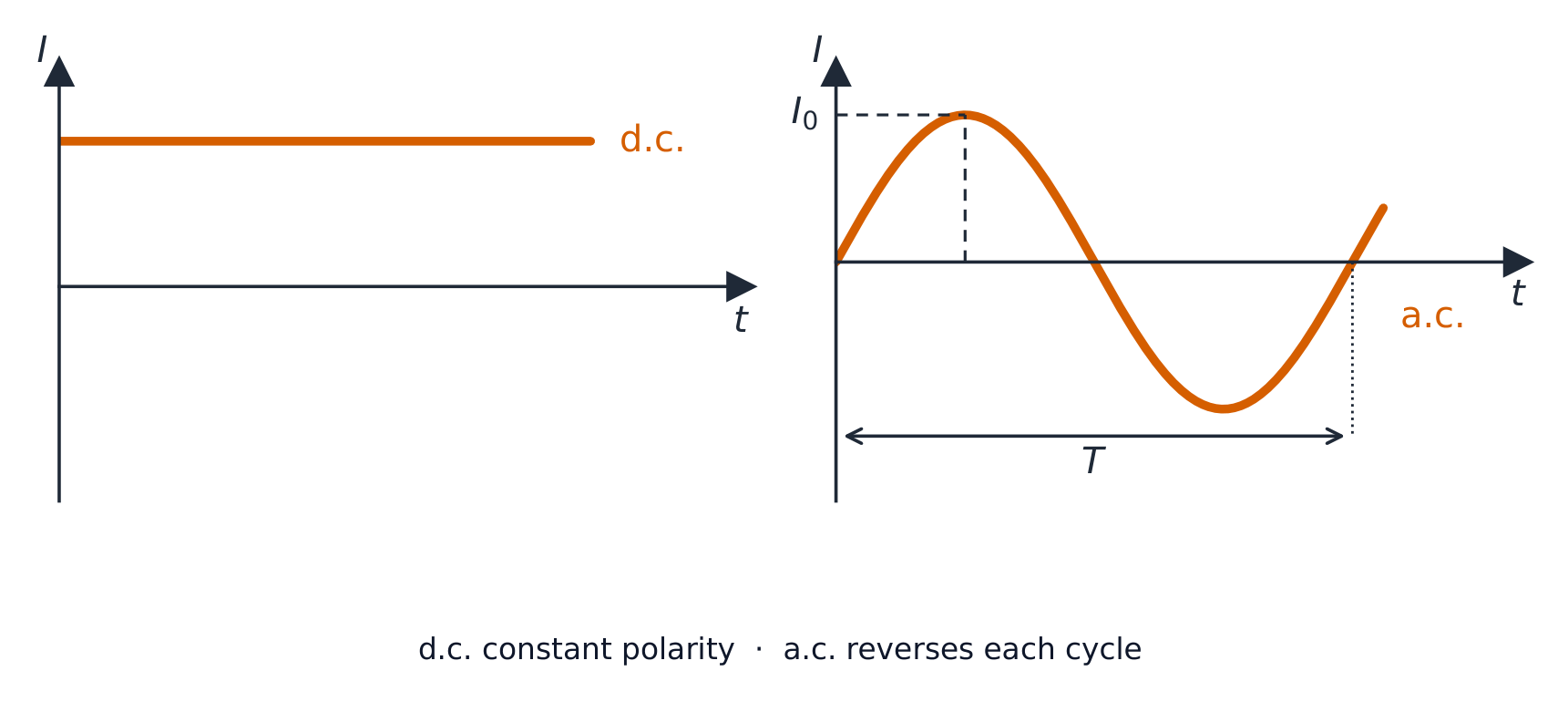
- An alternating current 交流电 keeps reversing direction; the mains is sinusoidal 正弦, so $I$ and $V$ follow sine waves in time.
- The period $T$ is the time for one complete cycle. The frequency $f$ is the number of complete cycles per unit time, so $f = 1/T$.
- The peak value is the maximum value of the current or voltage in a cycle. Those three sentences are the marked wordings.
- The mean value over a whole cycle is zero, since the wave spends as long negative as positive. That is precisely why an r.m.s. value is needed at all.
One line that never moves, one that never stops
Período, frecuencia y valor pico
- Una corriente alterna (alternating current) cambia constantemente de dirección; la red es sinusoidal, por lo que $I$ y $V$ siguen ondas senoidales en el tiempo.
- El período $T$ es el tiempo para completar un ciclo. La frecuencia $f$ es el número de ciclos completos por unidad de tiempo, así que $f = 1/T$.
- El valor pico es el valor máximo de la corriente o el voltaje en un ciclo. Esas tres oraciones son las definiciones clave que debes memorizar.
- El valor medio a lo largo de un ciclo completo es cero, ya que la onda pasa tanto tiempo siendo negativa como positiva. Por eso es exactamente necesario definir un valor r.m.s. (cuadrático medio).
Una línea que nunca se mueve, otra que nunca se detiene
Alternating current · Corriente alterna
I = a sin(bt)
AC is a sine · seno wave — amplitude is the peak, b sets the frequency. · La CA es una onda senoidal — la amplitud es el pico, b determina la frecuencia.
An alternating current: · Una corriente alterna:
a.c. keeps swapping direction — mains does so 50 (or 60) times a second. · La c.a. cambia constantemente de dirección: la red eléctrica lo hace 50 (o 60) veces por segundo.
Match each term to the definition the examiner marks. · Asocia cada término con la definición que marca el examinador.
Each is a fixed wording. The r.m.s. one is the only definition that mentions another current, because that is what it compares itself to. · Cada una es una redacción fija. La de r.m.s. es la única definición que menciona otra corriente, porque es con ella con la que se compara.
Reading the equation
- A supply is written $V = V_0 \sin(\omega t)$. The number in front is the peak value; the number multiplying $t$ is the angular frequency 角频率 $\omega = 2\pi f$.
- So $f = \omega / 2\pi$ and $T = 1/f$. The angle $\omega t$ is in radians 弧度, so put the calculator in radians before evaluating anything.
- A supply written with $\cos$ is the same wave started at its peak rather than at zero.
Leyendo la ecuación
- Una fuente se escribe como $V = V_0 \sin(\omega t)$. El número que está delante es el valor pico; el número que multiplica a $t$ es la frecuencia angular $\omega = 2\pi f$.
- Así que $f = \omega / 2\pi$ y $T = 1/f$. El ángulo $\omega t$ está en radianes, así que pon la calculadora en radianes antes de evaluar cualquier cosa.
- Una fuente escrita con $\cos$ es la misma onda iniciada en su pico en lugar de empezar en cero.
In $V = V_0\sin(\omega t)$ the coefficient of $t$ is the ____ frequency, equal to $2\pi f$. · En $V = V_0\sin(\omega t)$ el coeficiente de $t$ es la frecuencia ____ igual a $2\pi f$.
omega is 2pif, so a supply written sin(100pit) has f = 50 Hz, not 100pi Hz. The angle is in radians, so a calculator left in degrees turns every such step into nonsense. · omega es 2pif, así que una fuente escrita como sin(100pit) tiene f = 50 Hz, no 100pi Hz. El ángulo está en radianes, por lo que dejar la calculadora en grados convierte cada paso en tonterías.
Worked example: unpacking a supply equation
- A supply has $V = 320\sin(100\pi t)$, with $V$ in volts and $t$ in seconds. Find the peak value, frequency, period and r.m.s. voltage, and the first time after $t = 0$ at which $V = 160\ \text{V}$.
- Peak: $V_0 = 320\ \text{V}$. Angular frequency: $\omega = 100\pi\ \text{rad/s}$, so $f = 100\pi / 2\pi = 50\ \text{Hz}$ and $T = 1/50 = 0.020\ \text{s}$.
- $V_{\text{r.m.s.}} = 320/\sqrt{2} = 226\ \text{V}$.
- For $V = 160\ \text{V}$: $\sin(100\pi t) = 0.5$, so $100\pi t = \pi/6$ and $t = 1/600 = 1.7 \times 10^{-3}\ \text{s}$. In degrees mode this last step gives nonsense.
Ejemplo resuelto: analizando una ecuación de fuente
- Una fuente tiene $V = 320\sin(100\pi t)$, con $V$ en voltios y $t$ en segundos. Encuentra el valor pico, la frecuencia, el período y el voltaje r.m.s., y el primer instante después de $t = 0$ en el que $V = 160\ \text{V}$.
- Pico: $V_0 = 320\ \text{V}$. Frecuencia angular: $\omega = 100\pi\ \text{rad/s}$, así que $f = 100\pi / 2\pi = 50\ \text{Hz}$ y $T = 1/50 = 0.020\ \text{s}$.
- $V_{\text{r.m.s.}} = 320/\sqrt{2} = 226\ \text{V}$.
- Para $V = 160\ \text{V}$: $\sin(100\pi t) = 0.5$, así que $100\pi t = \pi/6$ y $t = 1/600 = 1.7 \times 10^{-3}\ \text{s}$. Si haces este último paso en modo grados, obtendrás un resultado sin sentido.
Mains supply is $50\ \text{Hz}$. What is its period? · La red eléctrica es de $50\ \text{Hz}$. ¿Cuál es su período?
$T = \dfrac{1}{f} = \dfrac{1}{50} = 0.020\ \text{s}$.
Reading a CRO trace
- A cathode-ray oscilloscope 示波器 is read exactly as in Topic 7.
- Horizontal: count the divisions for one full cycle and multiply by the time-base 时基 setting. That gives $T$, and $f = 1/T$.
- Vertical: count the divisions from the centre line to a peak and multiply by the $y$-gain. That gives $V_0$. Measuring peak to peak and halving is usually more accurate, because the centre line is easy to misjudge.
Leyendo una traza en CRO
- Un osciloscopio de rayos catódicos se lee exactamente igual que en el Tema 7.
- Horizontal: cuenta las divisiones para un ciclo completo y multiplícalo por el ajuste de base de tiempo (time-base). Eso te da $T$, y $f = 1/T$.
- Vertical: cuenta las divisiones desde la línea central hasta un pico y multiplícalo por la ganancia en $y$. Eso te da $V_0$. Medir de pico a pico y dividir entre dos suele ser más preciso, porque la línea central es fácil de malinterpretar.
On a CRO trace one complete cycle spans 4.0 divisions with the time-base at 5.0 ms per division. What is the frequency, in Hz? · En una traza del CRO, un ciclo completo abarca 4.0 divisiones con la base de tiempo en 5.0 ms por división. ¿Cuál es la frecuencia, en Hz?
T = 4.0 x 5.0 ms = 20 ms, so f = 1/0.020 = 50 Hz. Count divisions for a WHOLE cycle, not a half. · T = 4.0 x 5.0 ms = 20 ms, por lo tanto f = 1/0.020 = 50 Hz. Cuenta las divisiones para UN ciclo COMPLETO, no para medio ciclo.
Power in a resistor
- For a resistive load the instantaneous power is $P = I^2 R$, and with $I = I_0\sin(\omega t)$:
- This is always positive, since the current is squared, so a reversing current still heats the resistor. It pulses between zero and $I_0^2 R$ at twice the frequency of the current.
- The mean of $\sin^2$ over a cycle is $\tfrac{1}{2}$, so the average power is half the peak power.
Twice the frequency, and never negative
Potencia en una resistencia
- Para una carga resistiva, la potencia instantánea es $P = I^2 R$, y con $I = I_0\sin(\omega t)$:
- Esto es siempre positivo, ya que la corriente está elevada al cuadrado, por lo que una corriente inversa sigue calentando la resistencia. Pulsa entre cero y $I_0^2 R$ a doble frecuencia que la corriente.
- El promedio de $\sin^2$ sobre un ciclo es $\tfrac{1}{2}$, así que la potencia media es la mitad de la potencia pico.

Doble frecuencia, y nunca negativo
The average power of a.c. in a resistor is ____ the peak power. · La potencia media de la c.a. en un resistor es ____ la potencia de pico.
The mean of $\sin^{2}$ over a cycle is $\tfrac{1}{2}$, so $\langle P\rangle = \tfrac{1}{2}P_{\text{peak}}$. · El promedio de $\sin^{2}$ sobre un ciclo es $\tfrac{1}{2}$, así que $\langle P\rangle = \tfrac{1}{2}P_{\text{peak}}$.
Worked example: showing it is half
- A supply of peak voltage $12\ \text{V}$ drives a $680\ \Omega$ resistor. Show by calculation that the mean power is half the peak power.
- Peak power, at the instant the voltage is at its peak: $P_0 = V_0^2/R = 12^2/680 = 0.212\ \text{W}$.
- Mean power, through the r.m.s. value: $V_{\text{r.m.s.}} = 12/\sqrt{2} = 8.49\ \text{V}$, so $\langle P\rangle = V_{\text{r.m.s.}}^2/R = 8.49^2/680 = 0.106\ \text{W}$.
- The two are shown separately, and the second is half the first. Writing "half of $0.212$" scores nothing, because that is the very thing being shown.
- The factor $\tfrac{1}{2}$ is just $(1/\sqrt{2})^2$: the r.m.s. factor, squared.
Ejemplo resuelto: demostrando que es la mitad
- Una fuente de voltaje pico de $12\ \text{V}$ impulsa una resistencia de $680\ \Omega$. Demuestra mediante cálculo que la potencia media es la mitad de la potencia pico.
- Potencia pico, en el instante en que el voltaje está en su máximo: $P_0 = V_0^2/R = 12^2/680 = 0.212\ \text{W}$.
- Potencia media, usando el valor r.m.s.: $V_{\text{r.m.s.}} = 12/\sqrt{2} = 8.49\ \text{V}$, así que $\langle P\rangle = V_{\text{r.m.s.}}^2/R = 8.49^2/680 = 0.106\ \text{W}$.
- Se muestran por separado, y la segunda es la mitad de la primera. Escribir "la mitad de $0.212$" no otorga puntos, porque eso es precisamente lo que se debe demostrar.
- El factor $\tfrac{1}{2}$ es simplemente $(1/\sqrt{2})^2$: el factor r.m.s., elevado al cuadrado.
What r.m.s. actually means
- The r.m.s. value of an alternating current is the value of the direct (steady) current that would dissipate the same mean power in the same resistor. That sentence is the two-mark definition, and "by reference to the heating effect" is asking for exactly it.
- From $\langle P\rangle = I_{\text{r.m.s.}}^2 R = \tfrac{1}{2}I_0^2 R$ it follows that, for a sine wave:
- A definition that says only "$I_0/\sqrt{2}$" scores nothing, because that formula holds for a sine wave alone.
- Quoted a.c. values are r.m.s. values, which settles the opening puzzle: $230\ \text{V}$ mains has $V_0 = 230\sqrt{2} \approx 325\ \text{V}$, and components must be rated for the peak.
One dashed line that does the same heating
Lo que realmente significa r.m.s.
- El valor r.m.s. de una corriente alterna es el valor de la corriente directa (constante) que disiparía la misma potencia media en la misma resistencia. Esa oración es la definición de dos puntos, y "haciendo referencia al efecto térmico" pide exactamente eso.
- De $\langle P\rangle = I_{\text{r.m.s.}}^2 R = \tfrac{1}{2}I_0^2 R$ se deduce que, para una onda sinusoidal:
- Una definición que diga solo "$I_0/\sqrt{2}$" obtiene cero puntos, porque esa fórmula solo aplica a ondas sinusoidales.
- Los valores de c.a. citados son valores r.m.s., lo que resuelve el acertijo inicial: una red de $230\ \text{V}$ tiene $V_0 = 230\sqrt{2} \approx 325\ \text{V}$, y los componentes deben estar clasificados para el valor pico.

Una línea discontinua que produce el mismo calor
An a.c. has a peak current of $2.0\ \text{A}$. What is the r.m.s. current? · Una c.a. tiene una corriente de pico de $2.0\ \text{A}$. ¿Cuál es la corriente r.m.s.?
$I_{\text{rms}} = \dfrac{I_0}{\sqrt{2}} = \dfrac{2.0}{\sqrt{2}} \approx 1.41\ \text{A}$.
A 230 V (r.m.s.) mains supply has a peak voltage of about 325 V. · Una red de 230 V (r.m.s.) tiene un voltaje de pico de aproximadamente 325 V.
$V_0 = V_{\text{rms}}\sqrt{2} = 230 \times \sqrt{2} \approx 325\ \text{V}$ — components must be rated for the peak. · $V_0 = V_{\text{rms}}\sqrt{2} = 230 \times \sqrt{2} \approx 325\ \text{V}$ — los componentes deben estar clasificados para el pico.
Which statements belong in the definition of an r.m.s. current? Select all · todos that apply. · ¿Qué afirmaciones pertenecen a la definición de una corriente r.m.s.? Selecciona todas las que correspondan.
The last one is a consequence for a sine wave, not the definition. A definition giving only I0/sqrt(2) scores nothing, because it is false for any other waveform. · La última es una consecuencia para una onda senoidal, no la definición. Una definición que dé solo I0/sqrt(2) obtiene cero puntos, porque es falsa para cualquier otra forma de onda.
Worked example: a wave that is not a sine
- A current is $+2.0\ \text{A}$ for the first half of each cycle and $-1.0\ \text{A}$ for the second half. Find its r.m.s. value and the mean power in a $10\ \Omega$ resistor.
- Take the name literally. Square: $4.0\ \text{A}^2$ for half the time, $1.0\ \text{A}^2$ for the other half. Mean: $(4.0 + 1.0)/2 = 2.5\ \text{A}^2$. Root: $I_{\text{r.m.s.}} = \sqrt{2.5} = 1.6\ \text{A}$.
- Mean power $= I_{\text{r.m.s.}}^2 R = 2.5 \times 10 = 25\ \text{W}$.
- The sign of the current never matters, because it is squared away. And $I_0/\sqrt{2}$ would have given $1.4\ \text{A}$, which is wrong: that shortcut is for sine waves only.
Ejemplo resuelto: una onda que no es sinusoidal
- Una corriente es de $+2.0\ \text{A}$ durante la primera mitad de cada ciclo y de $-1.0\ \text{A}$ durante la segunda mitad. Encuentra su valor r.m.s. y la potencia media en una resistencia de $10\ \Omega$.
- Toma el nombre literalmente. Cuadrado: $4.0\ \text{A}^2$ durante la mitad del tiempo, $1.0\ \text{A}^2$ durante la otra mitad. Media: $(4.0 + 1.0)/2 = 2.5\ \text{A}^2$. Raíz: $I_{\text{r.m.s.}} = \sqrt{2.5} = 1.6\ \text{A}$.
- Potencia media $= I_{\text{r.m.s.}}^2 R = 2.5 \times 10 = 25\ \text{W}$.
- El signo de la corriente nunca importa, porque se eleva al cuadrado. Y $I_0/\sqrt{2}$ habría dado $1.4\ \text{A}$, lo cual es incorrecto: ese atajo es solo para ondas sinusoidales.
Put the steps for finding the r.m.s. value of a non-sinusoidal current in order. · Coloca los pasos para encontrar el valor r.m.s. de una corriente no sinusoidal en orden.
Root-mean-square, read backwards. For a square wave of +2.0 A and -1.0 A the mean square is 2.5 A^2 and the r.m.s. is 1.6 A, not the 1.4 A that I0/sqrt(2) would give. · Raíz-cuadrada-del-promedio-leído-al-revés. Para una onda cuadrada de +2.0 A y -1.0 A, el promedio de los cuadrados es 2.5 A^2 y el r.m.s. es 1.6 A, no los 1.4 A que daría I0/sqrt(2).
Marks that slip away
- The r.m.s. definition is about the same power in the same resistor, not about dividing by $\sqrt{2}$. Quote the sentence, not the formula.
- "Show that the mean power is half the peak" needs two separate calculations. Halving the first one is circular.
- Put the calculator in radians before evaluating $\sin(\omega t)$.
- $\omega$ is not the frequency. Divide by $2\pi$ first.
- The mean current over a cycle is zero; the mean power is not, because power depends on $I^2$.
Puntos que se escapan
- La definición de r.m.s. trata sobre la misma potencia en la misma resistencia, no sobre dividir por $\sqrt{2}$. Cita la oración, no la fórmula.
- "Demuestra que la potencia media es la mitad de la pico" necesita dos cálculos separados. Dividir el primero entre dos es circular.
- Pon la calculadora en radianes antes de evaluar $\sin(\omega t)$.
- $\omega$ no es la frecuencia. Divide primero por $2\pi$.
- La corriente media sobre un ciclo es cero; la potencia media no lo es, porque la potencia depende de $I^2$.
You've got it
- period is the time for one complete cycle, frequency the number of complete cycles per unit time, peak value the maximum in a cycle
- in $V = V_0\sin(\omega t)$ the coefficient of $t$ is $\omega = 2\pi f$, and the angle is in radians
- the power in a resistor pulses at twice the frequency and is never negative, so the mean power is half the peak power
- the r.m.s. value is the steady direct current dissipating the same mean power in the same resistor; only for a sine wave is it $I_0/\sqrt{2}$
Ya lo tienes
- período es el tiempo para un ciclo completo, frecuencia el número de ciclos completos por unidad de tiempo, valor pico el máximo en un ciclo
- en $V = V_0\sin(\omega t)$ el coeficiente de $t$ es $\omega = 2\pi f$, y el ángulo está en radianes
- la potencia en una resistencia pulsa a doble frecuencia y nunca es negativa, por lo que la potencia media es la mitad de la potencia pico
- el valor r.m.s. es la corriente directa constante que disipa la misma potencia media en la misma resistencia; solo para una onda sinusoidal es $I_0/\sqrt{2}$