Damped and forced oscillations · Oscilaciones amortiguadas y forzadas
| English | Español |
|---|---|
| driving force/ˈdraɪvɪŋ fɔːs/ | fuerza impulsora |
| damping/ˈdæmpɪŋ/ | amortiguamiento |
| forced oscillations/fɔːst ˌɒsɪˈleɪʃnz/ | oscilaciones forzadas |
| resonance/ˈrezənəns/ | resonancia |
| driving frequency/ˈdraɪvɪŋ ˈfriːkwənsi/ | frecuencia impulsora |
| natural frequency/ˈnætʃərəl ˈfriːkwənsi/ | frecuencia natural |
The bridge that had to be closed on its opening day
- London's Millennium Bridge opened in June 2000. Within hours it was swaying sideways so alarmingly that it was closed, and it stayed closed for nearly two years.
- Nobody had done anything wrong with the steel. The problem was that a small sideways sway made people adjust their step, that adjustment pushed the bridge at exactly the rhythm it liked, and the sway grew.
- A driving force at the right frequency, an oscillator with too little damping: those two ingredients build amplitude out of almost nothing.
- This lesson is damping 阻尼, forced oscillations 受迫振动, and resonance 共振.
El puente que tuvo que cerrarse el mismo día de su inauguración
- El Puente del Milenio de Londres se inauguró en junio de 2000. En cuestión de horas, oscilaba lateralmente de forma tan alarmante que fue cerrado, y permaneció cerrado durante casi dos años.
- Nadie había cometido ningún error con el acero. El problema era que una pequeña oscilación lateral hacía que la gente ajustara su paso; ese ajuste empujaba al puente exactamente al ritmo que este prefería, y la oscilación crecía.
- Una fuerza impulsora a la frecuencia adecuada, un oscilador con poco amortiguamiento: esos dos ingredientes construyen amplitud a partir de casi nada.
- Esta lección trata sobre amortiguamiento (damping), oscilaciones forzadas (forced oscillations) y resonancia (resonance).
Damping
- Damping is the removal of energy from an oscillator by a resistive force such as friction or air drag.
- The amplitude decreases with time, and the lost energy is transferred to thermal energy in the oscillator and its surroundings.
- The frequency is essentially unchanged for light damping, so the oscillation keeps its rhythm as it fades. That is a bell: same note, dying away.
The envelope shrinks; the spacing of the peaks does not
Amortiguamiento
- El amortiguamiento es la extracción de energía de un oscilador mediante una fuerza resistiva, como la fricción o la resistencia del aire.
- La amplitud disminuye con el tiempo, y la energía perdida se transfiere a energía térmica en el oscilador y sus alrededores.
- Para un amortiguamiento ligero, la frecuencia permanece esencialmente sin cambios, por lo que la oscilación mantiene su ritmo mientras se desvanece. Es como una campana: misma nota, pero que se apaga.

La envolvente se encoge; la separación entre los picos no cambia
Damping of an oscillation is caused by: · El amortiguamiento de una oscilación es causado por:
Friction or drag carries energy away as heat, so each swing is smaller than the last. · La fricción o el arrastre transportan la energía away como calor, por lo que cada oscilación es menor que la anterior.
Damping reduces the frequency of an oscillation rather than its amplitude. · El amortiguamiento reduce la frecuencia de una oscilación en lugar de su amplitud.
The amplitude falls as energy becomes thermal. For light damping the frequency is essentially unchanged, which is why a bell keeps its note as it fades. · La amplitud disminuye a medida que la energía se vuelve térmica. Para un amortiguamiento ligero, la frecuencia permanece esencialmente sin cambios, razón por la cual una campana mantiene su tono mientras se desvanece.
The three degrees of damping
- Light damping: the amplitude decreases slowly over many oscillations. The system still oscillates.
- Critical damping: the system returns to equilibrium in the shortest possible time without oscillating or overshooting. This is what a car suspension and an analogue meter needle are designed for.
- Heavy damping: the system returns to equilibrium slowly and without oscillating, taking longer than critical. A heavy door closer is the example.
- The exam distinction is between critical and heavy: both avoid oscillating, but only critical does it in the shortest time.
Two curves that both avoid overshooting, one much slower than the other
Los tres grados de amortiguamiento
- Amortiguamiento ligero: la amplitud disminuye lentamente a lo largo de muchas oscilaciones. El sistema sigue oscilando.
- Amortiguamiento crítico: el sistema retorna al equilibrio en el menor tiempo posible sin oscilar ni sobrepasar el punto de equilibrio. Este es el diseño utilizado en las suspensiones de automóviles y en las agujas de los medidores analógicos.
- Amortiguamiento fuerte: el sistema retorna al equilibrio lentamente y sin oscilar, tardando más que en el caso crítico. Un cierre de puertas pesado es el ejemplo típico.
- La distinción en los exámenes es entre el amortiguamiento crítico y el fuerte: ambos evitan oscilar, pero solo el crítico lo hace en el menor tiempo.
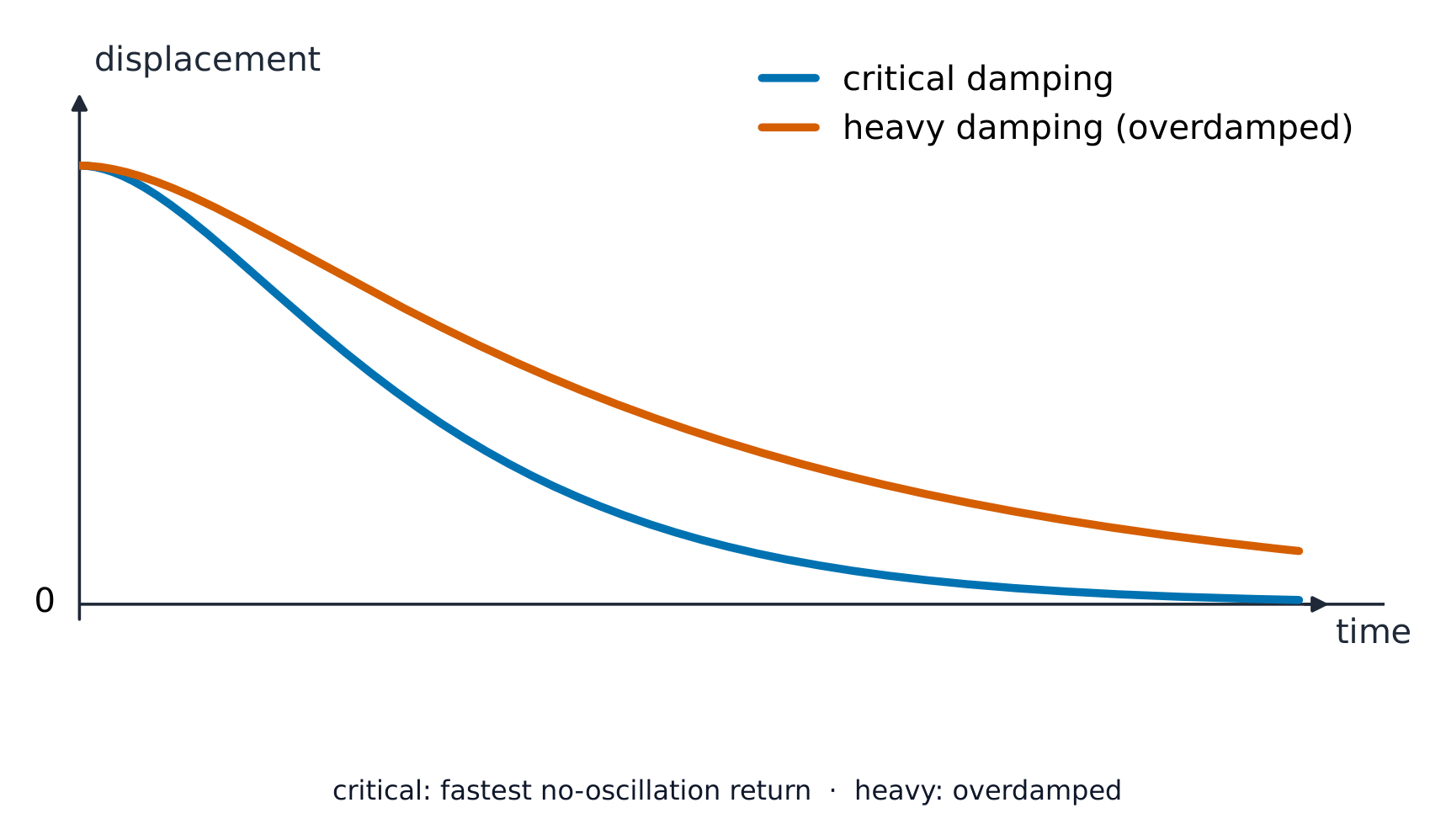
Dos curvas que evitan el sobrepaso, una mucho más lenta que la otra
Match each type of damping to its behaviour. · Asocia cada tipo de amortiguamiento con su comportamiento.
Critical damping returns to equilibrium in the shortest time without overshooting; heavy damping is slower still. · El amortiguamiento crítico retorna al equilibrio en el tiempo más corto sin sobrepasar; el amortiguamiento pesado es aún más lento.
Worked example: choose the damping
- A car's suspension is designed so that after hitting a bump the car returns to its normal height quickly and without bouncing. What damping is used, and why?
- Critical damping: it returns the system to equilibrium in the shortest time with no oscillation, so the car neither bounces (light damping) nor sags back slowly (heavy damping).
- An analogue ammeter needle must settle on a reading as quickly as possible. Critical damping again, and for the same reason: a needle that overshoots must be waited for, and one that is heavily damped is slow to read.
- Name the type, then give both properties: shortest time and no oscillation.
Ejemplo resuelto: elegir el tipo de amortiguamiento
- La suspensión de un automóvil está diseñada para que, tras golpear un bache, el coche vuelva a su altura normal rápidamente y sin rebotar. ¿Qué tipo de amortiguamiento se utiliza y por qué?
- Amortiguamiento crítico: devuelve el sistema al equilibrio en el menor tiempo posible sin oscilación, por lo que el coche ni rebota (como en el amortiguamiento ligero) ni se hunde lentamente (como en el amortiguamiento fuerte).
- La aguja de un amperímetro analógico debe asentarse en una lectura lo más rápido posible. Nuevamente, amortiguamiento crítico, y por la misma razón: una aguja que sobrepasa la marca obliga a esperar, y una muy amortiguada es lenta de leer.
- Nombre el tipo y proporcione ambas propiedades: menor tiempo y ausencia de oscilación.
A car suspension returns the car to its normal height quickly without bouncing. Which damping is this, and why? · La suspensión de un automóvil devuelve el coche a su altura normal rápidamente sin rebotar. ¿Qué amortiguamiento es este y por qué?
Heavy damping also avoids oscillating but takes longer, so the car would sag back slowly. Give both properties: shortest time and no oscillation. · El amortiguamiento pesado también evita oscilar pero tarda más, por lo que el coche se hundiría lentamente. Se deben dar ambas propiedades: tiempo más corto y sin oscilación.
Forced oscillations
- A forced oscillation happens when a driving force 驱动力 of frequency $f_{\text{d}}$ is applied to a system.
- After the start-up settles, the system oscillates at the driving frequency 驱动频率, not at its own natural frequency.
- Its natural frequency 固有频率 $f_0$ is the frequency at which it oscillates when displaced and left alone, with no driving force.
- Both facts matter and are often confused: the driving frequency sets how fast it oscillates, and the natural frequency decides how big the response is.
Oscilaciones forzadas
- Una oscilación forzada ocurre cuando se aplica una fuerza impulsora de frecuencia $f_{\text{d}}$ a un sistema.
- Después de que se estabiliza el arranque, el sistema oscila a la frecuencia de impulsión, no a su propia frecuencia natural.
- Su frecuencia natural $f_0$ es la frecuencia a la que oscila cuando se desplaza y se deja solo, sin ninguna fuerza impulsora.
- Ambos hechos son importantes y a menudo se confunden: la frecuencia de impulsión determina qué tan rápido oscila, y la frecuencia natural decide qué tan grande es la respuesta.
A forced oscillator vibrates at: · Un oscilador forzado vibra a:
It follows the driver — it oscillates at the driving frequency $f_{\text{d}}$. · Sigue al conductor — oscila a la frecuencia de accionamiento $f_{\text{d}}$.
Once the start-up has settled, a forced oscillator vibrates at the ____ frequency. · Una vez que el arranque se ha estabilizado, un oscilador forzado vibra a la frecuencia ____.
The driving frequency sets how fast it oscillates; the natural frequency decides only how large the response is. · La frecuencia de accionamiento determina qué tan rápido oscila; la frecuencia natural decide solo qué tan grande es la respuesta.
Resonance
- Resonance occurs when the driving frequency equals the natural frequency of the system. The amplitude is then a maximum, and there is maximum transfer of energy from the driver to the system.
- The lighter the damping, the higher and sharper the resonance peak, and the closer the peak sits to $f_0$. Heavier damping gives a lower, broader peak.
- Everyday resonance: pushing a swing in time with it, a wine glass shattered by a sung note, a radio tuned to a station, and the Millennium Bridge.
Same natural frequency, very different responses
Resonancia
- La resonancia ocurre cuando la frecuencia de impulsión iguala la frecuencia natural del sistema. En ese momento, la amplitud es un máximo y hay una transferencia máxima de energía desde el impulsor al sistema.
- Cuanto menor sea el amortiguamiento, más alta y aguda será la resonancia, y más cerca estará el pico de $f_0$. Un amortiguamiento mayor produce un pico más bajo y ancho.
- Resonancia cotidiana: empujar un columpio al ritmo adecuado, un vaso de vino roto por una nota cantada, una radio sintonizada a una emisora y el Puente del Milenio.

Misma frecuencia natural, respuestas muy diferentes
Resonance happens when the driving frequency equals the ____ frequency. · La resonancia ocurre cuando la frecuencia de accionamiento es igual a la frecuencia ____.
At $f_{\text{d}} = f_0$ the driver feeds energy in most effectively and the amplitude peaks. · En $f_{\text{d}} = f_0$, el conductor inyecta energía de manera más efectiva y la amplitud alcanza su máximo.
Lighter damping gives a sharper, higher resonance peak. · Un amortiguamiento más ligero produce un pico de resonancia más agudo y alto.
Less energy is lost each cycle, so the amplitude builds higher and the peak is narrower. · Se pierde menos energía por ciclo, por lo que la amplitud aumenta más y el pico es más estrecho.
Worked example: describe a resonance curve
- Sketch and describe how the amplitude of a lightly damped driven oscillator varies with driving frequency. [3]
- The amplitude is small at low driving frequency, rises to a sharp maximum when the driving frequency equals the natural frequency, and falls again at higher frequencies.
- With greater damping the peak is lower and broader, and occurs at a slightly lower frequency.
- The mark most often lost is failing to say where the peak is: at the natural frequency, which is the whole definition of resonance.
Ejemplo resuelto: describir una curva de resonancia
- Dibuje y describa cómo varía la amplitud de un oscilador forzado con amortiguamiento ligero según la frecuencia de impulsión. [3]
- La amplitud es pequeña a bajas frecuencias de impulsión, aumenta hasta un máximo agudo cuando la frecuencia de impulsión iguala a la frecuencia natural, y vuelve a disminuir a frecuencias más altas.
- Con mayor amortiguamiento, el pico es más bajo y ancho, y ocurre a una frecuencia ligeramente menor.
- La calificación que más se pierde es no especificar dónde se encuentra el pico: en la frecuencia natural, que es toda la definición de resonancia.
Resonance · Resonancia
Drive the swing at different frequencies. Far from its natural frequency it barely moves; tune them to match and the amplitude explodes — resonance, the same effect that can shake a bridge apart. · Impulsa el balanceo a diferentes frecuencias. Lejos de su frecuencia natural apenas se mueve; sintonízalas para que coincidan y la amplitud explota: resonancia, el mismo efecto que puede hacer saltar un puente.
Describing a resonance curve, which statements earn marks? Select all · todos that apply. · Al describir una curva de resonancia, ¿cuáles afirmaciones obtienen puntos? Selecciona todas las que correspondan.
Beyond the peak the amplitude falls again. Saying where the peak is, at the natural frequency, is the mark most often lost. · Más allá del pico, la amplitud vuelve a disminuir. Indicar dónde está el pico, en la frecuencia natural, es el punto que más suele perderse.
Wanted and unwanted
- Wanted: a radio or television tuned by matching a circuit's natural frequency to the broadcast; a microwave oven driving water molecules; magnetic resonance imaging; a musical instrument's air column or string.
- Unwanted: a bridge or building driven by wind, footsteps or an earthquake; a vibrating car panel at one particular engine speed.
- The engineering answer to unwanted resonance is to increase the damping, which lowers and broadens the peak, or to change the natural frequency so it no longer matches the driver.
Deseado e indeseado
- Deseado: una radio o televisión sintonizada haciendo coincidir la frecuencia natural de un circuito con la transmisión; un horno microondas moviendo moléculas de agua; la imagen por resonancia magnética; la columna de aire o cuerda de un instrumento musical.
- Indeseado: un puente o edificio impulsado por el viento, pasos de personas o un terremoto; un panel de automóvil vibrando a una velocidad específica del motor.
- La solución ingenieril ante la resonancia indeseada es aumentar el amortiguamiento, lo que baja y ensancha el pico, o cambiar la frecuencia natural para que ya no coincida con la del impulsor.
Select all · todos the examples of resonance. · Selecciona todos los ejemplos de resonancia.
Each of the first three matches a driving frequency to a natural frequency. A rolling ball is not a driven oscillation. · Cada uno de los tres primeros coincide una frecuencia de accionamiento con una frecuencia natural. Una bola rodando no es una oscilación forzada.
Marks that slip away
- A damped oscillator loses amplitude, not frequency. Say what decreases.
- Critical damping is the shortest time without oscillating; heavy damping also avoids oscillating but is slower. Give both properties.
- A forced oscillator vibrates at the driving frequency. Its natural frequency decides only how large the response is.
- Resonance is the driving frequency equal to the natural frequency, not merely close to it. Name where the peak is.
Puntos que se pierden fácilmente
- Un oscilador amortiguado pierde amplitud, no frecuencia. Indique qué disminuye.
- El amortiguamiento crítico es el menor tiempo sin oscilar; el amortiguamiento fuerte también evita oscilar pero es más lento. Proporcione ambas propiedades.
- Un oscilador forzado vibra a la frecuencia de impulsión. Su frecuencia natural solo decide qué tan grande es la respuesta.
- La resonancia es la frecuencia de impulsión igual a la frecuencia natural, no simplemente cercana a ella. Nombre dónde se encuentra el pico.
An engineer must stop a footbridge resonating with pedestrians' footsteps. Put a sensible approach in order. · Un ingeniero debe evitar que un puente peatonal resuene con los pasos de los peatones. Ordena un enfoque sensato.
The two engineering answers to unwanted resonance are more damping or a different natural frequency. Both were used on the Millennium Bridge. · Las dos respuestas de ingeniería ante la resonancia indeseada son más amortiguamiento o una frecuencia natural diferente. Ambas se utilizaron en el Puente Milenario.
You've got it
- damping is a resistive force removing energy, so the amplitude falls and the energy becomes thermal; the rhythm is essentially unchanged
- light damping decays slowly and still oscillates; critical returns to equilibrium in the shortest time without oscillating; heavy also does not oscillate but is slower
- a forced oscillator vibrates at the driving frequency, whatever its natural frequency
- resonance is driving frequency equal to natural frequency, giving maximum amplitude and maximum energy transfer; lighter damping gives a higher, sharper peak
Ya lo tiene
- El amortiguamiento es una fuerza resistiva que extrae energía, por lo que la amplitud cae y la energía se convierte en térmica; el ritmo permanece esencialmente sin cambios.
- El amortiguamiento ligero decae lentamente y aún oscila; el crítico retorna al equilibrio en el menor tiempo sin oscilar; el fuerte tampoco oscila pero es más lento.
- Un oscilador forzado vibra a la frecuencia de impulsión, independientemente de su frecuencia natural.
- La resonancia es la frecuencia de impulsión igual a la frecuencia natural, dando amplitud máxima y transferencia máxima de energía; menor amortiguamiento produce un pico más alto y agudo.