The ideal gas equation · La ecuación del gas ideal
| English | Español |
|---|---|
| volume/ˈvɒljuːm/ | volumen |
| pressure/ˈpreʃə/ | presión |
| equation of state/ɪˈkweɪʒn ɒv steɪt/ | ecuación de estado |
| ideal gas/aɪˈdɪəl ɡæs/ | gas ideal |
| thermodynamic temperature/ˌθɜːməʊdaɪˈnæmɪk ˈtemprɪtʃə/ | temperatura termodinámica |
| molar gas constant/ˈməʊlə ɡæs ˈkɒnstənt/ | constante molar de los gases |
| Boltzmann constant/ˈbɒltsmən ˈkɒnstənt/ | constante de Boltzmann |
| Boyle's law/bɔɪlz lɔː/ | Ley de Boyle |
| Charles's law/ˈtʃɑːlzɪz lɔː/ | Ley de Charles |
| pressure law/ˈpreʃə lɔː/ | ley de presión |
The tank that must not be filled at noon
- A scuba tank is filled to 200 bar on a cool morning and left in a car in the sun. Nothing is added and nothing escapes, yet by afternoon the gauge reads far higher.
- The gas has not changed. Its temperature has, and for a fixed amount in a fixed volume, pressure and temperature move together in strict proportion.
- Divers are taught this as a safety rule. The exam asks for it as an equation, and one equation covers every case of it.
- This lesson is the equation of state 状态方程 $pV = nRT$, its per-molecule twin, and the three special cases that fall out of it.
El tanque que no debe llenarse al mediodía
- Un tanque de buceo se llena hasta 200 bar en una mañana fresca y se deja dentro de un coche expuesto al sol. No se añade ni escapa nada, pero para la tarde el manómetro marca mucho más alto.
- El gas no ha cambiado. Su temperatura sí, y para una cantidad fija en un volumen fijo, la presión y la temperatura varían juntas en estricta proporción.
- A los buceadores se les enseña esto como una regla de seguridad. El examen lo pide como una ecuación, y una sola ecuación cubre todos sus casos.
- Esta lección trata sobre la ecuación de estado 状态方程 $pV = nRT$, su gemela por molécula, y los tres casos especiales que se desprenden de ella.
What makes a gas ideal
- An ideal gas 理想气体 is one that obeys $pV \propto T$, where $T$ is the thermodynamic temperature 热力学温度, at all values of pressure, volume and temperature.
- The examiner's two-mark definition needs both halves: the relationship, and "at all values of $p$, $V$ and $T$". Stating the equation alone earns one.
- Real gases approach this behaviour at low pressure and high temperature, and depart from it when the molecules are crowded or slow.
Qué hace que un gas sea ideal
- Un gas ideal 理想气体 es aquel que obedece $pV \propto T$, donde $T$ es la temperatura termodinámica 热力学温度, en todos los valores de presión, volumen y temperatura.
- La definición de dos puntos del examinador necesita ambas mitades: la relación, y "en todos los valores de $p$, $V$ y $T$". Enunciar solo la ecuación otorga un punto.
- Los gases reales se aproximan a este comportamiento a baja presión y alta temperatura, y se desvían cuando las moléculas están apretujadas o lentas.
A two-mark definition of an ideal gas needs which elements? Select all · todos that apply. · ¿Qué elementos necesita una definición de dos puntos de un gas ideal? Selecciona todos los que correspondan.
The relationship alone earns one mark; "at all values" earns the second. Being monatomic is not part of the definition. · Solo la relación otorga un punto; "para todos los valores" otorga el segundo. Ser monoatómico no forma parte de la definición.
The equation of state, both forms
- $p$ is the pressure 压强 in Pa, $V$ the volume 体积 in m³, $T$ the thermodynamic temperature in kelvin, never °C.
- $n$ is the number of moles and $R = 8.31\ \text{J/(mol K)}$ the molar gas constant 摩尔气体常量. $N$ is the number of molecules and $k = 1.38 \times 10^{-23}\ \text{J/K}$ the Boltzmann constant 玻尔兹曼常量.
- The two forms are the same equation: since $N = nN_{\text{A}}$, it follows that $k = R/N_{\text{A}}$. Choose the form that matches the "amount" the question gives you: moles go with $R$, molecules with $k$.
A fixed amount in a fixed volume: only temperature is left to change the pressure
La ecuación de estado, ambas formas
- $p$ es la presión 压强 en Pa, $V$ el volumen 体积 en m³, $T$ la temperatura termodinámica en kelvin, nunca °C.
- $n$ es el número de moles y $R = 8.31\ \text{J/(mol K)}$ la constante molar de los gases 摩尔气体常量. $N$ es el número de moléculas y $k = 1.38 \times 10^{-23}\ \text{J/K}$ la constante de Boltzmann 玻尔兹曼常量.
- Ambas formas son la misma ecuación: dado que $N = nN_{\text{A}}$, se deduce que $k = R/N_{\text{A}}$. Elige la forma que coincida con la "cantidad" que te da el enunciado: moles con $R$, moléculas con $k$.

Una cantidad fija en un volumen fijo: solo la temperatura queda para cambiar la presión
The equation of state of an ideal gas is: · La ecuación de estado de un gas ideal es:
$pV = nRT$ (moles) or $pV = NkT$ (molecules) — with $T$ in kelvin. · $pV = nRT$ (moles) o $pV = NkT$ (moléculas) — con $T$ en kelvin.
You may use temperature in °C in the ideal gas equation. · Puedes usar la temperatura en °C en la ecuación del gas ideal.
No — $pV \propto T$ only with $T$ in kelvin. Convert °C to K first. · No — $pV \propto T$ solo con $T$ en kelvin. Convierte °C a K primero.
The Boltzmann constant equals $R / N_{\text{A}}$ — the gas constant per molecule. · La constante de Boltzmann es igual a $R / N_{\text{A}}$ — la constante de los gases por molécula.
Since $N = n N_{\text{A}}$, comparing $pV = nRT$ with $pV = NkT$ gives $k = \dfrac{R}{N_{\text{A}}}$. · Dado que $N = n N_{\text{A}}$, al comparar $pV = nRT$ con $pV = NkT$ se obtiene $k = \dfrac{R}{N_{\text{A}}}$.
Worked example: how much gas is in the cylinder
- A cylinder of volume $0.020\ \text{m}^3$ holds gas at $27\ ^\circ\text{C}$ and a pressure of $2.0 \times 10^5\ \text{Pa}$. How many moles are there?
- Convert first: $T = 27 + 273 = 300\ \text{K}$. The volume and pressure are already in SI units.
- Rearrange and substitute:
- Convert to kelvin before anything else. Using 27 in place of 300 gives an answer eleven times too large, and it is the single commonest error in this topic.
Ejemplo resuelto: cuánto gas hay en el cilindro
- Un cilindro de volumen $0.020\ \text{m}^3$ contiene gas a $27\ ^\circ\text{C}$ y una presión de $2.0 \times 10^5\ \text{Pa}$. ¿Cuántos moles hay?
- Convierte primero: $T = 27 + 273 = 300\ \text{K}$. El volumen y la presión ya están en unidades SI.
- Despeja y sustituye:
- Convierte a kelvin antes de hacer cualquier otra cosa. Usar 27 en lugar de 300 da una respuesta once veces demasiado grande, y es el error más común en este tema.
A cylinder of volume 0.020 m^3 holds gas at 27 degrees C and 2.0 x 10^5 Pa. How many moles are there? (R = 8.31) · Un cilindro de volumen 0.020 m^3 contiene gas a 27 grados C y 2.0 x 10^5 Pa. ¿Cuántos moles hay? (R = 8.31)
T must be 300 K, not 27. n = pV/RT = (2.0e5 x 0.020)/(8.31 x 300) = 1.6 mol. Using 27 gives an answer eleven times too large. · T debe ser 300 K, no 27. n = pV/RT = (2.0e5 x 0.020)/(8.31 x 300) = 1.6 mol. Usar 27 da una respuesta once veces demasiado grande.
A fixed amount changing state
- If the amount of gas does not change, $nR$ is a constant, so $pV/T$ is the same before and after:
- Write down the six quantities, mark the one you want, and substitute. Any quantity that is unchanged cancels from both sides.
- Because it cancels, you do not need the volume in a constant-volume problem, nor the pressure in a constant-pressure one.
Una cantidad fija cambiando de estado
- Si la cantidad de gas no cambia, $nR$ es una constante, por lo que $pV/T$ es lo mismo antes y después:
- Escribe las seis cantidades, marca la que quieres, y sustituye. Cualquier cantidad que no cambiale se cancela de ambos lados.
- Debido a que se cancela, no necesitas el volumen en un problema de volumen constante, ni la presión en uno de presión constante.
A gas at $200\ \text{kPa}$ and · y $300\ \text{K}$ is heated to $600\ \text{K}$ at constant volume. What is the new pressure? · Un gas a $200\ \text{kPa}$ y $300\ \text{K}$ se calienta hasta $600\ \text{K}$ a volumen constante. ¿Cuál es la nueva presión?
At constant volume $\dfrac{p}{T}$ is constant: $p_2 = 200 \times \dfrac{600}{300} = 400\ \text{kPa}$. · A volumen constante $\dfrac{p}{T}$ es constante: $p_2 = 200 \times \dfrac{600}{300} = 400\ \text{kPa}$.
The three special cases
- Boyle's law 玻意耳定律, constant temperature: $pV$ is constant, so $p_1V_1 = p_2V_2$. Halve the volume and the pressure doubles.
- Charles's law 查理定律, constant pressure: $V/T$ is constant. Volume rises linearly with absolute temperature and extrapolates to zero at absolute zero.
- The pressure law 气体压强定律, constant volume: $p/T$ is constant. This is the scuba tank in the sun.
- All three are the same equation with one quantity held fixed. Learn the parent equation and derive the case you need.
The line points at absolute zero, which is what makes the kelvin scale the natural one
Los tres casos especiales
- Ley de Boyle 玻意耳定律, temperatura constante: $pV$ es constante, así que $p_1V_1 = p_2V_2$. Reducir el volumen a la mitad duplica la presión.
- Ley de Charles 查理定律, presión constante: $V/T$ es constante. El volumen aumenta linealmente con la temperatura absoluta y se extrapolan a cero en el cero absoluto.
- La ley de la presión 气体压强定律, volumen constante: $p/T$ es constante. Este es el tanque de buceo bajo el sol.
- Las tres son la misma ecuación con una cantidad mantenida fija. Aprende la ecuación padre y deriva el caso que necesites.
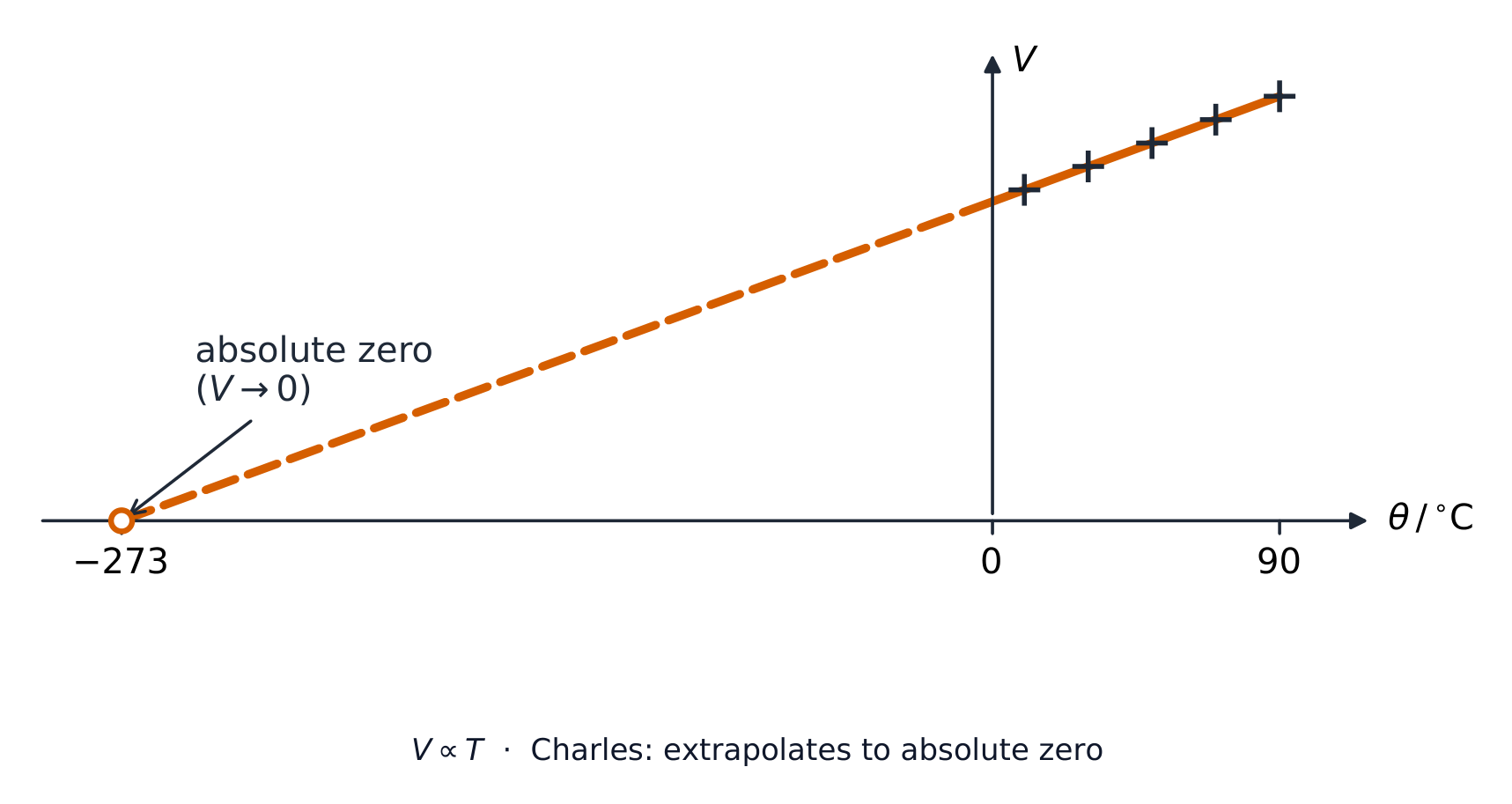
La línea apunta hacia el cero absoluto, lo cual hace que la escala kelvin sea la natural
The ideal gas (Boyle) · El gas ideal (Boyle)
p = k / V
At constant temperature p ∝ 1/V — squeeze the volume and pressure rises. · A temperatura constante p ∝ 1/V — si se comprime el volumen, la presión aumenta.
At constant temperature, a gas at $100\ \text{kPa}$ is squeezed to half its volume. What is the new pressure? · A temperatura constante, un gas a $100\ \text{kPa}$ se comprime a la mitad de su volumen. ¿Cuál es la nueva presión?
Boyle: $pV$ is constant, so halving $V$ doubles $p$ → $200\ \text{kPa}$. · Boyle: $pV$ es constante, por lo que al reducir $V$ a la mitad, $p$ se duplica → $200\ \text{kPa}$.
At constant pressure, $V$ divided by $T$ stays ____. · A presión constante, $V$ dividido por $T$ permanece ____.
That is Charles's law: $\dfrac{V}{T} =$ constant at fixed pressure. · Esa es la ley de Charles: $\dfrac{V}{T} =$ constante a presión fija.
Match each gas law to what is held constant and what stays constant. · Empareja cada ley de los gases con lo que se mantiene constante y qué permanece constante.
All three are the parent equation with one quantity fixed, so the fixed one cancels from p1V1/T1 = p2V2/T2. · Las tres son la ecuación padre con una cantidad fija, por lo que la fija se cancela de p1V1/T1 = p2V2/T2.
Worked example: heating at constant pressure
- A fixed mass of gas at $300\ \text{K}$ occupies $0.50\ \text{m}^3$. It is heated to $450\ \text{K}$ at constant pressure. Find the new volume.
- Pressure is constant, so it cancels from $p_1V_1/T_1 = p_2V_2/T_2$, leaving $V/T$ constant.
- Both temperatures are already in kelvin here. Had they been in °C, the ratio would have been meaningless: $\tfrac{177}{27}$ is not $\tfrac{450}{300}$.
Ejemplo resuelto: calentamiento a presión constante
- Una masa fija de gas a $300\ \text{K}$ ocupa $0.50\ \text{m}^3$. Se calienta hasta $450\ \text{K}$ a presión constante. Encuentra el nuevo volumen.
- La presión es constante, por lo que se cancela en $p_1V_1/T_1 = p_2V_2/T_2$, dejando $V/T$ constante.
- Aquí ambas temperaturas ya están en kelvin. Si hubieran estado en °C, la razón carecería de sentido: $\tfrac{177}{27}$ no es igual a $\tfrac{450}{300}$.
A fixed mass of gas at 300 K occupies 0.50 m^3. It is heated to 450 K at constant pressure. What is the new volume in m^3? · Una masa fija de gas a 300 K ocupa 0.50 m^3. Se calienta hasta 450 K a presión constante. ¿Cuál es el nuevo volumen en m^3?
Pressure cancels, leaving V/T constant: V2 = 0.50 x 450/300 = 0.75 m^3. The ratio only works because both temperatures are in kelvin. · La presión se cancela, dejando V/T constante: V2 = 0.50 x 450/300 = 0.75 m^3. La proporción solo funciona porque ambas temperaturas están en kelvin.
Worked example: reading a p-V cycle
- A fixed amount of gas at temperature $T$ is in state X, with pressure $2p$ and volume $V$. It is cooled at constant volume to state Y at pressure $p$, then heated at constant pressure to state Z at volume $2V$.
- X to Y is at constant volume, so $p/T$ is constant. Halving the pressure halves the temperature: $T_{\text{Y}} = T/2$.
- Y to Z is at constant pressure, so $V/T$ is constant. Doubling the volume doubles the temperature: $T_{\text{Z}} = T$.
- On a $p$-$V$ diagram a vertical line is constant volume and a horizontal line is constant pressure, and $pV/T$ has the same value at every state on the cycle. That last fact is what lets you check your answers.
Ejemplo resuelto: leer un ciclo p-V
- Una cantidad fija de gas a temperatura $T$ está en el estado X, con presión $2p$ y volumen $V$. Se enfría a volumen constante hasta el estado Y a presión $p$, luego se calienta a presión constante hasta el estado Z a volumen $2V$.
- X a Y es a volumen constante, así que $p/T$ es constante. Reducir la presión a la mitad reduce la temperatura a la mitad: $T_{\text{Y}} = T/2$.
- Y a Z es a presión constante, así que $V/T$ es constante. Duplicar el volumen duplica la temperatura: $T_{\text{Z}} = T$.
- En un diagrama $p$-$V$, una línea vertical indica volumen constante y una horizontal indica presión constante, y $pV/T$ tiene el mismo valor en cada estado del ciclo. Ese último hecho es lo que permite verificar tus respuestas.
A fixed amount of gas at temperature T, pressure 2p and volume V is cooled at constant volume to pressure p. What is its new temperature? · Una cantidad fija de gas a temperatura T, presión 2p y volumen V se enfría a volumen constante hasta una presión p. ¿Cuál es su nueva temperatura?
At constant volume p/T is constant, so halving the pressure halves the absolute temperature. On a p-V diagram this is a vertical line. · A volumen constante p/T es constante, por lo que al reducir la presión a la mitad, la temperatura absoluta también se reduce a la mitad. En un diagrama p-V esto es una línea vertical.
Marks that slip away
- Kelvin, always. $T(\text{K}) = \theta(^\circ\text{C}) + 273$. This is the most-penalised error in the topic.
- Match the form to the amount: moles with $R$, molecules with $k$. Mixing them is out by $N_{\text{A}}$.
- The two-mark definition of an ideal gas needs "at all values of $p$, $V$ and $T$" as well as the relationship.
- Volumes in m³ and pressures in Pa. A volume in litres or a pressure in kPa must be converted first.
Puntos que se escapan
- Kelvin, siempre. $T(\text{K}) = \theta(^\circ\text{C}) + 273$. Este es el error más penalizado en el tema.
- Ajusta la forma a la cantidad: moles con $R$, moléculas con $k$. Mezclarlos introduce un factor $N_{\text{A}}$ de error.
- La definición de dos puntos de un gas ideal necesita "en todos los valores de $p$, $V$ y $T$" además de la relación.
- Volúmenes en m³ y presiones en Pa. Un volumen en litros o una presión en kPa deben convertirse primero.
You've got it
- an ideal gas obeys $pV \propto T$ with $T$ thermodynamic, at all values of $p$, $V$ and $T$
- $pV = nRT$ with moles and $R$, or $pV = NkT$ with molecules and $k$, and $k = R/N_{\text{A}}$; temperature in kelvin and SI units throughout
- for a fixed amount, $\dfrac{p_1V_1}{T_1} = \dfrac{p_2V_2}{T_2}$, and anything held constant cancels
- the three cases: Boyle ($pV$ constant), Charles ($V/T$ constant), pressure law ($p/T$ constant)
Lo has entendido
- un gas ideal obedece $pV \propto T$ con $T$ termodinámica, en todos los valores de $p$, $V$ y $T$
- $pV = nRT$ con moles y $R$, o $pV = NkT$ con moléculas y $k$, y $k = R/N_{\text{A}}$; temperatura en kelvin y unidades SI en todo momento
- para una cantidad fija, $\dfrac{p_1V_1}{T_1} = \dfrac{p_2V_2}{T_2}$, y cualquier cantidad mantenida constante se cancela
- los tres casos: Boyle ($pV$ constante), Charles ($V/T$ constante), ley de la presión ($p/T$ constante)