Electric current · Corriente eléctrica
| English | Español |
|---|---|
| current/ˈkʌrənt/ | corriente |
| charge carriers/tʃɑːdʒ ˈkærɪəz/ | portadores de carga |
| conventional current/kənˈvenʃənl ˈkʌrənt/ | corriente convencional |
| quantised/ˈkwɒntaɪzd/ | cuantizados |
| elementary charge/ˌelɪˈmentəri tʃɑːdʒ/ | carga elemental |
| coulomb/ˈkuːlɒm/ | coulomb |
| drift velocity/drɪft vəˈlɒsɪti/ | velocidad de deriva |
| number density/ˈnʌmbə ˈdensɪti/ | densidad numérica |
| semiconductor/ˌsemɪkənˈdʌktə/ | semiconductor |
Slower than a snail
- Flip a switch and the light comes on instantly.
- Yet the electrons themselves drift through the wire slower than a snail.
- The push (the electric field) travels fast; the charges crawl.
Más lento que un caracol
- Al encender un interruptor, la luz se ilumina al instante.
- Sin embargo, los propios electrones derivan a través del cable más despacio que un caracol.
- El empuje (el campo eléctrico) viaja rápido; las cargas se arrastran lentamente.
What current 电流 is
- An electric current is a flow of charge carriers 载流子 (electrons in a metal, ions in a liquid).
- Conventional current 常规电流 points the way positive charge would flow — opposite to the electrons.
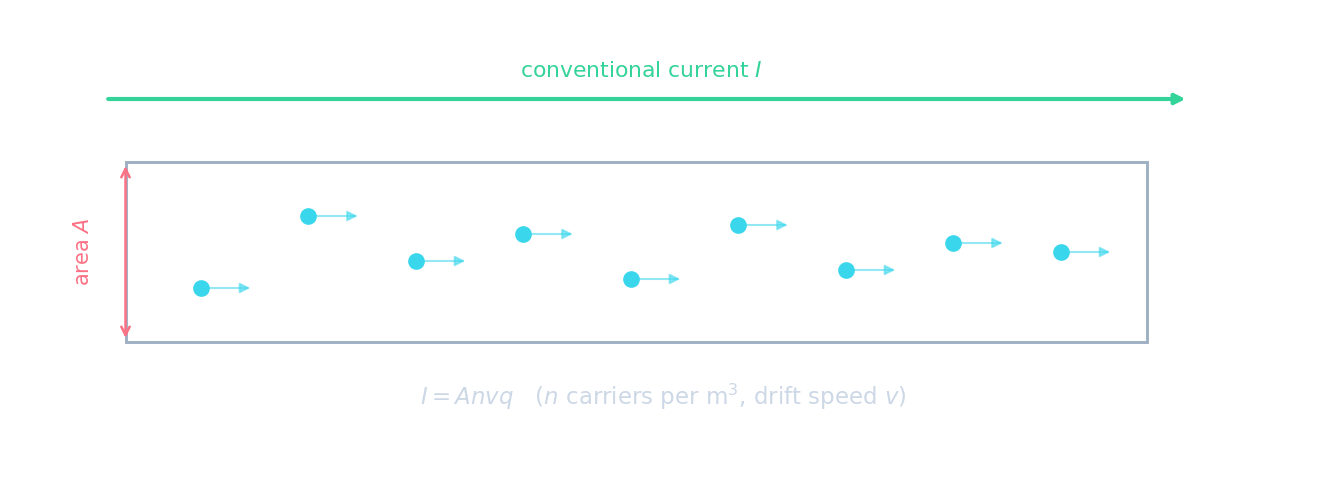
Charge carriers drifting inside a conductor
Qué es la corriente 电流
- Una corriente eléctrica 电流 es un flujo de portadores de carga 载流子 (electrones en un metal, iones en un líquido).
- La corriente convencional 常规电流 indica la dirección en la que fluiría una carga positiva, opuesta a la de los electrones.

Portadores de carga derivando dentro de un conductor
Current, voltage and resistance · Corriente, voltaje y resistencia
Current is the rate of flow of charge. Raise the voltage and current rises; raise the resistance and it falls — I = V / R. · La corriente es la tasa de flujo de carga. Aumenta el voltaje y aumenta la corriente; aumenta la resistencia y disminuye — I = V / R.
Conventional current points in the direction that: · La corriente convencional apunta en la dirección que:
Conventional current is the flow of positive charge — opposite to the electron drift in a metal wire. · La corriente convencional es el flujo de carga positiva — opuesta a la deriva de electrones en un cable metálico.
Charge comes in lumps
- Charge is quantised 量子化: the smallest free unit is the elementary charge 基本电荷 $e = 1.60 \times 10^{-19}\ \text{C}$.
- Every free charge is a whole-number multiple of $e$. Unit of charge: the coulomb 库仑 (C).
La carga viene en paquetes
- La carga está cuantizada 量子化: la unidad libre más pequeña es la carga elemental 基本电荷 $e = 1.60 \times 10^{-19}\ \text{C}$.
- Toda carga libre es un múltiplo entero de $e$. Unidad de carga: el coulomb 库仑 (C).
The smallest free unit of charge is the ____ charge, $e = 1.6 \times 10^{-19}\ \text{C}$. · La unidad más pequeña de carga libre es la carga ____, $e = 1.6 \times 10^{-19}\ \text{C}$.
All free charges are whole-number multiples of the elementary charge $e$. · Toda carga libre es un múltiplo de número entero de la carga elemental $e$.
Current = charge per second
- $I = \dfrac{Q}{t}$, so $Q = It$. Unit: the ampere ($1\ \text{A} = 1\ \dfrac{\text{C}}{\text{s}}$).
- For a changing current, the charge is the area under an $I$–$t$ graph.
- Time must be in seconds — a question that says "minutes" is testing exactly that.
Corriente = carga por segundo
- $I = \dfrac{Q}{t}$, por lo tanto $Q = It$. Unidad: el amperio ($1\ \text{A} = 1\ \dfrac{\text{C}}{\text{s}}$).
- Para una corriente variable, la carga es el área bajo una gráfica de $I$–$t$.
- El tiempo debe estar en segundos: una pregunta que dice "minutos" pone a prueba específicamente esto.
A current of $2.0\ \text{A}$ flows for $5.0\ \text{s}$. How much charge passes? · Una corriente de $2.0\ \text{A}$ fluye durante $5.0\ \text{s}$. ¿Cuánta carga pasa?
$Q = It = 2.0 \times 5.0 = 10\ \text{C}$.
The charge that has flowed equals the area under an $I$–$t$ graph. · La carga que ha fluído es igual al área bajo una gráfica $I$–$t$.
Yes — current is the rate of flow of charge, so the area (current × time) gives the total charge. · Sí — la corriente es la tasa de flujo de carga, por lo que el área (corriente × tiempo) da la carga total.
Worked example: how many electrons?
A current of $0.25\ \text{A}$ flows in a wire for $4.0$ minutes. How much charge passes, and how many electrons is that?
- Seconds first: $t = 4.0 \times 60 = 240\ \text{s}$.
- Charge: $Q = It = 0.25 \times 240 = 60\ \text{C}$.
- Electrons: $N = \dfrac{Q}{e} = \dfrac{60}{1.60 \times 10^{-19}} = 3.8 \times 10^{20}$.
- Check: a huge number from a small current — that is normal, because each electron carries so little charge.
Ejemplo resuelto: ¿cuántos electrones?
Una corriente de $0.25\ \text{A}$ circula por un cable durante $4.0$ minutos. ¿Cuánta carga pasa y cuántos electrones son eso?
- Segundos primero: $t = 4.0 \times 60 = 240\ \text{s}$.
- Carga: $Q = It = 0.25 \times 240 = 60\ \text{C}$.
- Electrones: $N = \dfrac{Q}{e} = \dfrac{60}{1.60 \times 10^{-19}} = 3.8 \times 10^{20}$.
- Comprobación: un número enorme proveniente de una corriente pequeña — eso es normal, porque cada electrón transporta muy poca carga.
A current of $0.50\ \text{A}$ flows for $2.0$ minutes. How many electrons pass a point in the wire? Give your answer as a multiple of $10^{20}$. · Una corriente de $0.50\ \text{A}$ fluye durante $2.0$ minutos. ¿Cuántos electrones pasan por un punto del cable? Da tu respuesta como un múltiplo de $10^{20}$.
$Q = It = 0.50 \times 120 = 60\ \text{C}$, so $N = \dfrac{60}{1.60 \times 10^{-19}} = 3.75 \times 10^{20}$. Minutes must become seconds first. · $Q = It = 0.50 \times 120 = 60\ \text{C}$, así que $N = \dfrac{60}{1.60 \times 10^{-19}} = 3.75 \times 10^{20}$. Los minutos deben convertirse a segundos primero.
Drift velocity 漂移速度
- $I = Anvq$ — area $A$, carrier number density 数密度 $n$, drift speed $v$, charge $q$ each.
- Same current in a thinner wire → faster drift; a semiconductor 半导体 (small $n$) → much faster drift.
Velocidad de deriva 漂移速度
- $I = Anvq$ — área $A$, densidad numérica de portadores 数密度 $n$, velocidad de deriva $v$, carga $q$ cada uno.
- Misma corriente en un cable más delgado → deriva más rápida; un semiconductor 半导体 (pequeño $n$) → deriva mucho más rápida.
Which equation gives the current in terms of the drift velocity? · ¿Cuál ecuación da la corriente en términos de la velocidad de deriva?
Current = (area)(number density)(drift speed)(charge per carrier) $= Anvq$. · Corriente = (área)(densidad numérica)(velocidad de deriva)(carga por portador) $= Anvq$.
In a thinner wire carrying the same current, the electrons drift faster. · En un cable más delgado que transporta la misma corriente, los electrones se desplazan más rápido.
From $I = Anvq$, a smaller area $A$ at the same $I$ needs a larger drift speed $v$. · De $I = Anvq$, un área menor $A$ a la misma $I$ requiere una mayor velocidad de deriva $v$.
Match each quantity in $I = Anvq$ to its SI unit. · Empareja cada cantidad en $I = Anvq$ con su unidad SI.
Multiply the units out: $\text{m}^{2} \times \text{m}^{-3} \times \dfrac{\text{m}}{\text{s}} \times \text{C} = \dfrac{\text{C}}{\text{s}} = \text{A}$, which is the check that the equation makes sense. · Multiplica las unidades: $\text{m}^{2} \times \text{m}^{-3} \times \dfrac{\text{m}}{\text{s}} \times \text{C} = \dfrac{\text{C}}{\text{s}} = \text{A}$, lo cual es la verificación de que la ecuación tiene sentido.
Where $n$ comes from
- In a metal, each atom gives up about one free electron, so $n$ is simply the number of atoms per cubic metre.
- Atoms per $\text{m}^{3}$ = $\dfrac{\text{density} \times N_{\text{A}}}{\text{molar mass}}$. For copper: $n = \dfrac{(8.9 \times 10^{3})(6.02 \times 10^{23})}{0.0635} = 8.4 \times 10^{28}\ \text{m}^{-3}$.
- Metals sit around $10^{28}$–$10^{29}\ \text{m}^{-3}$; semiconductors are many powers of ten lower.
De dónde sale $n$
- En un metal, cada átomo cede aproximadamente un electrón libre, así que $n$ es simplemente el número de átomos por metro cúbico.
- Átomos por $\text{m}^{3}$ = $\dfrac{\text{density} \times N_{\text{A}}}{\text{molar mass}}$. Para el cobre: $n = \dfrac{(8.9 \times 10^{3})(6.02 \times 10^{23})}{0.0635} = 8.4 \times 10^{28}\ \text{m}^{-3}$.
- Los metales se sitúan alrededor de $10^{28}$–$10^{29}\ \text{m}^{-3}$; los semiconductores están varios órdenes de magnitud por debajo.
Worked example: drift speed in a copper wire
A copper wire of diameter $1.3\ \text{mm}$ carries $2.0\ \text{A}$. Using $n = 8.4 \times 10^{28}\ \text{m}^{-3}$, find the drift speed. The wire then narrows to half the diameter.
- Area: $A = \pi r^{2} = \pi (0.65 \times 10^{-3})^{2} = 1.3 \times 10^{-6}\ \text{m}^{2}$.
- Drift speed: $v = \dfrac{I}{nAe} = \dfrac{2.0}{(8.4 \times 10^{28})(1.3 \times 10^{-6})(1.60 \times 10^{-19})} = 1.1 \times 10^{-4}\ \dfrac{\text{m}}{\text{s}}$ — about a tenth of a millimetre per second.
- Narrow section: the current is the same everywhere along the wire, so $v \propto \dfrac{1}{A} \propto \dfrac{1}{r^{2}}$. Half the diameter → a quarter of the area → four times the drift speed.
- Check: the electrons speed up in the narrow part for the same reason water speeds up in a narrow pipe — the same flow has to get through a smaller opening.
Ejemplo resuelto: velocidad de deriva en un cable de cobre
Un cable de cobre de diámetro $1.3\ \text{mm}$ transporta $2.0\ \text{A}$. Usando $n = 8.4 \times 10^{28}\ \text{m}^{-3}$, encuentra la velocidad de deriva. Luego el cable se estrecha a la mitad del diámetro.
- Área: $A = \pi r^{2} = \pi (0.65 \times 10^{-3})^{2} = 1.3 \times 10^{-6}\ \text{m}^{2}$.
- Velocidad de deriva: $v = \dfrac{I}{nAe} = \dfrac{2.0}{(8.4 \times 10^{28})(1.3 \times 10^{-6})(1.60 \times 10^{-19})} = 1.1 \times 10^{-4}\ \dfrac{\text{m}}{\text{s}}$ — aproximadamente una décima de milímetro por segundo.
- Sección estrecha: la corriente es la misma en todas partes a lo largo del cable, por lo que $v \propto \dfrac{1}{A} \propto \dfrac{1}{r^{2}}$. La mitad del diámetro → un cuarto del área → cuatro veces la velocidad de deriva.
- Comprobación: los electrones aceleran en la parte estrecha por la misma razón por la que el agua acelera en una tubería estrecha — el mismo flujo tiene que pasar por una abertura más pequeña.
A wire of cross-sectional area $2.0 \times 10^{-6}\ \text{m}^{2}$ carries $3.2\ \text{A}$. The number density of free electrons is $1.0 \times 10^{29}\ \text{m}^{-3}$. What is the drift speed, in mm/s? · Un cable de área transversal $2.0 \times 10^{-6}\ \text{m}^{2}$ transporta $3.2\ \text{A}$. La densidad numérica de electrones libres es $1.0 \times 10^{29}\ \text{m}^{-3}$. ¿Cuál es la velocidad de deriva, en mm/s?
$v = \dfrac{I}{nAe} = \dfrac{3.2}{(1.0 \times 10^{29})(2.0 \times 10^{-6})(1.60 \times 10^{-19})} = 1.0 \times 10^{-4}\ \dfrac{\text{m}}{\text{s}} = 0.10\ \dfrac{\text{mm}}{\text{s}}$.
Three slips cost marks here. $A$ must be in $\text{m}^{2}$: a diameter in mm gives an area in $\text{mm}^{2}$, and $1\ \text{mm}^{2} = 10^{-6}\ \text{m}^{2}$. Use the radius in $\pi r^{2}$, not the diameter. And a narrower part of a wire does not carry less current — the current is the same all along a series path; the drift speed is what changes.
Tres errores restan puntos aquí. $A$ debe estar en $\text{m}^{2}$: un diámetro en mm da un área en $\text{mm}^{2}$, y $1\ \text{mm}^{2} = 10^{-6}\ \text{m}^{2}$. Usa el radio en $\pi r^{2}$, no el diámetro. Y una parte más estrecha de un cable no transporta menos corriente — la corriente es la misma a lo largo de un trayecto en serie; lo que cambia es la velocidad de deriva.
You've got it
- current is a flow of charge; conventional current = direction of positive flow
- $I = \dfrac{Q}{t}$ (seconds!), and charge is the area under an $I$–$t$ graph; electrons $= \dfrac{Q}{e}$
- drift: $I = Anvq$; $n \approx 10^{29}\ \text{m}^{-3}$ for a metal; same current, smaller area → faster drift
Lo has entendido
- la corriente es un flujo de carga; corriente convencional = dirección del flujo positivo
- $I = \dfrac{Q}{t}$ (¡en segundos!), y la carga es el área bajo una gráfica de $I$–$t$; electrones $= \dfrac{Q}{e}$
- deriva: $I = Anvq$; $n \approx 10^{29}\ \text{m}^{-3}$ para un metal; misma corriente, área menor → deriva más rápida