The electromagnetic spectrum · El espectro electromagnético
| English | Español |
|---|---|
| electromagnetic waves/ɪˌlektrəʊməɡˈnetɪk weɪvz/ | ondas electromagnéticas |
| spectrum/ˈspektrəm/ | espectro |
| vacuum/ˈvækjuːm/ | vacío |
| microwave/ˈmaɪkrəʊweɪv/ | microonda |
| infrared/ˌɪnfrəˈred/ | infrarrojo |
| ultraviolet/ˌʊltrəˈvaɪəlɪt/ | ultravioleta |
| gamma/ˈɡæmə/ | gamma |
All the same family
- Radio, the heat from a fire, sunburn, a hospital X-ray — all are electromagnetic waves 电磁波.
- They differ only in wavelength (and so frequency).
- One family, one spectrum 光谱.
Todos de la misma familia
- Radio, el calor de una fogata, la quemadura solar y los rayos X de un hospital — todos son ondas electromagnéticas 电磁波.
- Difieren únicamente en su longitud de onda (y por tanto en su frecuencia).
- Una sola familia, un solo espectro 光谱.
What they share
- All EM waves are transverse.
- In a vacuum 真空 they all travel at the same speed, $c = 3.00 \times 10^{8}\ \dfrac{\text{m}}{\text{s}}$.
The electromagnetic spectrum
Lo que comparten
- Todas las ondas EM son transversales.
- En el vacío 真空 viajan todas a la misma velocidad, $c = 3.00 \times 10^{8}\ \dfrac{\text{m}}{\text{s}}$.
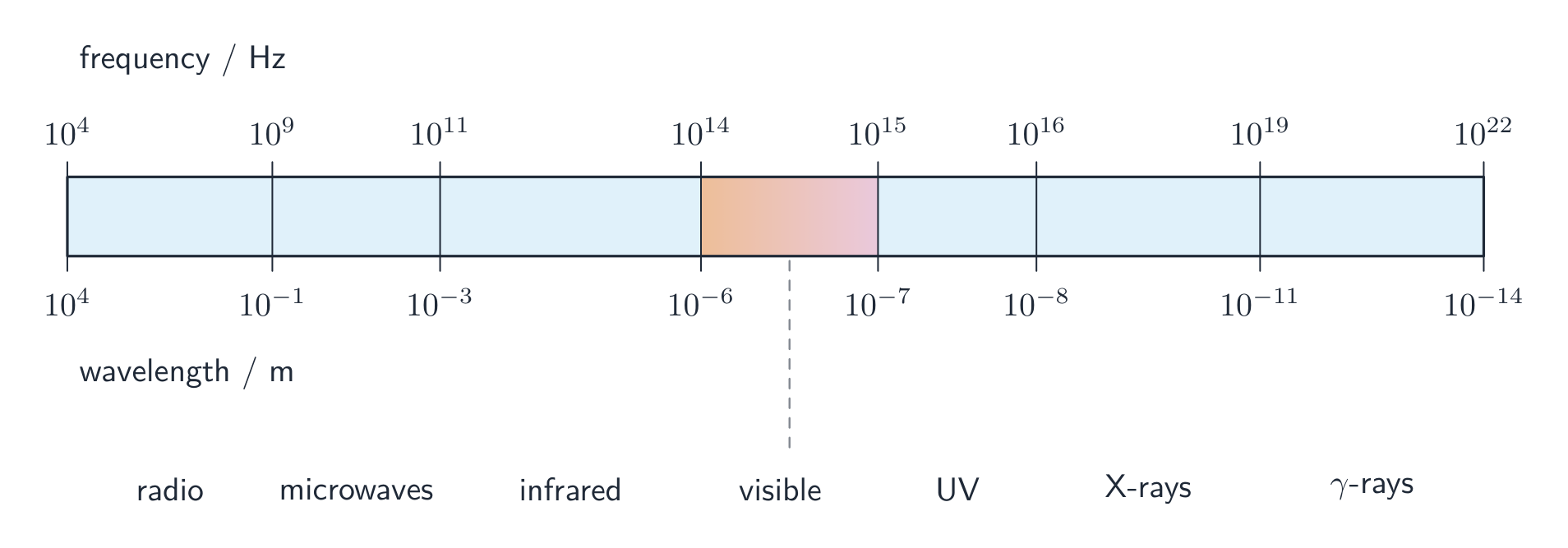
El espectro electromagnético
Slide across the spectrum · Desliza por el espectro
Radio waves, visible light and gamma rays are all the same wave — only the wavelength changes, and with it the frequency, photon energy and everyday use. · Las ondas de radio, la luz visible y los rayos gamma son todas la misma onda; solo cambia la longitud de onda, y con ella la frecuencia, la energía del fotón y su uso cotidiano.
All electromagnetic waves are transverse. · Todas las ondas electromagnéticas son transversales.
Yes — every EM wave is transverse, and all travel at $c$ in a vacuum. · Sí — toda onda EM es transversal, y todas viajan a $c$ en el vacío.
In a vacuum, which EM wave travels the fastest? · En el vacío, ¿qué onda EM viaja más rápido?
In a vacuum every EM wave travels at $c = 3.0 \times 10^{8}\ \dfrac{\text{m}}{\text{s}}$. · En el vacío, toda onda EM viaja a $c = 3.0 \times 10^{8}\ \dfrac{\text{m}}{\text{s}}$.
What do all electromagnetic waves share? Select all · todos that apply. · ¿Qué comparten todas las ondas electromagnéticas? Selecciona todas las que correspondan.
Needing no medium is exactly what lets sunlight cross space. Being transverse is what makes every one of them polarisable, unlike sound. · No necesitar medio es exactamente lo que permite que la luz solar cruce el espacio. Ser transversal es lo que hace que cada una de ellas sea polarizable, a diferencia del sonido.
The spectrum in order
- From long to short wavelength: radio · microwave 微波 · infrared 红外线 · visible · ultraviolet 紫外线 · X-ray · gamma 伽马.
- As wavelength decreases, frequency increases.
El espectro en orden
- De mayor a menor longitud de onda: radio · microondas 微波 · infrarrojo 红外线 · visible · ultravioleta 紫外线 · rayos X · gamma 伽马.
- A medida que disminuye la longitud de onda, aumenta la frecuencia.
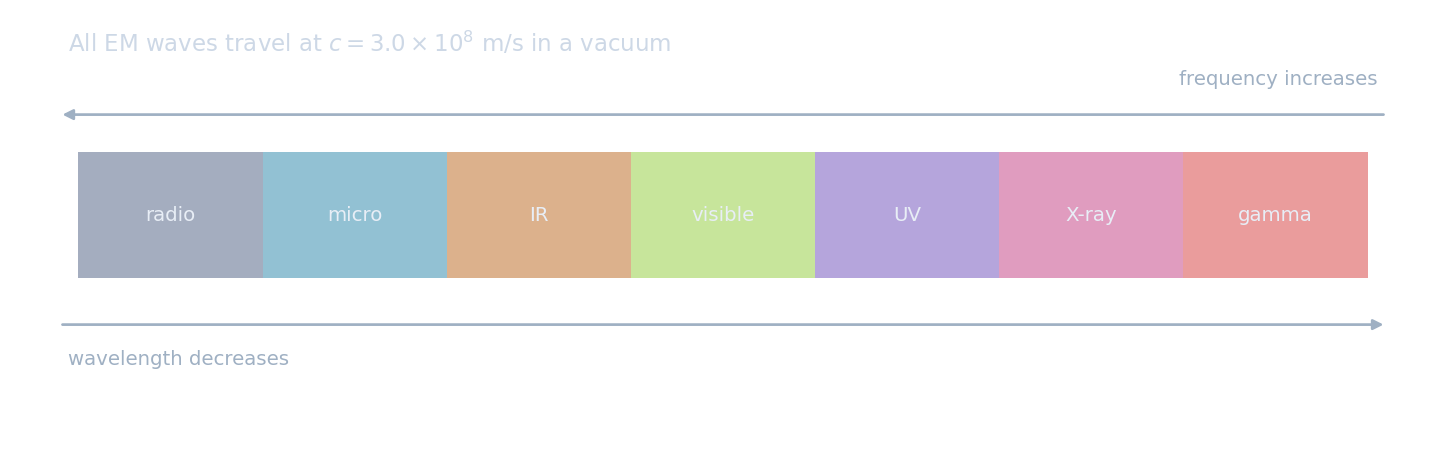
Put these in order of increasing frequency (lowest first). · Ordena estos elementos según frecuencia creciente (la más baja primero).
Frequency rises as wavelength falls: radio (longest) → microwave → visible → X-ray (much shorter). · La frecuencia aumenta a medida que disminuye la longitud de onda: radio (más larga) → microonda → visible → Rayos X (mucho más corta).
Put the electromagnetic spectrum in order of increasing wavelength. · Ordena el espectro electromagnético según longitud de onda creciente.
Increasing wavelength is decreasing frequency and decreasing photon energy, so the same list read backwards answers all three questions. · Aumentar la longitud de onda significa disminuir la frecuencia y la energía del fotón, por lo que leer la misma lista al revés responde las tres preguntas.
Wavelengths and the link
- Learn the orders of magnitude: radio $> 10^{-1}\ \text{m}$; microwave $10^{-1}$ to $10^{-3}\ \text{m}$; infrared $10^{-3}$ to $7 \times 10^{-7}\ \text{m}$; visible $400$–$700\ \text{nm}$; ultraviolet $4 \times 10^{-7}$ to $10^{-8}\ \text{m}$; X-rays $10^{-8}$ to $10^{-13}\ \text{m}$; gamma below about $10^{-10}\ \text{m}$.
- Visible light is the narrow band $400$–$700\ \text{nm}$ — violet at the short end, red at the long end.
- Switch between $\lambda$ and $f$ with $c = f\lambda$.
Longitudes de onda y la relación
- Aprende los órdenes de magnitud: radio $> 10^{-1}\ \text{m}$; microondas entre $10^{-1}$ y $10^{-3}\ \text{m}$; infrarrojo entre $10^{-3}$ y $7 \times 10^{-7}\ \text{m}$; visible entre $400$ y $700\ \text{nm}$; ultravioleta entre $4 \times 10^{-7}$ y $10^{-8}\ \text{m}$; rayos X entre $10^{-8}$ y $10^{-13}\ \text{m}$; gamma por debajo de aproximadamente $10^{-10}\ \text{m}$.
- La luz visible es la estrecha banda de $400$–$700\ \text{nm}$ — violeta en el extremo de longitud corta, rojo en el de longitud larga.
- Alterna entre $\lambda$ y $f$ usando $c = f\lambda$.
Visible light has wavelengths of roughly: · La luz visible tiene longitudes de onda aproximadas de:
About $400\ \text{nm}$ (violet) to $700\ \text{nm}$ (red) — a tiny slice of the whole spectrum. · Alrededor de $400\ \text{nm}$ (violeta) a $700\ \text{nm}$ (rojo) — una pequeña porción del espectro completo.
A radio wave has wavelength $3.0\ \text{m}$. What is its frequency, in MHz? (Use $c = 3.0 \times 10^{8}\ \dfrac{\text{m}}{\text{s}}$.) · Una onda de radio tiene una longitud de onda de $3.0\ \text{m}$. ¿Cuál es su frecuencia, en MHz? (Usa $c = 3.0 \times 10^{8}\ \dfrac{\text{m}}{\text{s}}$.)
$f = \dfrac{c}{\lambda} = \dfrac{3.0 \times 10^{8}}{3.0} = 1.0 \times 10^{8}\ \text{Hz} = 100\ \text{MHz}$.
Naming the region
- Exam questions give a wavelength or a frequency and ask which region. Convert to wavelength if needed, then place it on the ladder.
- Just below $400\ \text{nm}$ is ultraviolet; just above $700\ \text{nm}$ is infrared.
- X-rays and gamma rays overlap in wavelength — they are told apart by where they come from (X-rays from electrons, gamma from nuclei), so either name can be right in the overlap.
Identificación de la región
- Las preguntas de examen dan una longitud de onda o una frecuencia y piden cuál es la región. Convierte a longitud de onda si es necesario, luego ubícala en la escala.
- Justo por debajo de $400\ \text{nm}$ está el ultravioleta; justo por encima de $700\ \text{nm}$ está el infrarrojo.
- Los rayos X y los rayos gamma se superponen en longitud de onda — se distinguen por su origen (rayos X procedentes de electrones, gamma procedentes de núcleos), por lo que cualquiera de los dos nombres puede ser correcto en la zona de superposición.
An electromagnetic wave has a wavelength of 500 nm. What is its frequency, in units of 1e14 Hz? · Una onda electromagnética tiene una longitud de onda de 500 nm. ¿Cuál es su frecuencia, en unidades de 1e14 Hz?
f = c/lambda = 3.00e8/5.00e-7 = 6.0e14 Hz, in the green of the visible band. Convert nm to m before dividing. · f = c/lambda = 3.00e8/5.00e-7 = 6.0e14 Hz, en el verde de la banda visible. Convierte nm a m antes de dividir.
Worked example: which region, and what period?
(a) A laser emits waves of wavelength $8.1 \times 10^{-8}\ \text{m}$. (b) A satellite link uses $12\ \text{GHz}$. Name each region and find the period of the satellite waves in picoseconds.
- (a) $8.1 \times 10^{-8}\ \text{m} = 81\ \text{nm}$, which is below $400\ \text{nm}$ but above $10^{-8}\ \text{m}$: ultraviolet. Its frequency is $f = \dfrac{c}{\lambda} = \dfrac{3.00 \times 10^{8}}{8.1 \times 10^{-8}} = 3.7 \times 10^{15}\ \text{Hz}$.
- (b) $\lambda = \dfrac{c}{f} = \dfrac{3.00 \times 10^{8}}{12 \times 10^{9}} = 0.025\ \text{m}$: a few centimetres, so microwave.
- Period: $T = \dfrac{1}{f} = \dfrac{1}{12 \times 10^{9}} = 8.3 \times 10^{-11}\ \text{s} = 83\ \text{ps}$.
- Check: $1\ \text{ps} = 10^{-12}\ \text{s}$, so divide by $10^{-12}$ to convert — an answer of $0.083\ \text{ps}$ means the prefix was applied the wrong way.
Ejemplo resuelto: qué región y qué periodo?
(a) Un láser emite ondas con una longitud de onda de $8.1 \times 10^{-8}\ \text{m}$. (b) Un enlace satelital utiliza $12\ \text{GHz}$. Nombra cada región y halla el periodo de las ondas del satélite en picosegundos.
- (a) $8.1 \times 10^{-8}\ \text{m} = 81\ \text{nm}$, que es inferior a $400\ \text{nm}$ pero superior a $10^{-8}\ \text{m}$: ultravioleta. Su frecuencia es $f = \dfrac{c}{\lambda} = \dfrac{3.00 \times 10^{8}}{8.1 \times 10^{-8}} = 3.7 \times 10^{15}\ \text{Hz}$.
- (b) $\lambda = \dfrac{c}{f} = \dfrac{3.00 \times 10^{8}}{12 \times 10^{9}} = 0.025\ \text{m}$: unos pocos centímetros, por lo tanto microondas.
- Periodo: $T = \dfrac{1}{f} = \dfrac{1}{12 \times 10^{9}} = 8.3 \times 10^{-11}\ \text{s} = 83\ \text{ps}$.
- Comprobación: $1\ \text{ps} = 10^{-12}\ \text{s}$, así que divide entre $10^{-12}$ para convertir — una respuesta de $0.083\ \text{ps}$ indicaría que el prefijo se aplicó incorrectamente.
An electromagnetic wave has a wavelength of $5.0 \times 10^{-9}\ \text{m}$. Which region of the spectrum is it in? · Una onda electromagnética tiene una longitud de onda de $5.0 \times 10^{-9}\ \text{m}$. ¿A qué región del espectro pertenece?
$5.0 \times 10^{-9}\ \text{m} = 5\ \text{nm}$ — shorter than $10^{-8}\ \text{m}$ (the bottom of the ultraviolet range), so X-rays. · $5.0 \times 10^{-9}\ \text{m} = 5\ \text{nm}$ — más corta que $10^{-8}\ \text{m}$ (el límite inferior del rango ultravioleta), por lo tanto Rayos X.
Microwaves in a satellite link have a frequency of $12\ \text{GHz}$. What is their period, in ps? · Las microondas en un enlace satelital tienen una frecuencia de $12\ \text{GHz}$. ¿Cuál es su período, en ps?
$T = \dfrac{1}{f} = \dfrac{1}{12 \times 10^{9}} = 8.3 \times 10^{-11}\ \text{s}$, and $1\ \text{ps} = 10^{-12}\ \text{s}$, so $T = 83\ \text{ps}$. · $T = \dfrac{1}{f} = \dfrac{1}{12 \times 10^{9}} = 8.3 \times 10^{-11}\ \text{s}$, y $1\ \text{ps} = 10^{-12}\ \text{s}$, así que $T = 83\ \text{ps}$.
$c = 3.00 \times 10^{8}\ \dfrac{\text{m}}{\text{s}}$ is the speed in a vacuum (air is close enough). In glass or water the wave slows down and its wavelength shortens, but its frequency stays the same — frequency is fixed by the source. And the order of the spectrum by frequency is the reverse of the order by wavelength.
$c = 3.00 \times 10^{8}\ \dfrac{\text{m}}{\text{s}}$ es la velocidad en el vacío (el aire es suficientemente similar). En vidrio o agua la onda se desacelera y su longitud de onda se acorta, pero su frecuencia permanece igual — la frecuencia está fijada por la fuente. Además, el orden del espectro según la frecuencia es el inverso al orden según la longitud de onda.
When light passes from air into glass, its speed and wavelength both decrease but its ____ does not change. · Cuando la luz pasa del aire al vidrio, su velocidad y longitud de onda disminuyen, pero su ____ no cambia.
Frequency is set by the source. Since $v = f\lambda$, a smaller $v$ with the same $f$ means a smaller $\lambda$. · La frecuencia está determinada por la fuente. Dado que $v = f\lambda$, una menor $v$ con la misma $f$ implica una menor $\lambda$.
Recognise them by their uses
- Radio: broadcasting. Microwave: phones, satellite links, ovens. Infrared: remote controls, thermal imaging, heating.
- Visible: seeing, fibre-optic signals. Ultraviolet: fluorescence, sterilising, sunburn.
- X-rays: medical imaging. Gamma: sterilising equipment, treating cancer.
Reconocimiento por sus aplicaciones
- Radio: radiodifusión. Microondas: teléfonos, enlaces satelitales, hornos. Infrarrojo: mandos a distancia, termografía, calefacción.
- Visible: visión, señales de fibra óptica. Ultravioleta: fluorescencia, esterilización, quemaduras solares.
- Rayos X: imágenes médicas. Gamma: esterilización de equipos, tratamiento del cáncer.
You've got it
- all EM waves are transverse and travel at $c = 3.0 \times 10^{8}\ \dfrac{\text{m}}{\text{s}}$ in a vacuum
- order by wavelength: radio → microwave → IR → visible → UV → X-ray → gamma (frequency runs the other way)
- visible light is $400$–$700\ \text{nm}$; use $c = f\lambda$ and $T = \dfrac{1}{f}$ to name a region
Ya lo tienes
- Todas las ondas EM son transversales y viajan a $c = 3.0 \times 10^{8}\ \dfrac{\text{m}}{\text{s}}$ en el vacío.
- Ordenadas por longitud de onda: radio → microondas → IR → visible → UV → rayos X → gamma (la frecuencia sigue el sentido contrario).
- La luz visible abarca entre $400$ y $700\ \text{nm}$; usa $c = f\lambda$ y $T = \dfrac{1}{f}$ para identificar una región.