Elastic and plastic behaviour · Comportamiento elástico y plástico
| English | Español |
|---|---|
| elastic/ɪˈlæstɪk/ | elástica |
| plastic/ˈplæstɪk/ | plástico |
| limit of proportionality/ˈlɪmɪt ɒv prəˌpɔːʃəˈnælɪti/ | límite de proporcionalidad |
| elastic limit/ɪˈlæstɪk ˈlɪmɪt/ | límite elástico |
| permanent extension/ˈpɜːmənənt ekˈstenʃn/ | extensión permanente |
The paperclip test
- Bend a paperclip a little and it springs back — elastic 弹性.
- Bend it far and it stays bent — plastic 塑性.
- The same material can do both, depending on how hard you push it.
La prueba del clip
- Doble un poco un clip y volverá a su forma original — elástico 弹性.
- Dóblelo mucho y se quedará doblado — plástico 塑性.
- El mismo material puede hacer ambas cosas, dependiendo de cuánto lo fuerces.
Three stages of stretching
- Elastic and straight — obeys Hooke's law; returns to shape.
- Elastic but curved — past the limit of proportionality 比例极限; still returns to shape.
- Plastic — past the elastic limit 弹性极限; a permanent change is left.
A stress-strain graph, straight up to the limit of proportionality P
Tres etapas de estiramiento
- Elástico y recto — obedece la ley de Hooke; vuelve a su forma.
- Elástico pero curvo — superó el límite de proporcionalidad 比例极限; aún vuelve a su forma.
- Plástico — superó el límite elástico 弹性极限; queda un cambio permanente.
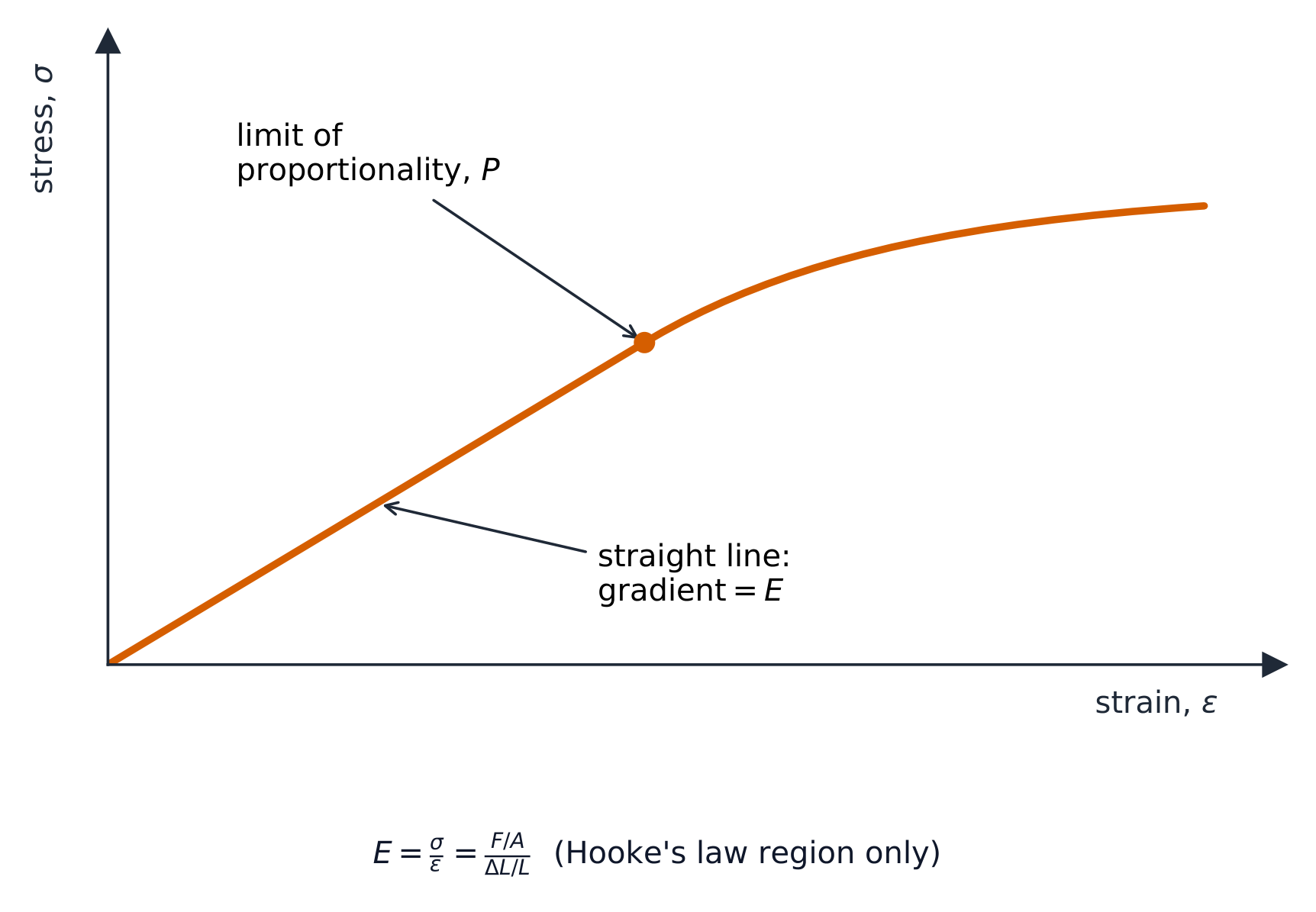
Un gráfico de tensión-deformación, recto hasta el límite de proporcionalidad P
Hooke's law · Ley de Hooke
F = kx
Up to the limit, extension is proportional to force — the gradient is the spring constant k. · Hasta el límite, la elongación es proporcional a la fuerza: la pendiente es la constante del resorte k.
Match each stage of stretching to what happens. · Asocia cada etapa de estiramiento con lo que ocurre.
Elastic = returns to its first length on unloading; plastic = a permanent change once you pass the elastic limit. · Elástico = vuelve a su longitud original al retirar la carga; plástico = un cambio permanente una vez superado el límite elástico.
Loading and unloading
- Stretch past the elastic limit, then remove the load.
- The unloading line is parallel to the first line but shifted — leaving a permanent extension 永久伸长.
Carga y descarga
- Estira más allá del límite elástico, luego retira la carga.
- La línea de descarga es paralela a la primera línea pero desplazada — dejando una elongación permanente 永久伸长.
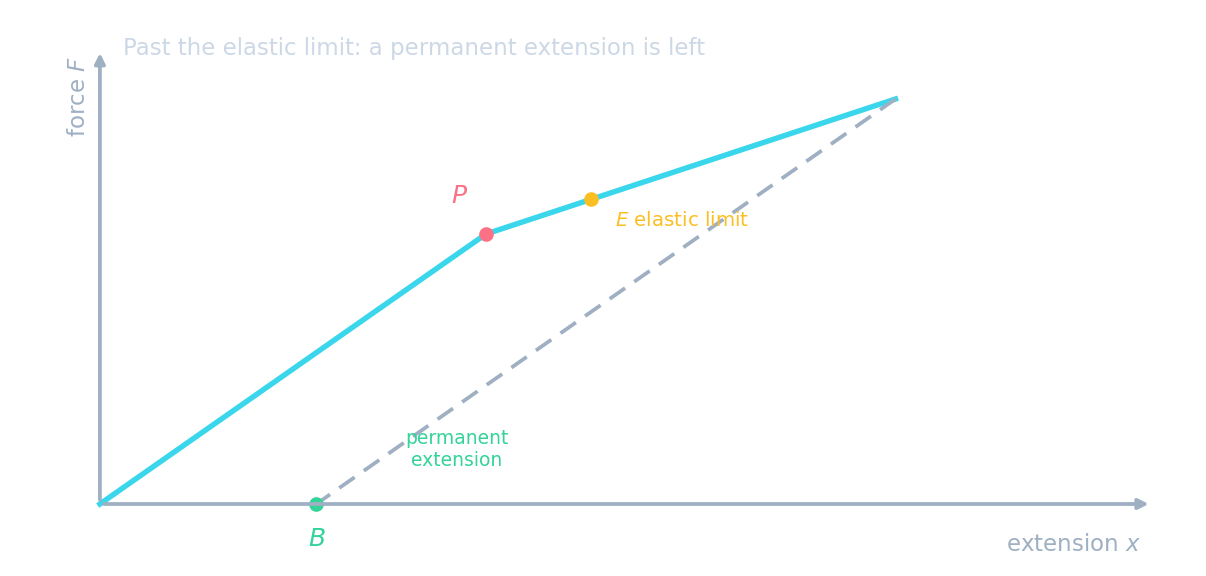
Past the elastic limit, an object returns to its original length when the load is removed. · Más allá del límite elástico, un objeto vuelve a su longitud original cuando se retira la carga.
No — in the plastic region a permanent extension stays after unloading. · No — en la región plástica queda una extensión permanente tras retirar la carga.
Match each term to the definition the examiner marks. · Asocia cada término con la definición que marca el examinador.
The elastic limit sits a little beyond the limit of proportionality, so a material can stop obeying Hooke's law while still being elastic. · El límite elástico está un poco más allá del límite de proporcionalidad, por lo que un material puede dejar de obedecer la ley de Hooke mientras sigue siendo elástico.
Energy = area under the graph
- The work done stretching a material is the area under its force–extension graph.
Energía = área bajo la gráfica
- El trabajo realizado para estirar un material es el área bajo su gráfico de fuerza-extensión.
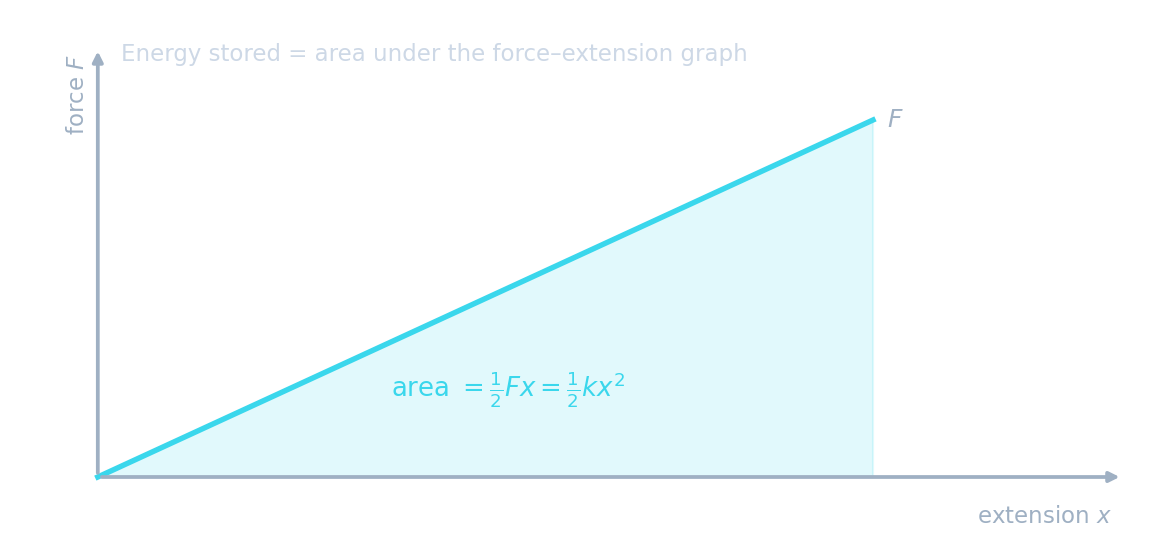
The energy stored in a stretched material equals the ____ under the force–extension graph. · La energía almacenada en un material estirado es igual a la ____ bajo la gráfica de fuerza-extensión.
Work done = area under the force–extension graph (a triangle for a Hooke material). · Trabajo realizado = área bajo la gráfica de fuerza-extensión (un triángulo para un material de Hooke).
Stored elastic energy
- For a Hooke's-law material the area is a triangle: $E_{\text{P}} = \tfrac{1}{2}Fx = \tfrac{1}{2}kx^{2}$.
- An equal form is $E_{\text{P}} = \dfrac{F^{2}}{2k}$.
Force-extension past the elastic limit: P and E marked, with a permanent extension B left after unloading
Energía elástica almacenada
- Para un material que sigue la ley de Hooke, el área es un triángulo: $E_{\text{P}} = \tfrac{1}{2}Fx = \tfrac{1}{2}kx^{2}$.
- Una forma equivalente es $E_{\text{P}} = \dfrac{F^{2}}{2k}$.
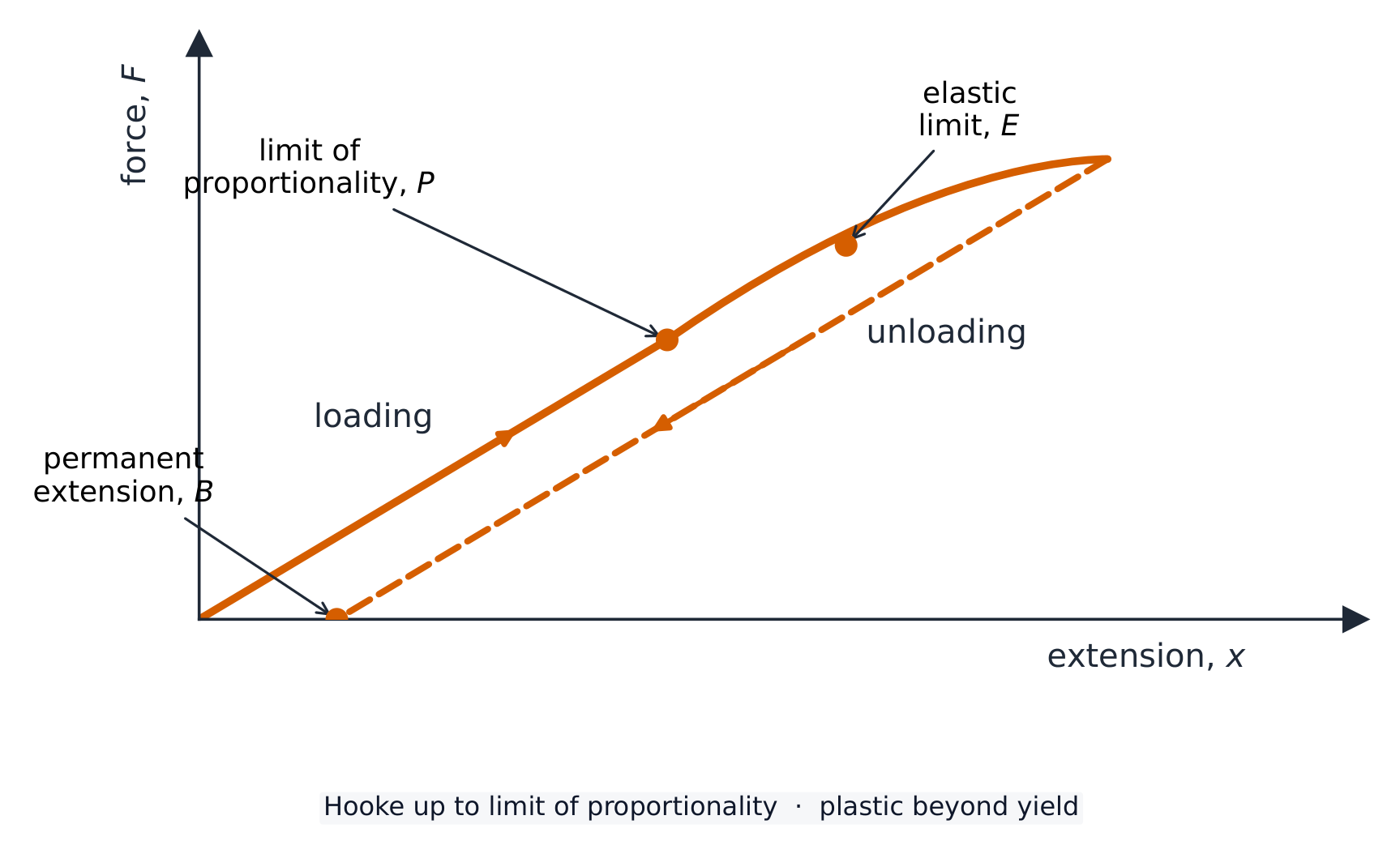
Fuerza-extensión más allá del límite elástico: P y E marcados, con una elongación permanente B dejada tras la descarga
A spring of constant $200\ \dfrac{\text{N}}{\text{m}}$ is stretched by $0.10\ \text{m}$. How much elastic PE is stored? · Un resorte de constante $200\ \dfrac{\text{N}}{\text{m}}$ se estira $0.10\ \text{m}$. ¿Cuánta energía potencial elástica se almacena?
$E_{\text{P}} = \tfrac{1}{2}kx^{2} = \tfrac{1}{2} \times 200 \times 0.10^{2} = 1.0\ \text{J}$.
When it's not a straight line
- For rubber, or a spring past its limit, the graph is a curve.
- Find the area by counting squares or using trapezia — the rule is the same.
Cuando no es una línea recta
- Para goma o un resorte pasado su límite, la gráfica es una curva.
- Encuentra el área contando cuadrados o usando trapecios — la regla es la misma.
Comparing and releasing
- Same force, softer spring (smaller $k$) → bigger $x$ → more energy stored.
- Released onto a mass, the elastic PE becomes kinetic energy: $\tfrac{1}{2}kx^{2} = \tfrac{1}{2}mv^{2}$.
Comparando y liberando
- Misma fuerza, resorte más suave (menor $k$) → mayor $x$ → más energía almacenada.
- Al soltarse sobre una masa, la PE elástica se convierte en energía cinética: $\tfrac{1}{2}kx^{2} = \tfrac{1}{2}mv^{2}$.
Two springs are pulled with the same force. The softer spring (smaller $k$) stores: · Dos resortes son jalados con la misma fuerza. El resorte más blando (menor $k$) almacena:
Same $F$, smaller $k$ → larger extension $x$ → larger area $\tfrac{1}{2}Fx$, so more energy is stored. · Misma $F$, menor $k$ → mayor extensión $x$ → mayor área $\tfrac{1}{2}Fx$, por lo que se almacena más energía.
When a stretched spring is released onto a mass, its elastic PE becomes ____ energy. · Cuando se libera un resorte estirado sobre una masa, su energía potencial elástica se convierte en energía ____.
Set · Conjunto $\tfrac{1}{2}kx^{2} = \tfrac{1}{2}mv^{2}$ (plus $mgh$ if it rises) to find the speed. · Igualar $\tfrac{1}{2}kx^{2} = \tfrac{1}{2}mv^{2}$ (más $mgh$ si asciende) para encontrar la velocidad.
Worked example: energy from a graph
- A spring of spring constant $40\ \text{N/m}$ is stretched by $0.10\ \text{m}$. Find the energy stored, and the extra energy needed to stretch it to $0.20\ \text{m}$.
- Energy stored is the area under the force-extension line, a triangle: $E = \tfrac{1}{2}kx^2 = \tfrac{1}{2}(40)(0.10)^2 = 0.20\ \text{J}$.
- At $0.20\ \text{m}$: $E = \tfrac{1}{2}(40)(0.20)^2 = 0.80\ \text{J}$.
- The extra energy is the difference, $0.80 - 0.20 = 0.60\ \text{J}$, not $0.20\ \text{J}$ again.
- Energy goes as $x^2$: doubling the extension gives four times the energy, so the second half of a stretch always costs more than the first.
Ejemplo resuelto: energía de una gráfica
- Un resorte con constante elástica de $40\ \text{N/m}$ se estira $0.10\ \text{m}$. Encuentra la energía almacenada y la energía extra necesaria para estirarlo a $0.20\ \text{m}$.
- La energía almacenada es el área bajo la línea de fuerza-extensión, un triángulo: $E = \tfrac{1}{2}kx^2 = \tfrac{1}{2}(40)(0.10)^2 = 0.20\ \text{J}$.
- En $0.20\ \text{m}$: $E = \tfrac{1}{2}(40)(0.20)^2 = 0.80\ \text{J}$.
- La energía extra es la diferencia, $0.80 - 0.20 = 0.60\ \text{J}$, no $0.20\ \text{J}$ otra vez.
- La energía depende de $x^2$: duplicar la elongación da cuatro veces la energía, así que la segunda mitad de un estiramiento siempre cuesta más que la primera.
Marks that slip away
- On a force-extension graph the area is the energy and the gradient is the spring constant. Reading one for the other loses the whole question.
- Energy stored goes as $x^2$, not as $x$. The work between two extensions is the difference of two $\tfrac{1}{2}kx^2$ values.
- Elastic deformation returns to the original length when the force is removed; plastic deformation leaves a permanent extension.
- On a length-force graph only the part beyond the original length $L_0$ is extension. The area right down to the axis is not work.
- For a curved line the area must be estimated by counting squares, because $\tfrac{1}{2}kx^2$ assumes a straight line.
Errores comunes
- En un gráfico de fuerza-extensión, el área es la energía y la pendiente es la constante del resorte. Leer uno en lugar del otro hace perder toda la pregunta.
- La energía almacenada depende de $x^2$, no de $x$. El trabajo entre dos elongaciones es la diferencia de dos valores de $\tfrac{1}{2}kx^2$.
- La deformación elástica vuelve a la longitud original cuando se quita la fuerza; la deformación plástica deja una elongación permanente.
- En un gráfico de longitud-fuerza, solo la parte más allá de la longitud original $L_0$ es elongación. El área hasta el eje no representa trabajo.
- Para una línea curva, el área debe estimarse contando cuadrados, porque $\tfrac{1}{2}kx^2$ asume una línea recta.
A spring of spring constant 40 N/m is stretched from 0.10 m to 0.20 m. How much extra energy does that take, in J? · Un resorte de constante elástica 40 N/m se estira de 0.10 m a 0.20 m. ¿Cuánta energía extra requiere eso, en J?
0.80 J minus 0.20 J = 0.60 J. Energy goes as x^2, so the second half of a stretch costs three times the first, not the same again. · 0.80 J menos 0.20 J = 0.60 J. La energía depende de x^2, así que la segunda mitad del estiramiento cuesta tres veces la primera, no lo mismo nuevamente.
On a force-extension graph for a spring, which are true? Select all · todos that apply. · En una gráfica de fuerza-extensión para un resorte, ¿cuáles son verdaderas? Selecciona todas las que correspondan.
Half k x squared assumes a straight line, so it is simply unavailable once the graph curves. Counting squares is then the only route. · La fórmula medio k x cuadrado asume una línea recta, por lo que simplemente no está disponible una vez que la gráfica se curva. Contar cuadrados es entonces la única opción.
Doubling the extension of a spring doubles the energy stored in it. · Duplicar la extensión de un resorte duplica la energía almacenada en él.
It quadruples it, because the energy goes as x squared. Treating stored energy as proportional to extension is one of this topic's standard errors. · La cuadruplica, porque la energía depende de x al cuadrado. Tratar la energía almacenada como proporcional a la extensión es uno de los errores estándar en este tema.
You've got it
- elastic returns to shape; plastic leaves a permanent extension (past the elastic limit)
- energy stored = area under the force–extension graph
- for a Hooke material $E_{\text{P}} = \tfrac{1}{2}kx^{2}$
Lo has entendido
- elástico vuelve a su forma; plástico deja una elongación permanente (pasado el límite elástico)
- energía almacenada = área bajo el gráfico de fuerza-extensión
- para un material de Hooke $E_{\text{P}} = \tfrac{1}{2}kx^{2}$