Describing motion · Describir el movimiento
| English | Español |
|---|---|
| distance/ˈdɪstəns/ | distancia |
| displacement/dɪˈspleɪsmənt/ | desplazamiento |
| speed/spiːd/ | velocidad |
| velocity/vəˈlɒsɪti/ | velocidad |
| acceleration/əkˌseləˈreɪʃn/ | la aceleración |
| gradient/ˈɡreɪdɪənt/ | pendiente |
| deceleration/dɪˌseləˈreɪʃn/ | desaceleración |
| tangent/ˈtændʒənt/ | tangente |
There and back
- A runner does one lap of a $400\ \text{m}$ track and stops where they started.
- Distance 距离 travelled: $400\ \text{m}$. Displacement 位移: $0$.
- Describing motion well starts with getting words like these exactly right.
Allá y de regreso
- Un corredor da una vuelta completa a una pista de $400\ \text{m}$ y se detiene en el punto donde comenzó.
- Distancia (recorrido): $400\ \text{m}$. Desplazamiento: $0$.
- Describir correctamente el movimiento comienza con usar con precisión términos como estos.
Five key words
- distance (scalar) — total path length; displacement (vector) — straight line, start to end.
- speed 速率 (scalar) — rate of change of distance; velocity 速度 (vector) — rate of change of displacement.
- acceleration 加速度 (vector) — rate of change of velocity. Units: $\dfrac{\text{m}}{\text{s}}$ and $\dfrac{\text{m}}{\text{s}^2}$.
Velocity–time graph — gradient 斜率 gives acceleration, area gives displacement
Cinco palabras clave
- distancia (escalar) — longitud total de la trayectoria; desplazamiento (vector) — línea recta, desde el inicio hasta el final.
- rapidez (escalar) — tasa de cambio de la distancia; velocidad (vector) — tasa de cambio del desplazamiento.
- aceleración (vector) — tasa de cambio de la velocidad. Unidades: $\dfrac{\text{m}}{\text{s}}$ y $\dfrac{\text{m}}{\text{s}^2}$.
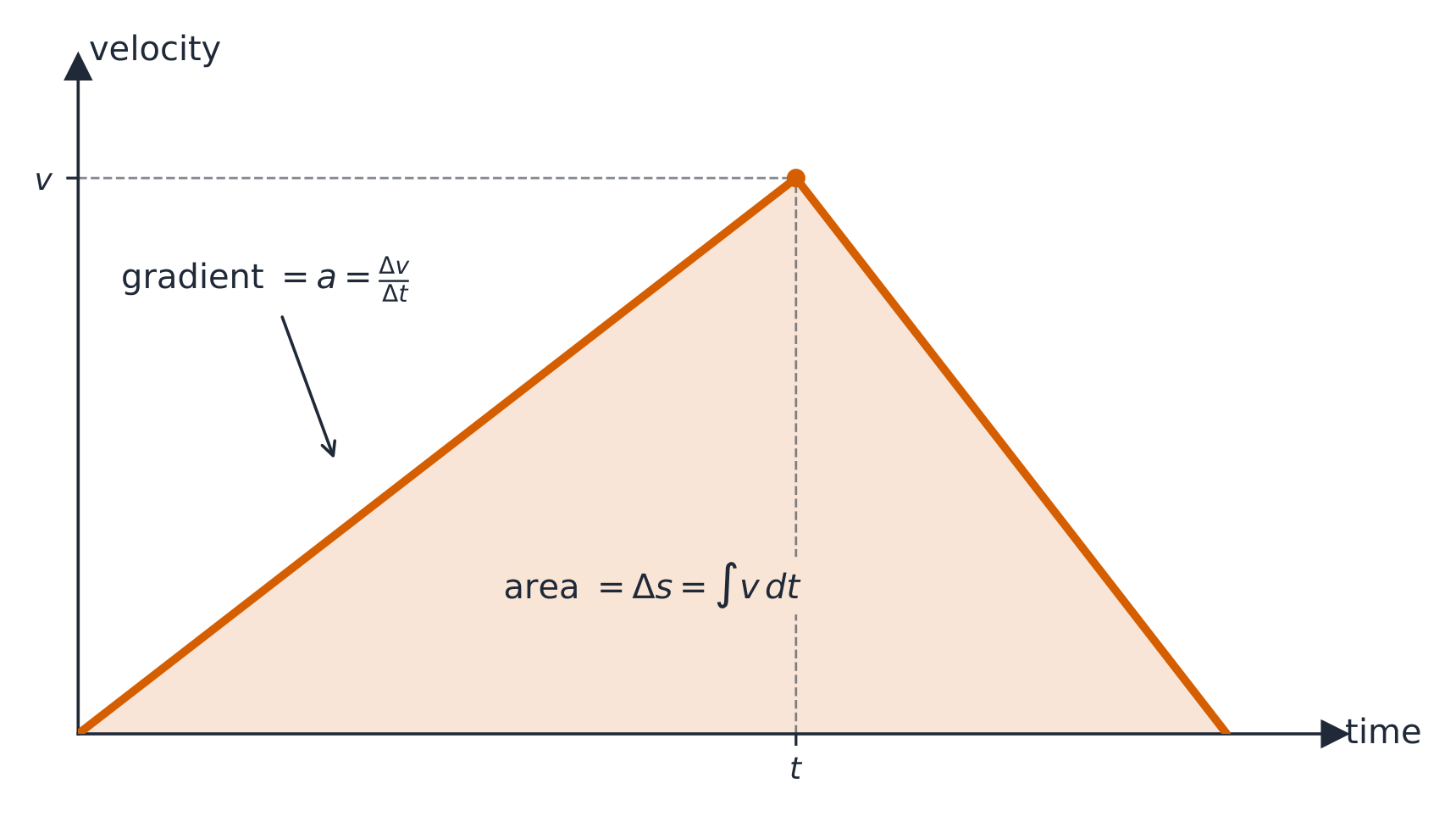
Gráfico de velocidad–tiempo — la pendiente da la aceleración, el área da el desplazamiento
The velocity–time graph · La gráfica de velocidad-tiempo
v = u + at
On a speed–time graph the gradient is the acceleration and the area · área underneath is the distance travelled. · En una gráfica de velocidad-tiempo, la pendiente es la aceleración y el área bajo la curva es la distancia recorrida.
The rate of change of velocity with time is called ____. · La tasa de cambio de la velocidad con respecto al tiempo se llama ____.
Acceleration is how fast the velocity changes — a vector, in $\dfrac{\text{m}}{\text{s}^2}$. · La aceleración indica qué tan rápido cambia la velocidad — un vector, en $\dfrac{\text{m}}{\text{s}^2}$.
Which quantity is the rate of change of displacement? · ¿Cuál cantidad corresponde a la tasa de cambio del desplazamiento?
Velocity is the rate of change of displacement · desplazamiento (a vector). Speed is the rate of change of distance · distancia (a scalar). · La velocidad es la tasa de cambio del desplazamiento (un vector). La rapidez es la tasa de cambio de la distancia (una magnitud escalar).
Match each term to the definition the examiner marks. · Asocia cada término con su definición según lo que marca el evaluador.
Speed and velocity differ by one word, distance against displacement, and that word is the mark. · La rapidez y la velocidad difieren en una sola palabra: distancia frente a desplazamiento, y esa diferencia es lo que otorga el punto.
Deceleration 减速度 is not a new quantity — it is just acceleration pointing opposite to the velocity (a negative acceleration).
Experimental set-up for measuring the acceleration due to free fall
La desaceleración no es una magnitud nueva; es simplemente una aceleración que apunta en dirección opuesta a la velocidad (una aceleración negativa).

Montaje experimental para medir la aceleración debida a la caída libre
Deceleration is a completely separate quantity from acceleration. · La desaceleración es una cantidad completamente distinta a la aceleración.
No — deceleration is just acceleration in the opposite direction to the motion (a negative acceleration). · No; la desaceleración es simplemente aceleración en dirección opuesta al movimiento (una aceleración negativa).
Two graphs do the work
- Most motion questions use a displacement–time or a velocity–time graph.
- The whole skill is knowing what the gradient and the area mean on each.
Dos gráficas hacen el trabajo
- La mayoría de los problemas de movimiento utilizan un gráfico de desplazamiento–tiempo o un gráfico de velocidad–tiempo.
- Toda la habilidad consiste en saber qué significan la pendiente y el área en cada uno.
Displacement–time graph
- The gradient (steepness) = the velocity.
- Flat → at rest. Straight → constant velocity. Curved → take a tangent 切线.
Gráfico de desplazamiento–tiempo
- La pendiente (inclinación) = la velocidad.
- Plano → en reposo. Recto → velocidad constante. Curvo → trazar una tangente.
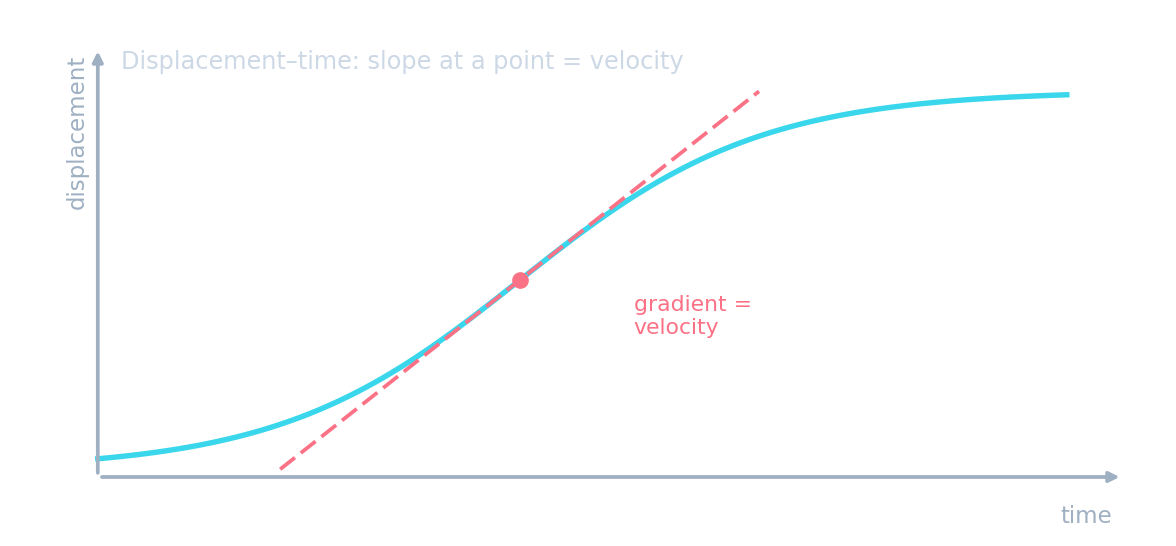
On a displacement–time graph, a flat (horizontal) line means the object is at rest. · En una gráfica de desplazamiento-tiempo, una línea plana (horizontal) significa que el objeto está en reposo.
A flat line has zero gradient, and the gradient is the velocity — so the velocity is zero (at rest). · Una línea plana tiene pendiente cero, y la pendiente equivale a la velocidad; por tanto, la velocidad es cero (en reposo).
Velocity–time graph
- The gradient = the acceleration.
- The area under the line = the displacement.
Gráfico de velocidad–tiempo
- La pendiente = la aceleración.
- El área bajo la línea = el desplazamiento.
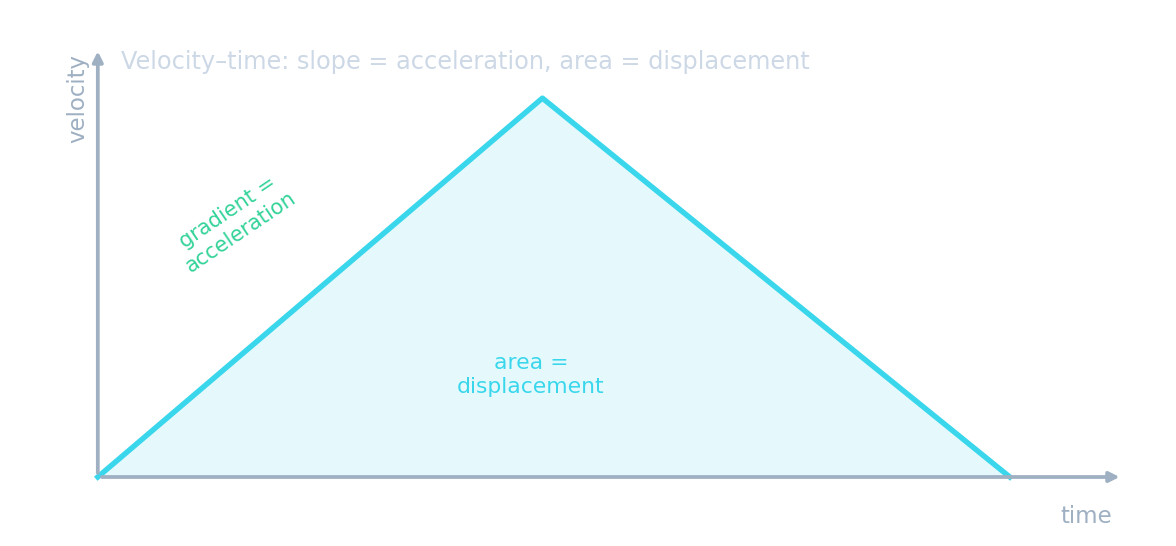
Match each graph feature to what it tells you. · Asocia cada característica de la gráfica con lo que te indica.
Gradients give rates of change; the area under a velocity–time graph builds up the displacement. · Las pendientes proporcionan tasas de cambio; el área bajo una gráfica de velocidad-tiempo representa el desplazamiento acumulado.
Displacement from the area
- Split the area into triangles and rectangles, then add them up.
- Triangle $= \tfrac{1}{2} \times \text{base} \times \text{height}$; rectangle $= \text{base} \times \text{height}$.
Desplazamiento a partir del área
- Dividir el área en triángulos y rectángulos, luego sumarlos.
- Triángulo $= \tfrac{1}{2} \times \text{base} \times \text{height}$; rectángulo $= \text{base} \times \text{height}$.
A car speeds up from rest to $20\ \dfrac{\text{m}}{\text{s}}$ in · hacia adentro $10\ \text{s}$ (a straight velocity–time line). How far does it travel? · Un automóvil acelera desde el reposo hasta $20\ \dfrac{\text{m}}{\text{s}}$ en $10\ \text{s}$ (línea recta en la gráfica de velocidad-tiempo). ¿Qué distancia recorre?
Displacement = area under the line = $\tfrac{1}{2} \times \text{base} \times \text{height} = \tfrac{1}{2} \times 10 \times 20 = 100\ \text{m}$. · Desplazamiento = área bajo la línea = $\tfrac{1}{2} \times \text{base} \times \text{height} = \tfrac{1}{2} \times 10 \times 20 = 100\ \text{m}$.
Worked example: reading a lift's journey
- A velocity-time graph shows a lift rising: $0$ to $2.0\ \text{m/s}$ in $4.0\ \text{s}$, then steady for $10\ \text{s}$, then back to rest in $2.0\ \text{s}$. Find the acceleration in each stage and the total distance.
- Gradients give the accelerations: $2.0/4.0 = 0.50\ \text{m/s}^2$, then $0$, then $-2.0/2.0 = -1.0\ \text{m/s}^2$.
- Areas give the distances: a triangle $\tfrac{1}{2}(4.0)(2.0) = 4.0\ \text{m}$, a rectangle $(10)(2.0) = 20\ \text{m}$, a triangle $\tfrac{1}{2}(2.0)(2.0) = 2.0\ \text{m}$.
- Total: $26\ \text{m}$. Split the graph into triangles and rectangles and add. Never try to fit one formula to the whole journey.
- The commonest error here is taking the gradient when the question wants the area. Gradient is acceleration; area is displacement.
Ejemplo resuelto: leer el viaje de un ascensor
- Un gráfico de velocidad–tiempo muestra un ascensor subiendo: de $0$ a $2.0\ \text{m/s}$ en $4.0\ \text{s}$, luego constante durante $10\ \text{s}$, y finalmente vuelve al reposo en $2.0\ \text{s}$. Hallar la aceleración en cada etapa y la distancia total.
- Las pendientes dan las aceleraciones: $2.0/4.0 = 0.50\ \text{m/s}^2$, luego $0$, luego $-2.0/2.0 = -1.0\ \text{m/s}^2$.
- Las áreas dan las distancias: un triángulo $\tfrac{1}{2}(4.0)(2.0) = 4.0\ \text{m}$, un rectángulo $(10)(2.0) = 20\ \text{m}$, un triángulo $\tfrac{1}{2}(2.0)(2.0) = 2.0\ \text{m}$.
- Total: $26\ \text{m}$. Dividir la gráfica en triángulos y rectángulos y sumar. Nunca intentar ajustar una sola fórmula a todo el recorrido.
- El error más común aquí es calcular la pendiente cuando la pregunta pide el área. La pendiente es aceleración; el área es desplazamiento.
On a velocity-time graph a lift speeds up from rest to 2.0 m/s in 4.0 s. How far does it travel in that stage, in metres? · En una gráfica de velocidad-tiempo, un ascensor acelera desde el reposo hasta 2.0 m/s en 4.0 s. ¿Qué distancia recorre en esa etapa, en metros?
The area under that part is a triangle: half of 4.0 x 2.0 = 4.0 m. Area is displacement; the gradient, 0.50 m/s^2, is the acceleration. · El área bajo esa parte es un triángulo: la mitad de 4.0 x 2.0 = 4.0 m. El área equivale al desplazamiento; la pendiente, 0.50 m/s², es la aceleración.
Worked example: when there is no time given
- A car accelerates uniformly from $8.0\ \text{m/s}$ to $20\ \text{m/s}$ over $56\ \text{m}$. Find its acceleration.
- List what you have: $u = 8.0$, $v = 20$, $s = 56$, $a = ?$, and $t$ is not wanted and not given.
- So choose the equation with no $t$ in it: $v^2 = u^2 + 2as$.
- $20^2 = 8.0^2 + 2a(56)$, so $400 - 64 = 112a$ and $a = 3.0\ \text{m/s}^2$.
- That is the whole method for these questions: write out $s, u, v, a, t$, mark the one you do not have and do not want, and pick the equation that is missing it.
Ejemplo resuelto: cuando no se da el tiempo
- Un coche acelera uniformemente desde $8.0\ \text{m/s}$ hasta $20\ \text{m/s}$ en $56\ \text{m}$. Hallar su aceleración.
- Listar lo que se tiene: $u = 8.0$, $v = 20$, $s = 56$, $a = ?$, y $t$ no se desea ni se da.
- Por tanto, elegir la ecuación que no tenga $t$: $v^2 = u^2 + 2as$.
- $20^2 = 8.0^2 + 2a(56)$, así que $400 - 64 = 112a$ y $a = 3.0\ \text{m/s}^2$.
- Ese es todo el método para este tipo de preguntas: escribir $s, u, v, a, t$, marcar la que no tienes y no necesitas, y elegir la ecuación que carezca de ella.
Put the method for a constant-acceleration problem in order. · Ordena los pasos para resolver un problema de aceleración constante.
Choosing the equation that is missing the quantity you neither have nor want avoids solving two equations at once. · Elegir la ecuación que falte la cantidad que ni tienes ni necesitas evita tener que resolver dos ecuaciones simultáneamente.
A car accelerates uniformly from 8.0 m/s to 20 m/s over 56 m. What is its acceleration, in m/s^2? · Un automóvil acelera uniformemente de 8.0 m/s a 20 m/s en 56 m. ¿Cuál es su aceleración, en m/s²?
No time is given or wanted, so use v^2 = u^2 + 2as: 400 - 64 = 112a, a = 3.0 m/s^2. · No se da ni se necesita el tiempo, así que usa v² = u² + 2as: 400 - 64 = 112a, a = 3.0 m/s².
Marks that slip away
- Gradient is acceleration, area is displacement. Read which one the question wants before touching the graph.
- The equations of motion apply only to constant acceleration. On a curved graph only the graph methods work.
- Choose one direction as positive and keep the signs consistent for the whole journey. With up positive, $a = -9.81\ \text{m/s}^2$ on the way down as well as on the way up.
- Distance is the total path length; displacement is from start to finish in a stated direction. A there-and-back trip has a distance but zero displacement.
- Speed is the rate of change of distance, velocity the rate of change of displacement. The two definitions differ by one word and that word is the mark.
Puntos que se escapan
- La pendiente es aceleración, el área es desplazamiento. Leer qué pide la pregunta antes de tocar la gráfica.
- Las ecuaciones del movimiento solo aplican a una aceleración constante. En una gráfica curva, solo funcionan los métodos gráficos.
- Elegir una dirección como positiva y mantener los signos consistentes para todo el recorrido. Con arriba como positivo, $a = -9.81\ \text{m/s}^2$ tanto en la bajada como en la subida.
- La distancia es la longitud total de la trayectoria; el desplazamiento es desde el inicio hasta el final en una dirección especificada. Un viaje de ida y vuelta tiene distancia pero desplazamiento cero.
- La rapidez es la tasa de cambio de la distancia; la velocidad es la tasa de cambio del desplazamiento. Las dos definiciones difieren en una palabra, y esa palabra es lo que otorga los puntos.
Which of these are errors in kinematics questions? Select all · todos that apply. · ¿Cuáles de estas son errores comunes en problemas de cinemática? Selecciona todos los que correspondan.
The last one is the correct method. The sign error is the subtlest: once up is positive, a stays negative for the whole flight, downward part included. · La última opción es el método correcto. El error de signo es el más sutil: una vez que hacia arriba es positivo, la aceleración a permanece negativa durante todo el vuelo, incluida la parte descendente.
You've got it
- distance & speed are scalars; displacement, velocity & acceleration are vectors
- displacement–time gradient = velocity; velocity–time gradient = acceleration
- area under a velocity–time graph = the displacement
Ya lo tienes
- distancia y rapidez son escalares; desplazamiento, velocidad y aceleración son vectores
- pendiente de un gráfico de desplazamiento–tiempo = velocidad; pendiente de un gráfico de velocidad–tiempo = aceleración
- área bajo un gráfico de velocidad–tiempo = el desplazamiento