Logarithmic and exponential functions · Funciones logarítmicas y exponenciales
| English | Español |
|---|---|
| logarithm/ˈlɒɡərɪθəm/ | logaritmo |
| laws of logarithms/lɔːz ɒv ˈlɒɡərɪθəmz/ | leyes de los logaritmos |
| natural logarithm/ˈnætʃərəl ˈlɒɡərɪθəm/ | logaritmo natural |
| linear form/ˈlɪnɪə fɔːm/ | forma lineal |
The number that grows forever
- A bank account doubles every 10 years. After 100 years, it's grown by a factor of $2^{10} = 1024$.
- But what if you want to know: "After how many years will it be worth exactly 500 times the original?" That's a question only logarithms 对数 can answer.
El número que crece sin fin
- Una cuenta bancaria se duplica cada 10 años. Después de 100 años, ha crecido por un factor de $2^{10} = 1024$.
- Pero, ¿qué pasa si quieres saber: "¿Después de cuántos años valdrá exactamente 500 veces el valor original?". Esa es una pregunta que solo los logaritmos puede responder.
What is a logarithm?
- A logarithm answers "what power?": if $a^x = y$ then $x = \log_a y$.
- Example: $2^x = 32 \Rightarrow x = \log_2 32 = 5$.
Worked example. Solve $3^x = 81$. Since $81 = 3^4$, we get $x = \log_3 81 = 4$.
Earthquake strength is measured on the logarithmic Richter scale
¿Qué es un logaritmo?
- Un logaritmo responde a "¿qué potencia?": si $a^x = y$, entonces $x = \log_a y$.
- Ejemplo: $2^x = 32 \Rightarrow x = \log_2 32 = 5$.
Ejemplo resuelto. Resolver $3^x = 81$. Dado que $81 = 3^4$, obtenemos $x = \log_3 81 = 4$.

La magnitud de un terremoto se mide en la escala logarítmica de Richter
Exponential growth · Crecimiento exponencial
y = a·bˣ
Change the base b: when b > 1 the curve grows, when 0 < b < 1 it decays · decae — and it always passes through (0, a). · Cambie la base b: cuando b > 1 la curva crece, cuando 0 < b < 1 decae — y siempre pasa por (0, a).
Evaluate log₂(8). · Evalúe log₂(8).
2³ = 8, so log₂(8) = 3. · 2³ = 8, por lo tanto log₂(8) = 3.
Solve 2ˣ = 8 for x. · Resuelva 2ˣ = 8 para x.
2³ = 8, so x = 3 (or x = log₂8 = 3). · 2³ = 8, así que x = 3 (o x = log₂8 = 3).
The laws of logarithms 对数定律
- The laws of logarithms:
- $\log(mn) = \log m + \log n$,
- $\log\dfrac{m}{n} = \log m - \log n$,
- $\log(m^k) = k\log m$.
Logs don't distribute over addition. $\log(a + b) \neq \log a + \log b$. The laws only apply to products, quotients, and powers — not sums.
Populations can grow exponentially when resources are plentiful
Las leyes de los logaritmos
- Las leyes de los logaritmos:
- $\log(mn) = \log m + \log n$,
- $\log\dfrac{m}{n} = \log m - \log n$,
- $\log(m^k) = k\log m$.
Los logaritmos no se distribuyen sobre la suma. $\log(a + b) \neq \log a + \log b$. Las leyes solo se aplican a productos, cocientes y potencias —no a sumas.

Las poblaciones pueden crecer exponencialmente cuando los recursos son abundantes
Which is a correct law of logarithms? · ¿Cuál es una ley correcta de los logaritmos?
log(mn) = log m + log n; and log(m^k) = k log m. · log(mn) = log m + log n; y log(m^k) = k log m.
log(a + b) = log a + log b.
Logarithms do not distribute over addition. log(a + b) ≠ log a + log b. · Los logaritmos no se distribuyen sobre la suma. log(a + b) ≠ log a + log b.
e and ln
- $e^x$ and the natural logarithm 自然对数 $\ln x$ are inverses: $\ln(e^x) = x$ and $e^{\ln x} = x$.
- When the unknown is in the power, take logs of both sides.
$e^x$ and $\ln x$ are inverse functions: their graphs are reflections in the line $y = x$.
e y ln
- $e^x$ y el logaritmo natural $\ln x$ son inversos: $\ln(e^x) = x$ y $e^{\ln x} = x$.
- Cuando la incógnita está en la potencia, aplica logaritmos a ambos lados.
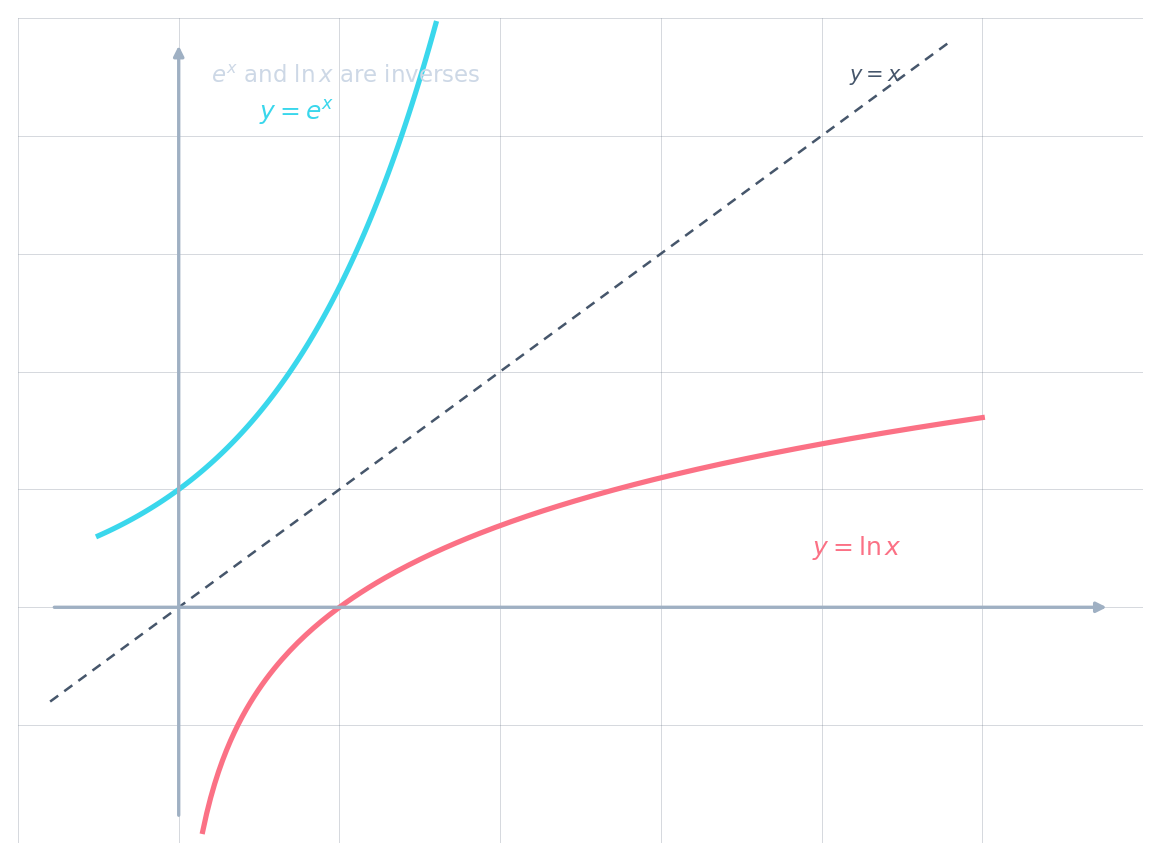
$e^x$ y $\ln x$ son funciones inversas: sus gráficas son reflexiones respecto a la recta $y = x$.
What is ln(e⁵)? · ¿Cuál es ln(e⁵)?
ln and e are inverses, so ln(e⁵) = 5. · ln y e son inversos, así que ln(e⁵) = 5.
Linear form 线性形式 and modelling
- Linear form: $y = Ax^n$ becomes $\ln y = \ln A + n\ln x$ — a line with gradient $n$, intercept $\ln A$.
- This lets you find the power law from experimental data by plotting $\ln y$ vs $\ln x$.
- Logarithms and indices (powers) are reverse operations.
Forma lineal y modelado
- Forma lineal: $y = Ax^n$ se convierte en $\ln y = \ln A + n\ln x$ —una línea con pendiente $n$ y ordenada al origen $\ln A$.
- Esto te permite encontrar la ley de potencias a partir de datos experimentales graficando $\ln y$ frente a $\ln x$.
- Los logaritmos y los exponentes (potencias) son operaciones inversas.
If y = 5x³, then ln y = ln 5 + n ln x. What is n? · Si y = 5x³, entonces ln y = ln 5 + n ln x. ¿Cuál es n?
ln(5x³) = ln 5 + 3 ln x, so n = 3 (the power becomes the gradient). · ln(5x³) = ln 5 + 3 ln x, así que n = 3 (el exponente se convierte en el coeficiente).
You've got it
- a log answers "what power?"; laws: $\log mn = \log m + \log n$, $\log m^k = k\log m$
- $e^x$ and $\ln x$ are inverses; take logs when the unknown is a power
- linear form: plot $\ln y$ vs $\ln x$ → gradient $n$, intercept $\ln A$
Lo has entendido
- un logaritmo responde a "¿qué potencia?"; leyes: $\log mn = \log m + \log n$, $\log m^k = k\log m$
- $e^x$ y $\ln x$ son inversos; aplica logaritmos cuando la incógnita es una potencia
- forma lineal: grafica $\ln y$ frente a $\ln x$ → pendiente $n$, ordenada al origen $\ln A$