Blood cells, plasma and tissue fluid
Introducido| English | Significado |
|---|---|
| plasma/ˈplæzmə/ | plasma |
| tissue fluid/ˈtɪʃuː ˈfluːɪd/ | líquido tisular |
| monocyte/ˈmɒnəʊsaɪt/ | monocito |
| neutrophil/ˈnjuːtrəfɪl/ | neutrófilo |
| lymphocyte/ˈlɪmfəsaɪt/ | linfocito |
Blood, plasma 血浆 and tissue fluid 组织液
- Blood is mostly water carrying cells and dissolved substances.
- The liquid that leaks out to bathe your cells is tissue fluid.
- It is how every cell gets its oxygen and food.
The straw-coloured liquid part of blood, which carries the cells, is the ______.
Dificultad 1/5 · 100 monedas + un pequeño bono en el primer intento de hoy
Plasma carries cells, dissolved nutrients, hormones and waste.
Blood cells
- Red blood cells carry oxygen (packed with haemoglobin, no nucleus).
- White blood cells defend the body — you should recognise:
- monocytes 单核细胞, neutrophils 中性粒细胞 (lobed nucleus), and lymphocytes 淋巴细胞.
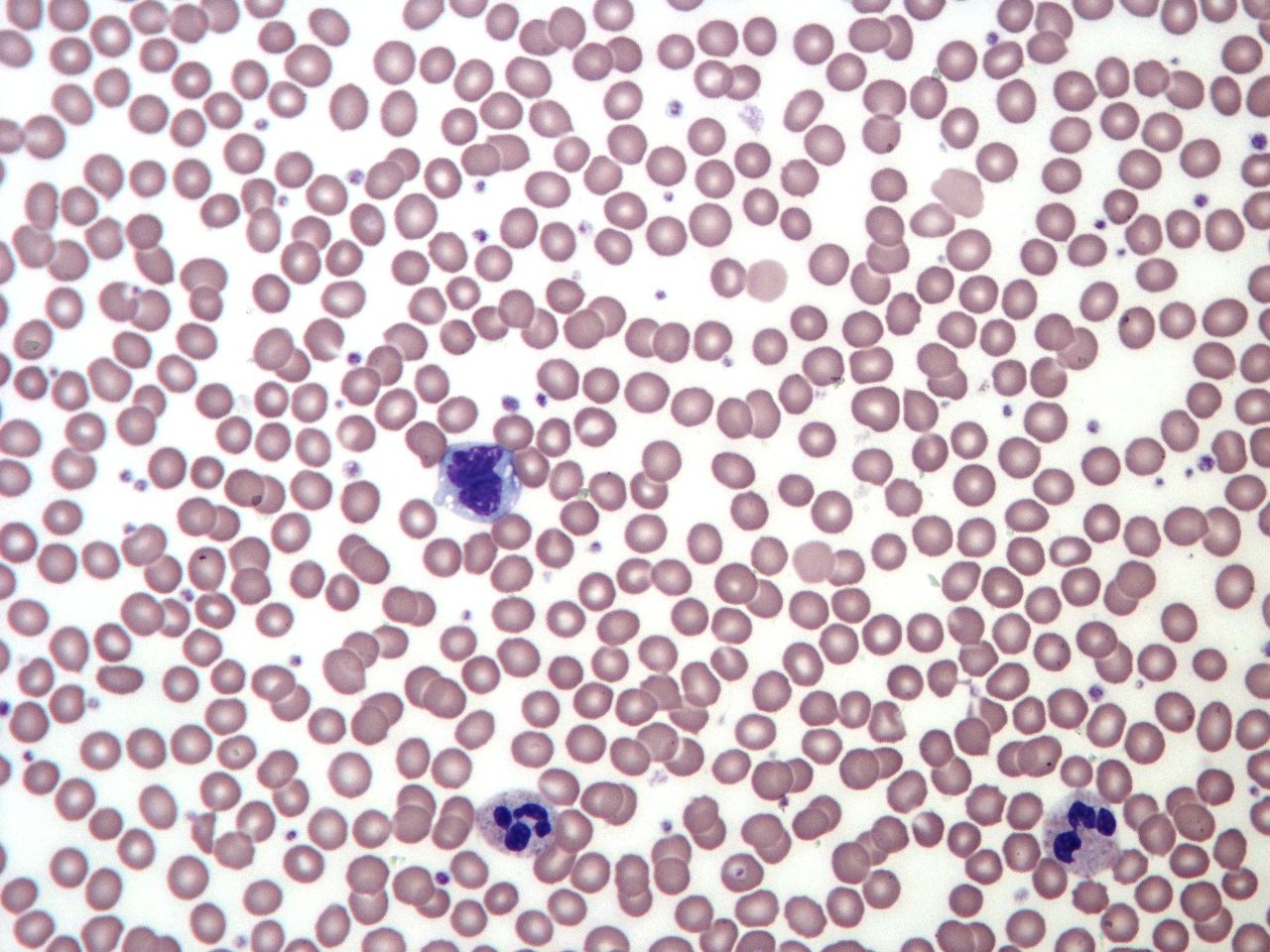
A stained blood smear: small red cells and one larger white cell
The main job of a red blood cell is to:
Dificultad 1/5 · 100 monedas + un pequeño bono en el primer intento de hoy
Red blood cells are packed with haemoglobin to carry oxygen; white cells handle defence.
Match each part of the blood to its job.
Dificultad 2/5 · 140 monedas + un pequeño bono en el primer intento de hoy
Red cells carry oxygen, white cells defend, platelets clot, and plasma is the liquid that carries everything.
Why water is ideal
- Water is a good solvent, so it carries dissolved substances (glucose, ions, gases).
- Water has a high specific heat capacity, so the blood's temperature stays steady.
Tissue fluid
- At the start of a capillary, the high blood pressure pushes liquid out of the plasma — but not the cells or large proteins.
- This liquid around the cells is tissue fluid: it supplies oxygen and glucose and carries waste away.
- Most of it returns to the capillary at the far (venous) end, where the pressure is lower.
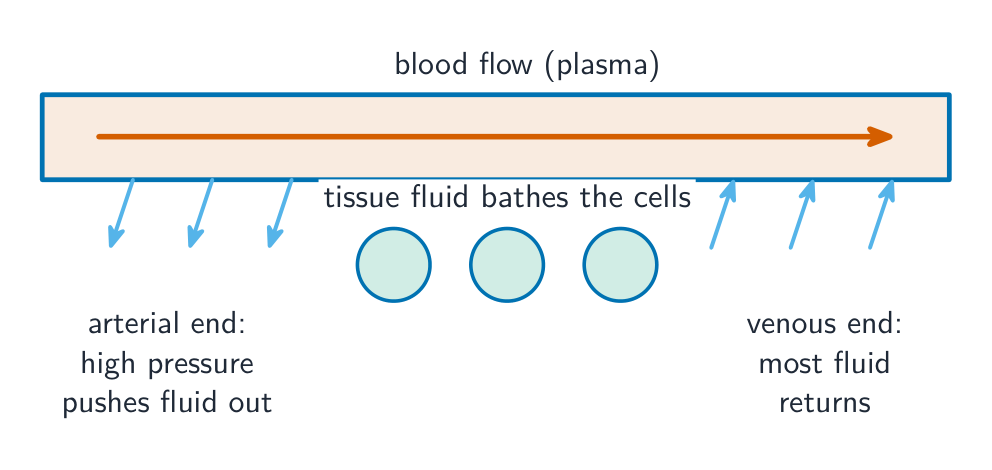
Tissue fluid forms at the arterial end and returns at the venous end
How tissue fluid forms
Step through it. High pressure pushes plasma out at the start of a capillary; most is drawn back at the far end.
Tissue fluid forms because:
Dificultad 1/5 · 100 monedas + un pequeño bono en el primer intento de hoy
High hydrostatic pressure forces liquid out of the plasma; cells and large proteins are too big to leave.
Most tissue fluid returns to the capillary at the arterial end, where the pressure is highest.
Dificultad 1/5 · 100 monedas + un pequeño bono en el primer intento de hoy
False. At the arterial end high hydrostatic pressure forces fluid out. Most returns at the venous end, where the pressure has dropped and water re-enters by osmosis.
Put the formation and return of tissue fluid in order.
Dificultad 3/5 · 200 monedas + un pequeño bono en el primer intento de hoy
Out at the arterial end → exchange → back at the venous end → excess into the lymph.
Worked example: why swelling (oedema) happens
In severe protein starvation, the blood plasma has very little protein, and tissues such as the ankles and belly swell with fluid. Explain using tissue fluid formation.
- Plasma proteins give blood a lower water potential than tissue fluid. At the venous end of a capillary, this draws water back into the blood by osmosis, because the blood pressure there is low.
- With little plasma protein, the water potential of the blood is higher, so less water returns. Tissue fluid builds up faster than the lymph can drain it, and the tissue swells: oedema.
Tissue fluid contains the same large plasma proteins as blood plasma.
Dificultad 1/5 · 100 monedas + un pequeño bono en el primer intento de hoy
Large proteins are too big to pass through the capillary wall.
Why does water return to the capillary at the venous end?
Dificultad 1/5 · 100 monedas + un pequeño bono en el primer intento de hoy
Low hydrostatic pressure lets osmosis win.
You've got it
- red blood cells carry oxygen; white cells (monocytes, neutrophils, lymphocytes) defend
- water = good solvent + high specific heat capacity (steady temperature)
- tissue fluid = plasma pushed out by high pressure (no cells/large proteins) to bathe cells
- most tissue fluid returns at the low-pressure (venous) end
Write from this case
- Plasma contains proteins and other dissolved substances.
- Fluid leaks from a capillary into the tissue spaces.
How does tissue fluid differ from plasma?
The capillary wall filters by size.
What is missing from tissue fluid compared with plasma?
Dificultad 1/5 · 100 monedas + un pequeño bono en el primer intento de hoy
Large proteins do not cross the capillary wall easily.