Find and fix the errors
"Identify the errors and correct them"
- A common Paper 2 question prints an algorithm with numbered lines and says it has, for example, four errors.
- For each error you give the line number and the corrected line. You do not rewrite the whole algorithm.
- The errors are small: a wrong starting value, a wrong comparison, a wrong loop limit, the wrong variable. They are found by tracing, not by guessing.
A method that finds them
- Read the question: write down what the algorithm should do and what it should output.
- Choose simple test data and work out the right answer by hand.
- Trace the algorithm line by line with that data, writing each variable's value.
- The first line where a value goes wrong holds an error. Fix it, then carry on tracing.
- Check the usual suspects: starting values (
0or the first item),<or>,<=or<, the loop limit, and the variable that is output.
Four errors in one algorithm
The algorithm should find the average and the highest of five temperatures.
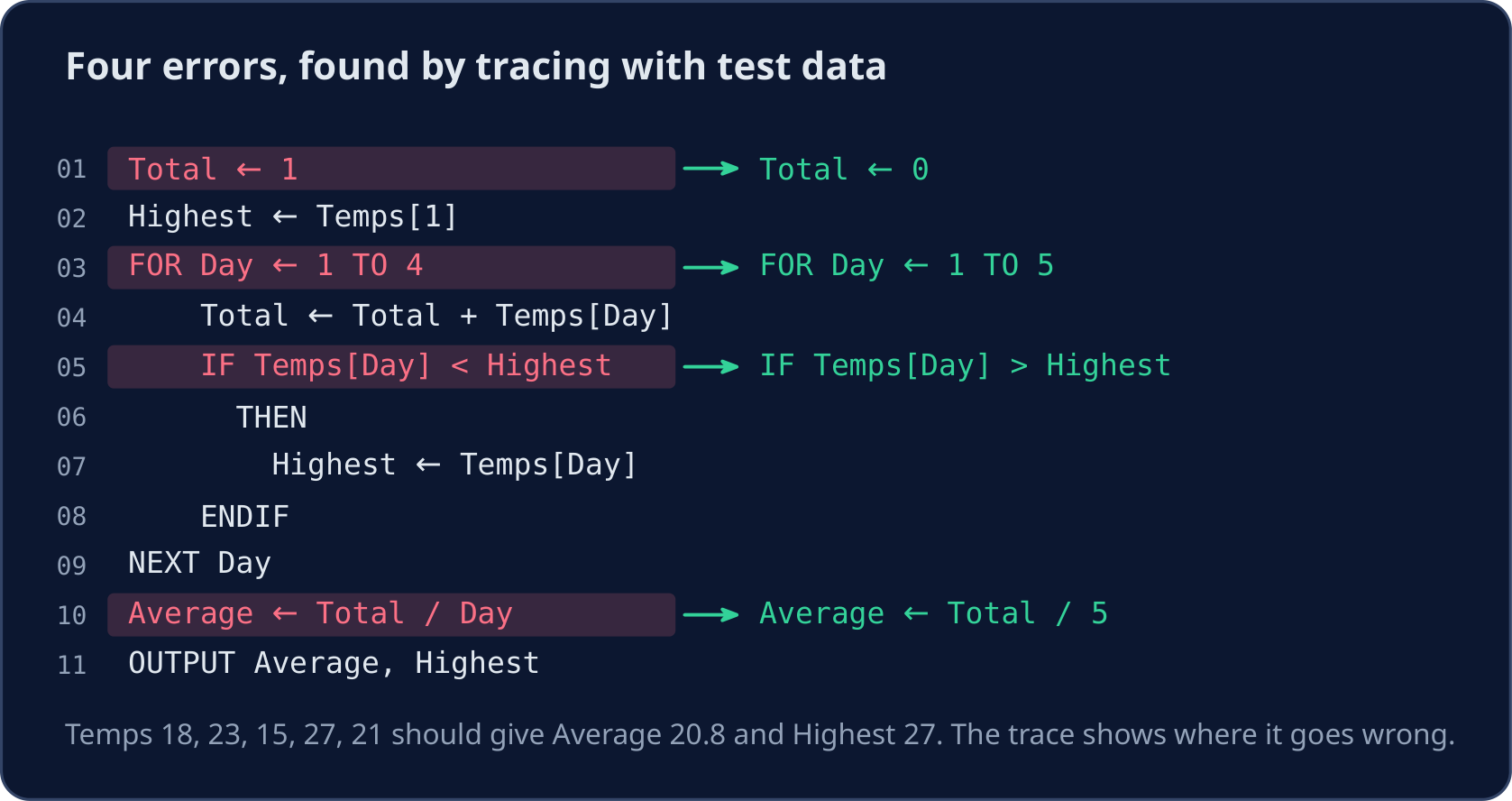
- Line 01: the total must start at 0, or every answer is 1 too big.
- Line 03: the loop must visit all five days.
- Line 05: to find the highest, replace it when the new value is bigger.
- Line 10: after the loop, divide by the number of values, 5.
The corrected algorithm
DECLARE Temps : ARRAY[1:5] OF INTEGER
DECLARE Day, Total, Highest : INTEGER
DECLARE Average : REAL
Temps[1] ← 18
Temps[2] ← 23
Temps[3] ← 15
Temps[4] ← 27
Temps[5] ← 21
Total ← 0
Highest ← Temps[1]
FOR Day ← 1 TO 5
    Total ← Total + Temps[Day]
    IF Temps[Day] > Highest
      THEN
        Highest ← Temps[Day]
    ENDIF
NEXT Day
Average ← Total / 5
OUTPUT "Average: ", Average, "  Highest: ", Highest
- With the corrections the output is
Average: 20.8 Highest: 27, which matches the answer worked out by hand.
How to write the answer
| Line | Error | Correction |
|---|---|---|
| 01 | the total starts at 1 | Total ← 0 |
| 03 | the loop misses day 5 | FOR Day ← 1 TO 5 |
| 05 | the test finds the lowest | IF Temps[Day] > Highest |
| 10 | divides by the loop counter | Average ← Total / 5 |
- Write the whole corrected line, not just the changed symbol.
- Do not "fix" lines that are already correct: each wrong change can cost a mark.
Common mistakes
| Wrong | Right | Why |
|---|---|---|
| rewriting the whole algorithm | give the line number and the corrected line | the marks are for each error found |
| guessing from how the code looks | trace it with test data | a line can look strange and still be correct |
writing only 0 as the correction |
Total ← 0 |
the examiner needs the full line |
| stopping after the first error | keep tracing to the end | the question says how many errors there are |
| changing a correct line | leave it alone | an extra change can make a correct algorithm wrong |
Now you try
- Each task has a program with errors. Trace it, find each error, and correct the line.
Independent transfer
The final task gives a description only. Write a correct algorithm, then test it with data that includes zero and negative numbers.
Dificultad 2/5 · 140 monedas + un pequeño bono en el primer intento de hoy
This program should count the marks of 50 or more. It has dos errors. Trace it, then correct both lines so it outputs the right count.
Haz clic en Ejecutar para ver la salida aquí.
Dificultad 2/5 · 140 monedas + un pequeño bono en el primer intento de hoy
This program should output all five names. It has uno error. Find it and correct the line.
Haz clic en Ejecutar para ver la salida aquí.
Dificultad 1/5 · 100 monedas + un pequeño bono en el primer intento de hoy
In the lesson's algorithm, which line number made the program find the lowest temperature instead of the highest? Give the number only.
Dificultad 3/5 · 200 monedas + un pequeño bono en el primer intento de hoy
Read five whole numbers. Output how many of them are negative. Zero is not negative.
Haz clic en Ejecutar para ver la salida aquí.