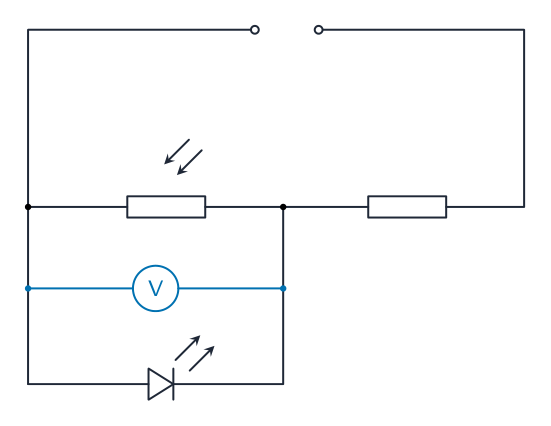
Fig. 8.1 shows a circuit. The circuit is designed to switch on a night light when the surroundings are dark.
Fig. 8.1
(i)
On Fig. 8.1, draw the circuit symbol for a voltmeter used to measure the potential difference (p.d.) across the light-dependent resistor (LDR).[1]
(ii)
The surroundings change from light to dark.
State the effect of this change on the resistance of the LDR.
[1]
State and explain the effect of this change on the p.d. across the light-emitting diode (LED).
[2]
(b)
Fig. 8.2 shows another circuit. Lamps A and B are identical filament lamps.
Fig. 8.2
The current supplied by the power supply is 0.50A.
Calculate the resistance of lamp A.
resistance = [3]
[Total: 7]
Show the mark scheme
These are the official mark-scheme rows. Each point that matches your answer earns a mark.
Tap the mark scheme to open it full size.
Show a worked answer
How to reach each mark, step by step. Try the question yourself first.
8(a)(i)
Draw a circle containing V and connect it in parallel across the LDR.
When the surroundings become dark, the LDR resistance increases.
The resistance of the parallel LDR and LED combination increases, so it takes a greater share of the supply p.d.
The p.d. across the LED therefore increases.
8(b)
The identical lamps share the supply current equally, so the current in A is $0.50\,\mathrm{A}/2 = 0.25\,\mathrm{A}$. Each has $240\,\mathrm{V}$ across it.