Skip to content

IGCSE Physics · June 2024 · Paper 31 · Difficulty 4 · Challenging

Question 7

7
(a)

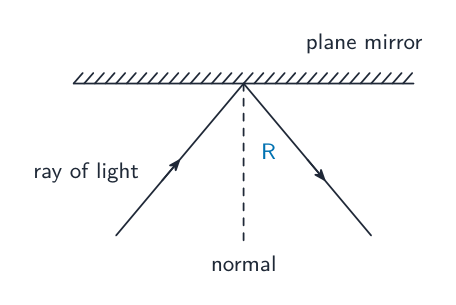
Fig. 7.1 shows a ray of light striking a plane mirror. The ray is reflected as shown.

Fig. 7.1

The angle of incidence for the ray of light is $40^{\circ}$.

(i)

Indicate the angle of reflection by drawing a letter R on Fig. 7.1.[1]

(ii)

State the size of the angle of reflection in Fig. 7.1.

angle of reflection = °[1]

(b)

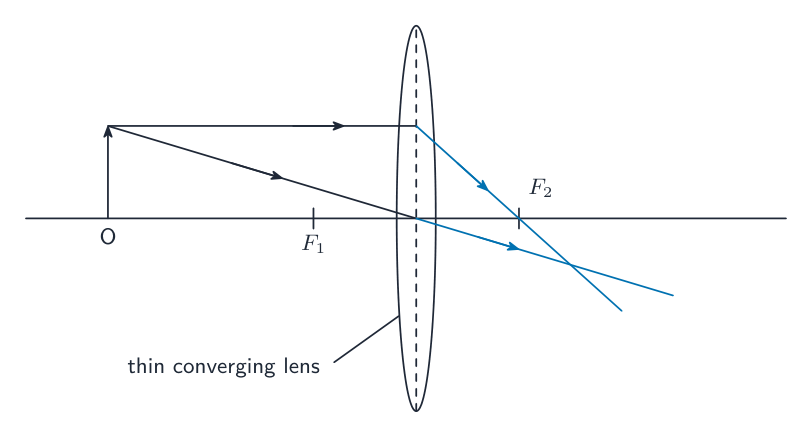
An object O is placed to the left of a thin converging lens. $\text{F}_1$ is the principal focus on one side of the lens and $\text{F}_2$ is the principal focus on the other side of the lens.

Two rays from the top of the object are incident on the lens, as shown in Fig. 7.2.

Fig. 7.2
(i)

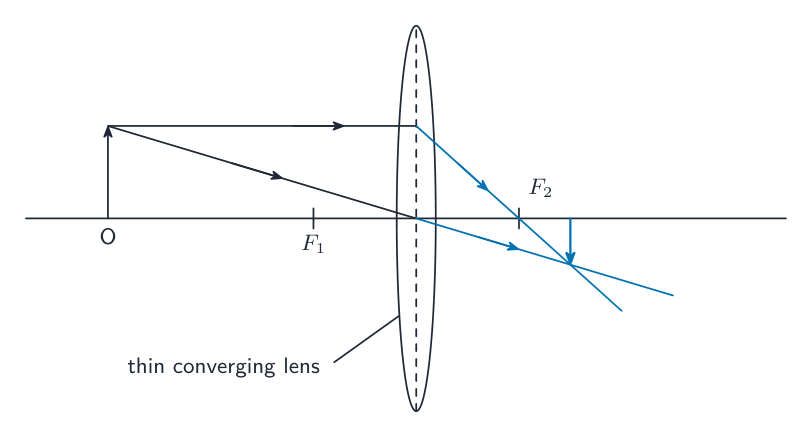
On Fig. 7.2, locate the image of O by continuing the path of each ray.[2]

(ii)

Draw an arrow to represent the image of O.[1]

(c)

Fig. 7.3 shows a prism producing a spectrum of colours from a narrow beam of white light.

(i)

The prism refracts the white light.

State the name of the effect that produces a spectrum.

[1]

(ii)

In the spectrum shown in Fig. 7.3, there are seven colours.

List the seven colours in the order they appear between X and Z.

X

Z [2]

[Total: 8]
Show the mark scheme

These are the official mark-scheme rows. Each point that matches your answer earns a mark.

Tap the mark scheme to open it full size.

Show a worked answer

How to reach each mark, step by step. Try the question yourself first.

7(a)(i)

  • Place R between the reflected ray and the normal at the point where the ray meets the mirror.
Worked answer drawing

7(a)(ii)

  • The angle of reflection equals the angle of incidence, so it is $\mathbf{40}^\circ$.

7(b)(i)

  • Continue the horizontal ray through $F_2$ after it passes through the lens.
  • Continue the ray through the centre of the lens in a straight line. The rays meet at the top of the image.
Worked answer drawing

7(b)(ii)

  • Draw the image arrow from the principal axis to the point where the two rays cross.
Worked answer drawing

7(c)(i)

  • The effect is called dispersion.

7(c)(ii)

  • From X to Z: red, orange, yellow, green, blue, indigo, violet.
  • Red is bent least by the prism, and violet is bent most.
Original question

Log in or create account

IGCSE, A-Level & AP