Skip to content

IGCSE Physics · March 2025 · Paper 42 · Difficulty 4 · Challenging

Question 5

5

A light-dependent resistor (LDR) has a low resistance in high light intensity and a high resistance in the dark.

(a)

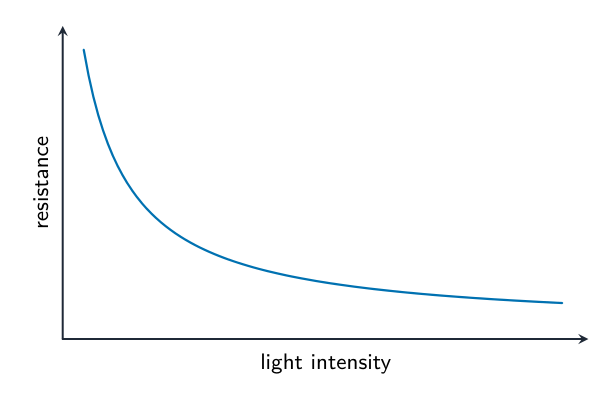
Sketch a graph of resistance (y-axis) against light intensity (x-axis) for an LDR.[2]

(b)

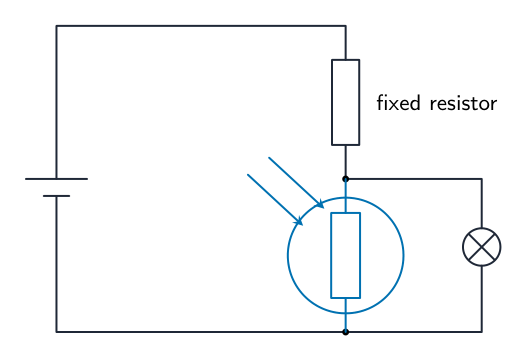
Fig. 5.1 shows part of the electric circuit used to turn on a light when it is dark.

Fig. 5.1
(i)

Complete the circuit in Fig. 5.1 with the symbol for a light-dependent resistor (LDR).[1]

(ii)

Explain why the lamp is off in the light and the lamp is on in the dark. Use ideas about potential difference (p.d.) in your answer.[3]

[Total: 6]
Show the mark scheme

These are the official mark-scheme rows. Each point that matches your answer earns a mark.

Tap the mark scheme to open it full size.

Show a worked answer

How to reach each mark, step by step. Try the question yourself first.

5(a)

  • Resistance decreases as light intensity increases.
Worked answer drawing

5(b)(i)

  • The completed circuit is shown below, with the LDR in parallel with the lamp.
Worked answer drawing

5(b)(ii)

  • The supply p.d. is shared between the fixed resistor and the LDR. The lamp has the same p.d. as the LDR because they are in parallel.
  • In the dark, the LDR resistance is high, so it gets a larger share of the supply p.d. and the lamp turns on.
  • In the light, the LDR resistance and its share of the p.d. are lower, so the lamp is off.
Original question

Log in or create account

IGCSE, A-Level & AP