Chinese course / HSK5 handouts
Comparing similar adverbs
Printable paper with separate answer pages Step-by-step lessons
Original teaching practice. Read one pattern, cover its model and try the questions before checking the separate answer section. Examples adapted from Chinese Grammar Wiki (AllSet Learning, CC BY-NC-SA) retain the course-reference provenance.
often常常 vs often经常 (often / regularly)
How often?
- A new friend asks about your exercise habits.
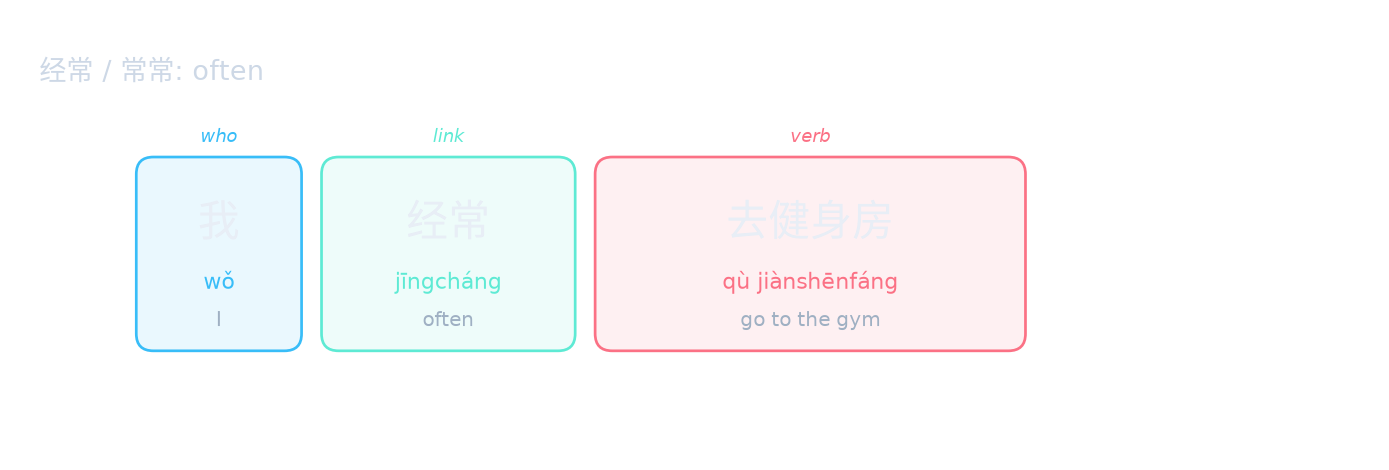
- I / me我often经常to go去gym健身房,weekend周末also也often常常to go去swimming游泳。 – "I go to the gym regularly, and at weekends I often go swimming too."
Both mean "often"
- often常常 and often经常 both describe frequent actions: I / me我often常常 / often经常to drink tea喝茶.
- In many sentences they are interchangeable.
he他regularly经常works overtime加班。
Where they differ
- often经常 can be an adjective before a noun: 经常性(modifier / structural particle)的question问题 – "a recurring problem". often常常 cannot.
- often常常 has a negative not不always常: I / me我不常去. often经常's negative not不often经常 is fine too; not不often常常 is not used.
I我not often不常go去the cinema电影院。
Negatives
- Say not不always常 or not不often经常, not not不often常常.
- Both go before the verb, after the subject and time words: he / him他weekend周末often经常to work overtime加班.
Versus usually往往
- often常常 / often经常 = often, simply a frequency.
- usually往往 = tends to, under a stated condition: 下雨天usually往往traffic jam堵车.
on rainy days下雨天tends to往往have traffic jams堵车。
Recap
- often常常 / often经常 = often (mostly interchangeable); often经常 can also describe nouns (经常性).
- Negatives: not不always常 / not不often经常, never not不often常常. usually往往 needs a condition.
Practise this pattern step by step.
Practice without the models
Choose a pattern, cover its teaching examples, and attempt its questions. Use the labels to find feedback in the separate key.
often常常 vs often经常 (often / regularly)
2401.1 Complete: “I don't often go to the cinema.” I / me我not不…………to go去cinema电影院。
2401.2 Which form is NOT used?
- A. not不always常
- B. not不often常常
- C. often经常
- D. not不often经常
2401.3 Build: “He regularly works overtime at weekends.”
Arrange all chunks: to work overtime加班。 / he / him他 / weekend周末 / often经常
2401.4 usually往往 needs a condition, unlike often常常.
True or false? Explain or repair the statement.
2401.5 A new friend asks about your exercise habits. Close the examples. Say a Mandarin response, then write it in Chinese. Explain briefly in English what the lesson’s pattern adds. Compare with the model, then change one detail and try again.
Write or say your own response before reading the key.
A fresh situation
R1. Interpret and repair. A learner says often经常 and often常常 are an exact frequency count. What can the words establish?
R2. Use it yourself. Say you often walk to school but take the bus when it rains.
Write your responses before opening the key. Compare meaning as well as form; a different valid answer need not copy the model.
Open the answers after your attempt
Answers and explanations
Check after your attempt. For open tasks, compare the message and the stated criteria, then revise one detail.
often常常 vs often经常 (often / regularly)
2401.1 always常
not不always常 or not不often经常; not不often常常 is not used.
2401.2 B. not不often常常
The negative of often常常 is not不always常 or not不often经常; not不often常常 is not used. often经常 itself is fine but is positive.
2401.3 he / him他weekend周末often经常to work overtime加班。
Subject + time + often经常 + verb.
2401.4 True.
True. usually往往 describes what tends to happen under a condition, so it needs one: 下雨天usually往往traffic jam堵车. often常常 can describe simple frequency or the future: after以后often常常to come来.
2401.5 One possible response: I / me我often经常to go去gym健身房,weekend周末also也often常常to go去swimming游泳。
Check meaning and form:
- My response conveys a message that fits the opening situation.
- I can explain the meaning of the pattern, rather than only naming it.
- Say not不always常 or not不often经常, not not不often常常.
- Both go before the verb, after the subject and time words: he / him他weekend周末often经常to work overtime加班.
- I tried a second response with a name, time, place, or description changed.
This is supported productive practice. Compare meaning and structure; your answer need not copy the model. A partner or teacher must hear the spoken response to comment on pronunciation.
Fresh-situation answers
R1. They describe frequent occurrence, not a numerical percentage or schedule. Both can express often in many contexts; sentence naturalness depends on the whole phrase.
R2. One possible response. I / me我often常常to walk走路to go to school上学,to rain下雨o'clock时to sit坐public transport vehicle公交车。This describes a habit with a condition. It does not establish an exact number of walking days per week.
Recall later. Tomorrow, distinguish frequent occurrence from a precise timetable.