Chinese course / HSK4 handouts
Complex sentence patterns
Printable paper with separate answer pages Step-by-step lessons
Original teaching practice. Read one pattern, cover its model and try the questions before checking the separate answer section. Examples adapted from Chinese Grammar Wiki (AllSet Learning, CC BY-NC-SA) retain the course-reference provenance.
Adj + to be / is是 + Adj,but但是 … (concede, then object)
Nice, but …
- Your friend loves a jacket in a shop. You agree it's pretty, but the price is crazy.
- pretty漂亮to be / is是pretty漂亮,but但是太贵(completed / change)了。 – "It's pretty, all right, but it's too expensive."
A to be / is是 A,but但是 / but可是 / exactly就是 …
- Adj to be / is是 Adj concedes a point ("it is …, admittedly"); then but但是 / but可是 / exactly就是 brings the objection.
- The same word repeats on both sides of to be / is是: good好to be / is是good好, cheap便宜to be / is是cheap便宜.
good好(it is)是good好,it's just that就是too太far远了。

Verbs work too
- to go去to be / is是want / think / miss想to go去,but可是not / haven't没(concept of) time时间。 – "I do want to go, but I don't have time."
- this这本书I / me我to see看to be / is是to see看(completed / change)了,but但是not / haven't没to see看to understand懂。 – "I did read the book, but I didn't understand it."
go去(it is)是want to想go去,but可是have no没time时间。
Repeat the same word
- Use the identical word on both sides: 贵是expensive贵, not 贵是degree / adjective linker很expensive贵.
- The second clause must object; good好to be / is是good好,moreover而且… does not work.
Versus although虽然…but但是…
- although虽然很漂亮,but但是太贵(completed / change)了 is neutral.
- pretty漂亮to be / is是pretty漂亮,but但是… sounds more conversational and shows you have considered the point.
although虽然very很pretty漂亮,but但是too太expensive贵了。
Recap
- A to be / is是 A,but但是 / but可是 / exactly就是 … = it's A, admittedly, but ….
- Same word twice; the second part must object.
Practise this pattern step by step.
one / a一 … then / just就 … (as soon as / whenever)
The moment you arrive
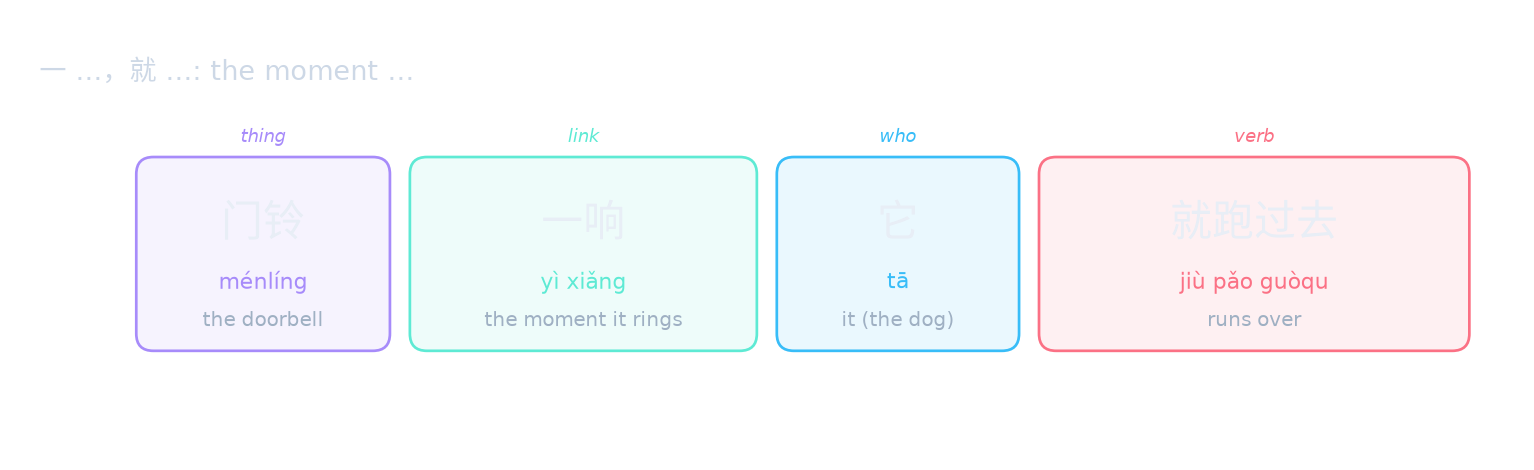
- Your friend's dog gets excited every time someone rings the doorbell.
- doorbell门铃一响,it它then / just就to run跑(verb suffix)过去。 – "As soon as the doorbell rings, it runs over."
one / a一 A,then / just就 B = as soon as A, B
- one / a一 + verb A,(Subject) then / just就 + verb B = B happens immediately after A.
- one / a一 and then / just就 each go after their own subject: I / me我一到,he / him他then / just就to walk走(completed / change)了.
I我as soon as一arrived到home家,then就rain下雨了。
Whenever: a habit
- he / him他one / a一喝咖啡then / just就睡不着。 – "Whenever he drinks coffee, he can't sleep."
- I / me我one / a一to see看then / just就to understand懂(completed / change)了。 – "I understood the moment I looked."
he他whenever一drinks喝coffee咖啡then就can't sleep睡不着。
Placement of one / a一 and then / just就
- one / a一 goes before the first verb, after its subject: I / me我一到, not one / a一I / me我to / arrive到.
- then / just就 goes after the second subject: he / him他then / just就to walk走(completed / change)了, not then / just就he / him他to walk走(completed / change)了.
one / a一…then / just就… versus just now刚…then / just就…
- one / a一…then / just就… = whenever / as soon as (also habits).
- just now刚…then / just就… = had only just … when (a single past event): 我刚to / arrive到,he / him他then / just就to walk走(completed / change)了.
I我just刚arrived到,he他then就left走了。
Recap
- one / a一 A,then / just就 B = as soon as / whenever A, B.
- one / a一 and then / just就 each after their own subject; just now刚…then / just就… for a single just-happened event.
Practise this pattern step by step.
on the one hand一方面 … ,on the one hand一方面 … (on one hand / on the other)
Two sides of the story
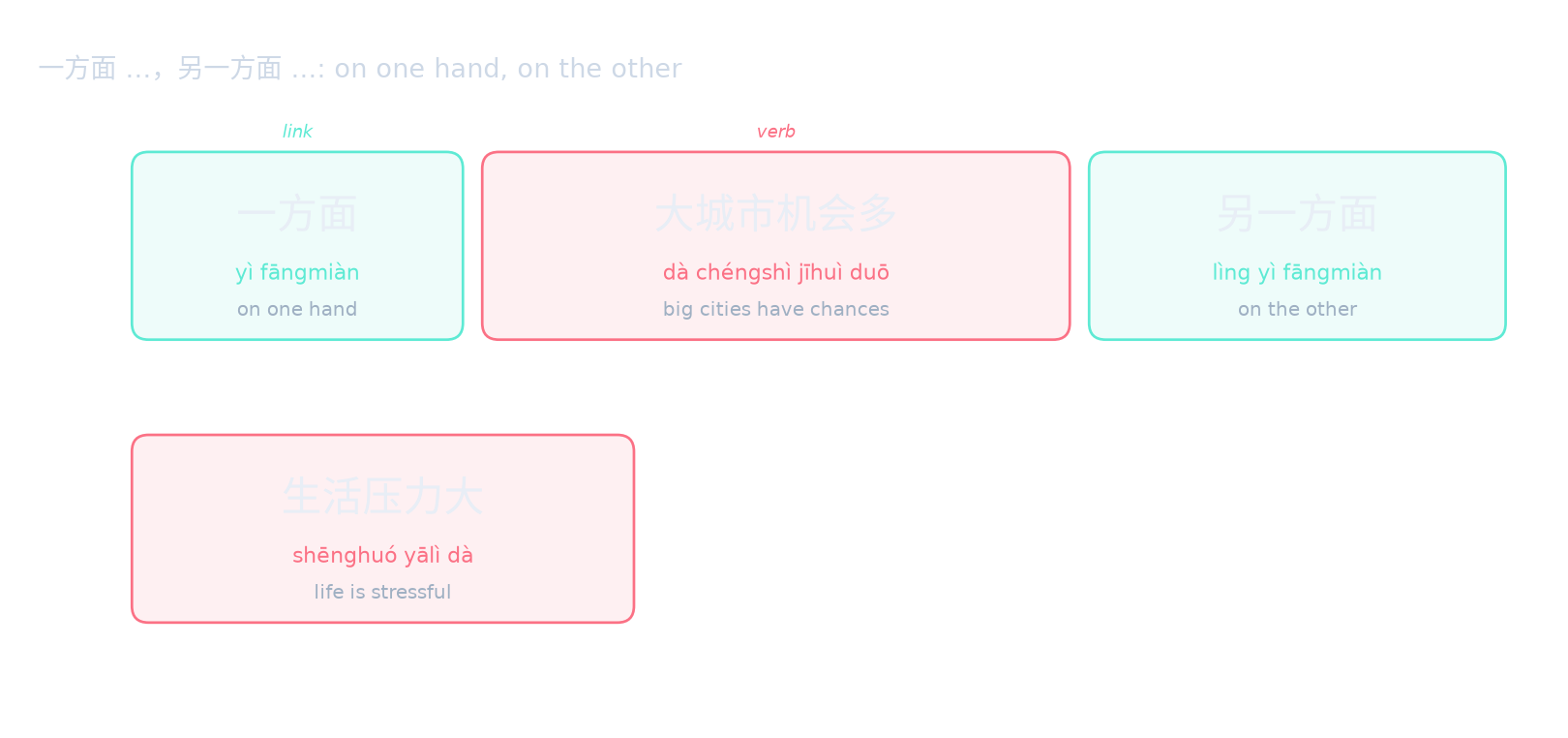
- In a class debate, you explain why many young people move to big cities.
- on the one hand一方面,major city大城市opportunity机会many多;on the other hand另一方面,to live生活also也more更convenient方便。 – "On the one hand, big cities have more opportunities; on the other, life is more convenient."
on the one hand一方面 …,(other另)on the one hand一方面 …
- on the one hand一方面…,on the one hand一方面… / on the other hand另一方面… presents two aspects or reasons side by side.
- Each on the one hand一方面 starts its clause, usually with a comma or semicolon in between.
on one hand一方面,the pay工资high高;on the other另一方面,from离home家close近。
Two reasons or a contrast
- Two reasons in the same direction: on the one hand一方面to be / is是in order to为了to learn学习,on the one hand一方面to be / is是in order to为了to make friends交朋友。 – "Partly to study, partly to make friends."
- A contrast: on the one hand一方面I / me我want / think / miss想to go去,on the other hand另一方面again又anxious担心to spend money花钱too太many多。 – "On the one hand I want to go; on the other, I worry about spending too much."
partly一方面is是for为了study学习,partly一方面is是for为了make交friends朋友。
Parallel halves
- Keep both halves in the same shape: on the one hand一方面to be / is是…,on the one hand一方面to be / is是….
- Do not use on the one hand一方面 alone; it needs its partner.
Versus not only (... but also ...)不但…moreover而且…
- not only (... but also ...)不但…moreover而且… builds up: the second point is stronger.
- on the one hand一方面…on the one hand一方面… weighs two points equally, often in an argument or explanation.
not only不但cheap便宜,but also而且tasty好吃。
Recap
- on the one hand一方面…,(other另)on the one hand一方面… = on the one hand …, on the other ….
- Two parallel aspects or a contrast; always used as a pair.
Practise this pattern step by step.
Practice without the models
Choose a pattern, cover its teaching examples, and attempt its questions. Use the labels to find feedback in the separate key.
Adj + to be / is是 + Adj,but但是 … (concede, then object)
2501.1 Complete: “It's cheap, all right, but the quality is poor.” cheap便宜to be / is是…………,but但是quality质量no good不好。
2501.2 Which sentence is correct?
- A. to be / is是to be fond of eating好吃to be fond of eating好吃,but但是太辣(completed / change)了。
- B. to be fond of eating好吃to be / is是to be fond of eating好吃,but但是太辣(completed / change)了。
- C. to be fond of eating好吃to be / is是to be fond of eating好吃,moreover而且太辣(completed / change)了。
- D. to be fond of eating好吃to be / is是degree / adjective linker很to be fond of eating好吃,but但是太辣(completed / change)了。
2501.3 Build: “I do want to go, but I don't have time.”
Arrange all chunks: but可是 / , / to go去to be / is是want / think / miss想to go去 / not / haven't没(concept of) time时间。
2501.4 pretty漂亮to be / is是pretty漂亮,but但是… concedes a point before objecting.
True or false? Explain or repair the statement.
2501.5 Your friend loves a jacket in a shop. You agree it's pretty, but the price is crazy. Close the examples. Say a Mandarin response, then write it in Chinese. Explain briefly in English what the lesson’s pattern adds. Compare with the model, then change one detail and try again.
Write or say your own response before reading the key.
one / a一 … then / just就 … (as soon as / whenever)
2502.1 Complete: “As soon as class ended, he left.” (used after a verb) give it…一下subject课,he / him他…………to walk走(completed / change)了。
2502.2 Which sentence is correct?
- A. one / a一I / me我to / arrive到home家,then / just就he / him他to walk走(completed / change)了。
- B. I / me我to / arrive到home家one / a一,he / him他to walk走then / just就(completed / change)了。
- C. I / me我一到home家,he / him他then / just就to walk走(completed / change)了。
- D. I / me我一到home家,then / just就he / him他to walk走(completed / change)了。
2502.3 Build: “Whenever he drinks coffee, he can't sleep.”
Arrange all chunks: 睡不着。 / he / him他 / then / just就 / one / a一喝咖啡
2502.4 one / a一…then / just就… can describe a habit.
True or false? Explain or repair the statement.
2502.5 Your friend's dog gets excited every time someone rings the doorbell. Close the examples. Say a Mandarin response, then write it in Chinese. Explain briefly in English what the lesson’s pattern adds. Compare with the model, then change one detail and try again.
Write or say your own response before reading the key.
on the one hand一方面 … ,on the one hand一方面 … (on one hand / on the other)
2503.1 Complete: “On the one hand it's cheap; on the other, it's close to home.” on the one hand一方面degree / adjective linker很cheap便宜,other另…………离家很近。
2503.2 What is wrong with on the one hand一方面I / me我want / think / miss想to go去。?
- A. It needs (yes/no ?)吗
- B. Nothing
- C. on the one hand一方面 needs its partner clause
- D. on the one hand一方面 must come last
2503.3 Build: “Partly to study, partly to make friends.”
Arrange all chunks: to make friends交朋友。 / on the one hand一方面to be / is是in order to为了 / , / on the one hand一方面to be / is是in order to为了to learn学习
2503.4 on the one hand一方面…on the one hand一方面… weighs two points equally.
True or false? Explain or repair the statement.
2503.5 In a class debate, you explain why many young people move to big cities. Close the examples. Say a Mandarin response, then write it in Chinese. Explain briefly in English what the lesson’s pattern adds. Compare with the model, then change one detail and try again.
Write or say your own response before reading the key.
A fresh situation
R1. Interpret and repair. A learner hears cheap便宜to be / is是cheap便宜,but但是太远(completed / change)了 and thinks the speaker denies the low price. What is conceded?
R2. Use it yourself. Describe an action that happens as soon as you arrive and another choice with two sides.
Write your responses before opening the key. Compare meaning as well as form; a different valid answer need not copy the model.
Open the answers after your attempt
Answers and explanations
Check after your attempt. For open tasks, compare the message and the stated criteria, then revise one detail.
Adj + to be / is是 + Adj,but但是 … (concede, then object)
2501.1 cheap便宜
The same word repeats on both sides of to be / is是.
2501.2 B. to be fond of eating好吃to be / is是to be fond of eating好吃,but但是太辣(completed / change)了。
to be fond of eating好吃to be / is是to be fond of eating好吃,but但是太辣(completed / change)了 is right: X to be / is是 X repeats the same word with no degree / adjective linker很, then a contrast with but但是. moreover而且 adds a point instead of objecting.
2501.3 to go去to be / is是want / think / miss想to go去,but可是not / haven't没(concept of) time时间。
A to be / is是 A,but可是 ….
2501.4 True.
That is the purpose of the pattern.
2501.5 One possible response: pretty漂亮to be / is是pretty漂亮,but但是太贵(completed / change)了。
Check meaning and form:
- My response conveys a message that fits the opening situation.
- I can explain the meaning of the pattern, rather than only naming it.
- Use the identical word on both sides: 贵是expensive贵, not 贵是degree / adjective linker很expensive贵.
- The second clause must object; good好to be / is是good好,moreover而且… does not work.
- I tried a second response with a name, time, place, or description changed.
This is supported productive practice. Compare meaning and structure; your answer need not copy the model. A partner or teacher must hear the spoken response to comment on pronunciation.
one / a一 … then / just就 … (as soon as / whenever)
2502.1 then / just就
one / a一 A,then / just就 B.
2502.2 C. I / me我一到home家,he / him他then / just就to walk走(completed / change)了。
I / me我一到home家,he / him他then / just就to walk走(completed / change)了 is right: one / a一 and then / just就 each come after their own subject (I / me我one / a一…, he / him他then / just就…).
2502.3 he / him他one / a一喝咖啡then / just就睡不着。
Subject + one / a一 + verb, then / just就 + result.
2502.4 True.
It means whenever as well as as soon as.
2502.5 One possible response: doorbell门铃一响,it它then / just就to run跑(verb suffix)过去。
Check meaning and form:
- My response conveys a message that fits the opening situation.
- I can explain the meaning of the pattern, rather than only naming it.
- one / a一 goes before the first verb, after its subject: I / me我一到, not one / a一I / me我to / arrive到.
- then / just就 goes after the second subject: he / him他then / just就to walk走(completed / change)了, not then / just就he / him他to walk走(completed / change)了.
- I tried a second response with a name, time, place, or description changed.
This is supported productive practice. Compare meaning and structure; your answer need not copy the model. A partner or teacher must hear the spoken response to comment on pronunciation.
on the one hand一方面 … ,on the one hand一方面 … (on one hand / on the other)
2503.1 on the one hand一方面
on the one hand一方面…,on the other hand另一方面….
2503.2 C. on the one hand一方面 needs its partner clause
on the one hand一方面 introduces one side and needs its partner: on the one hand一方面I / me我want / think / miss想to go去,on the other hand另一方面I / me我not have / haven't没有(concept of) time时间. On its own the sentence is incomplete.
2503.3 on the one hand一方面to be / is是in order to为了to learn学习,on the one hand一方面to be / is是in order to为了to make friends交朋友。
Parallel halves.
2503.4 True.
not only (... but also ...)不但…moreover而且… builds up instead.
2503.5 One possible response: on the one hand一方面,major city大城市opportunity机会many多;on the other hand另一方面,to live生活also也more更convenient方便。
Check meaning and form:
- My response conveys a message that fits the opening situation.
- I can explain the meaning of the pattern, rather than only naming it.
- Keep both halves in the same shape: on the one hand一方面to be / is是…,on the one hand一方面to be / is是….
- Do not use on the one hand一方面 alone; it needs its partner.
- I tried a second response with a name, time, place, or description changed.
This is supported productive practice. Compare meaning and structure; your answer need not copy the model. A partner or teacher must hear the spoken response to comment on pronunciation.
Fresh-situation answers
R1. The speaker accepts that it is cheap but objects that it is too far away. The repeated adjective concedes the point before the qualification.
R2. One possible response. I / me我一到home家then / just就to / for / give给you你to make a telephone call打电话。on the one hand一方面I / me我want / think / miss想to save money省钱,on the other hand另一方面also也want / think / miss想节省时间。The first orders closely linked events; the second separates two considerations, not two successive actions.
Recall later. Later, identify whether two clauses are a concession, a sequence or parallel considerations.