Chinese course / HSK4 handouts
Basic sentence patterns
Printable paper with separate answer pages Step-by-step lessons
Original teaching practice. Read one pattern, cover its model and try the questions before checking the separate answer section. Examples adapted from Chinese Grammar Wiki (AllSet Learning, CC BY-NC-SA) retain the course-reference provenance.
to link连 … all / both都 / also也 (even)
A hot stove
- A friend doesn't know that you shouldn't touch a hot stove.
- this这个to link连child小孩子all / both都to know知道! – "Even a small child knows that!"
to link连 + X + all / both都 / also也 + Verb = even X
- to link连 X all / both都/also也 + verb = "even X": X is the least likely case, so the statement is strong.
- The to link连 phrase comes before the verb: to link连he / him他all / both都to come来(completed / change)了 – "Even he came."
even连he他(even)都came来了。

Surprising subjects and objects
- Subject: to link连teacher老师also也not不to know知道answer答案。 – "Even the teacher doesn't know the answer."
- Object moved forward: he / him他to link连weekend周末all / both都at / in在to work工作。 – "He works even at weekends."
he他even连at weekends周末(even)都(is)在working工作。
Keep all / both都 / also也
- to link连 needs all / both都 or also也 after X: to link连he / him他all / both都to come来(completed / change)了, not to link连he / him他to come来(completed / change)了.
- Choose X as the most surprising case; to link连 + ordinary item sounds odd.
Positive to link连 versus negative to link连
- Positive: to link连child小孩子all / both都can / will会 – even a child can do it (so it's easy).
- Negative: to link连一个letter字all / both都improbable不会to write写 – can't write even one character (so it's hopeless).
he他even连one一个character字(even)都can't不(can)会write写。
Recap
- to link连 X all / both都 / also也 + Verb = even X …; X is the most surprising case.
- Keep all / both都 / also也; negative forms mean "not even".
Practise this pattern step by step.
Question Word + all / both都 (every)
Anywhere is fine
- Your friend asks where you want to eat. You are hungry and not fussy.
- where哪儿都行,you你to choose选(suggestion)吧。 – "Anywhere is fine; you choose."
Question word + all / both都 = every-, any-
- who谁all / both都 (everyone), what什么all / both都 (everything), where哪儿all / both都 (everywhere), what什么time时候all / both都 (any time), how / why怎么all / both都 (however).
- The QW goes before all / both都 and the verb.
he他anything什么all都can do会。

Negatives: no one, nothing
- I / me我what什么all / both都unexpectedly不想variant of 吃吃。 – "I don't want to eat anything."
- how / why怎么all / both都to try to find找not to arrive不到。 – "I can't find it no matter how I look."
I我however怎么(still)都look找(can't)不find到。
QW first
- I / me我what什么all / both都variant of 吃吃, not I / me我variant of 吃吃what什么all / both都: the QW moves before all / both都.
- With a noun: which哪个 / what什么 + noun + all / both都: what什么vegetable菜all / both都to be fond of eating好吃.
Versus not to be concerned不管 + QW
- QW + all / both都 is short and spoken: who谁all / both都can / may可以to come来.
- not to be concerned不管 + QW,all / both都 … spells out the condition: not to be concerned不管who谁to come来,I / me我all / both都to welcome欢迎.
no matter不管who谁comes来,I我(all)都welcome欢迎。
Recap
- QW + all / both都 + verb = every- / any-; with not不 / not / haven't没 = no- / nothing.
- QW before all / both都; not to be concerned不管 + QW is the longer form.
Practise this pattern step by step.
A to be / is是 B (modifier / structural particle)的 N (two, three etc) -fold倍 (N times)
Twice as big
- You compare your new flat with the tiny room you rented before.
- now现在(modifier / structural particle)的house房子to be / is是before以前(modifier / structural particle)的triple三倍。 – "My place now is three times the size of my old one."
A to be / is是 B (modifier / structural particle)的 N (two, three etc) -fold倍 = A is N times B
- A to be / is是 B (modifier / structural particle)的 N (two, three etc) -fold倍 = A is N times (as big / many as) B.
- (two, three etc) -fold倍 is a measure of multiples: twice as much两倍, triple三倍, tenfold十倍.
this这个city城市的population人口is是that那个的two两times倍。

than / compared to比 + many多 / to raise增加 + N (two, three etc) -fold倍
- A than / compared to比 B 多一倍 = A is one time more than B, i.e. double.
- price价格to raise增加(completed / change)了一倍。 – "The price has doubled." to raise增加(completed / change)了 N (two, three etc) -fold倍 counts the increase on top of the original.
this year今年的students学生than比last year去年more多one time一倍。
"Is N times" versus "N times more"
- to be / is是…(modifier / structural particle)的twice as much两倍 = twice as much (×2), and so is than / compared to比…多一倍. In careful usage, than / compared to比…多两倍 = ×3.
- (two, three etc) -fold倍 is for increases; for "half as much", use half一半: A to be / is是 B (modifier / structural particle)的half一半.
(two, three etc) -fold倍 versus next in sequence次
- (two, three etc) -fold倍 = times as much (multiples).
- next in sequence次 = times (occasions): I / me我去过third三次 – "I've been three times."
I我go去(experience)过three times三次。
Recap
- A to be / is是 B (modifier / structural particle)的 N (two, three etc) -fold倍 = A is N times B; A than / compared to比 B 多一倍 = double.
- "Half as much" = half一半; occasions are counted with next in sequence次.
Practise this pattern step by step.
a bit一点 + also也 / all / both都 + not不 (not at all)
A boring horror film
- A friend asks if the horror film was scary. You thought it was boring.
- erhua variant of 一点一点儿also也not不awful可怕。 – "It wasn't scary at all."
erhua variant of 一点一点儿 + also也 / all / both都 + not不 / not / haven't没 + Adj / Verb
- erhua variant of 一点一点儿also也not不 + Adj = "not … at all": erhua variant of 一点一点儿also也not不cold冷, erhua variant of 一点一点儿all / both都not不expensive贵.
- With verbs: erhua variant of 一点一点儿also也unexpectedly不想to go去, erhua variant of 一点一点儿also也not / haven't没to change变.
today今天a bit一点儿even也not不cold冷。

Strong denial
- I / me我erhua variant of 一点一点儿all / both都not不rope累。 – "I'm not tired in the slightest."
- he / him他erhua variant of 一点一点儿also也not / haven't没to change变,or / still还是like that那么young年轻。 – "He hasn't changed at all; he still looks so young."
he他a bit一点儿even也hasn't没changed变。
Order and the negative
- Put erhua variant of 一点一点儿also也 before not不 / not / haven't没: erhua variant of 一点一点儿also也not不cold冷, not not不erhua variant of 一点一点儿cold冷.
- It needs a negative; erhua variant of 一点一点儿also也cold冷 is wrong. "A bit cold" is slightly有点儿cold冷.
erhua variant of 一点一点儿also也not不 versus slightly有点儿 and 不太
- slightly有点儿cold冷 = a bit cold; not不太冷 = not very cold.
- erhua variant of 一点一点儿also也not不cold冷 = not cold at all (the strongest).
today今天not very不太cold冷。
Recap
- erhua variant of 一点一点儿 + also也/all / both都 + not不/not / haven't没 + Adj/Verb = not … at all.
- Needs a negative; scale: 不太 → erhua variant of 一点一点儿also也not不 (strongest).
Practise this pattern step by step.
not不to know知道 + embedded choice + good好 (unsure what is best)
Which present?
- It's your mother's birthday tomorrow and you still haven't chosen a gift.
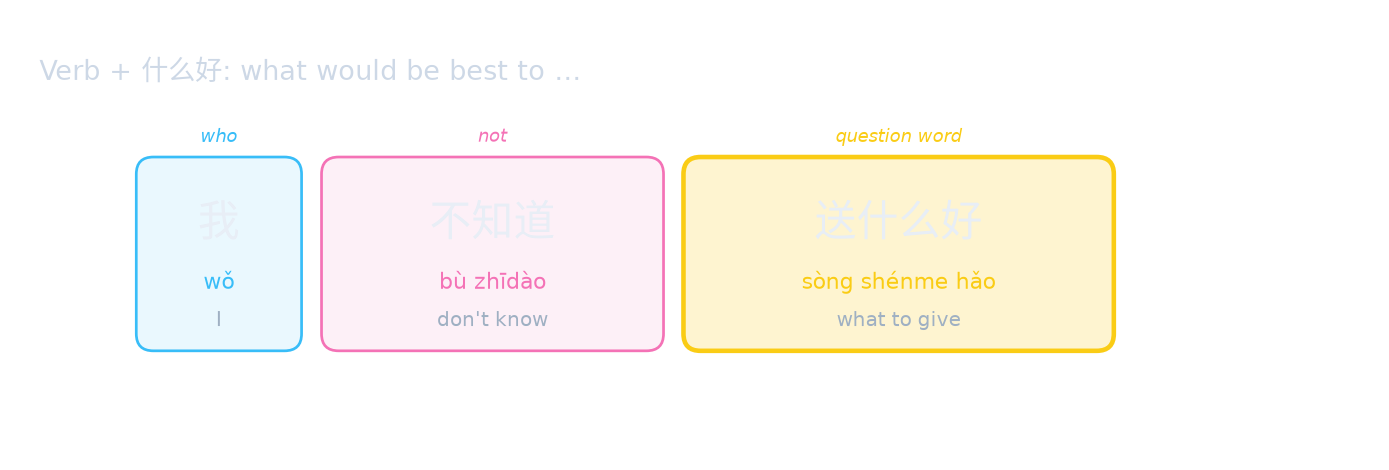
- I / me我not不to know知道to send送what什么good好。 – "I don't know what would be best to give."
not不to know知道 + Verb + QW + good好
- not不to know知道 + verb + question word + good好 = "don't know what / which / how it would be best to …".
- good好 at the end means "would be good, best": not不to know知道to buy买which哪个good好.
I我don't不know知道buy买which one哪个(is best)好。
Choices between options
- I / me我not不to know知道to go去Beijing, capital of the…北京good好or / still还是to go去Shanghai municipality…上海good好。 – "I don't know whether it's better to go to Beijing or Shanghai."
- he / him他not不to know知道what's to be done怎么办good好。 – "He didn't know what to do."
he他didn't不know知道how怎么to handle it办(best)好。
A statement, not a question
- The question word is embedded, so there is no question mark: not不to know知道to buy买what什么good好。
- good好 goes at the end of the embedded choice, not after to know知道: not不to know知道variant of 说说what什么good好, not not不to know知道good好variant of 说说what什么.
Asking for advice
- Turn it into a question with you你variant of 说说: you你variant of 说说I / me我to buy买which哪个good好? – "Which do you think I should buy?"
- Or with (yes/no ?)吗: you你to know知道to buy买which哪个good好(yes/no ?)吗?
you你say说I我buy买which one哪个(is best)好?
Recap
- not不to know知道 + Verb + QW + good好 = don't know what / which / how is best.
- good好 closes the embedded choice; ask advice with you你variant of 说说…good好?
Practise this pattern step by step.
to / towards / correct对 … 来说 (for / as far as … is concerned)
For me, it's hard
- Your classmate finds Chinese tones easy, but you don't.
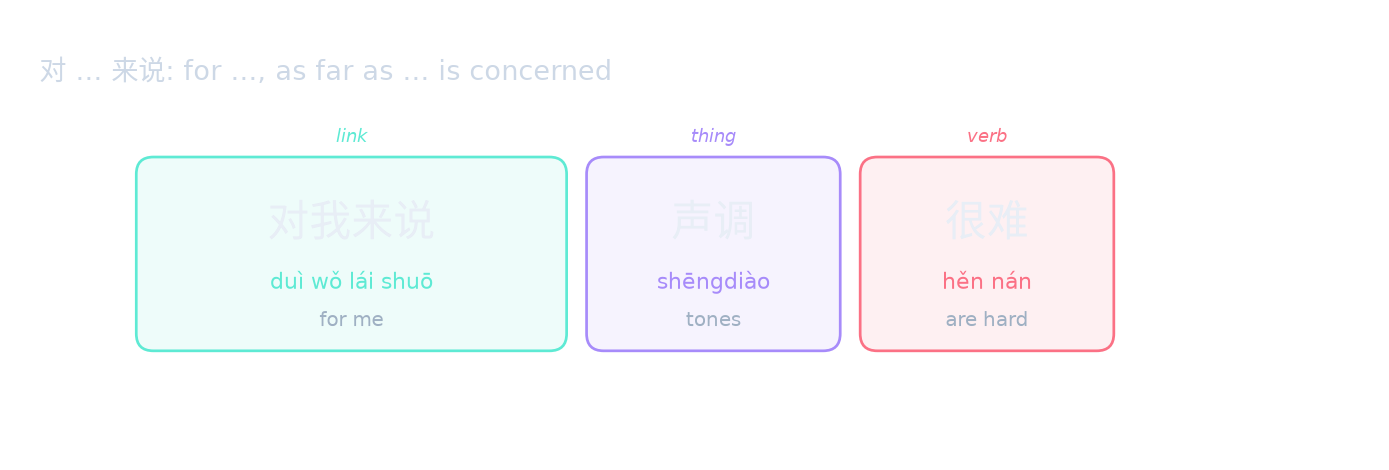
- to / towards / correct对I / me我来说,tone声调很难。 – "For me, tones are hard."
to / towards / correct对 + person + 来说,… = for, as far as … is concerned
- to / towards / correct对 X 来说 gives the point of view from which something is judged.
- It usually starts the sentence, followed by a comma.
for对me我(as far as … goes)来说,tones声调very很hard难。
Groups and things too
- to / towards / correct对student学生来说,(concept of) time时间most最important重要。 – "For students, time is the most important thing."
- to / towards / correct对this这个city城市来说,trip旅游degree / adjective linker很important重要。 – "Tourism is very important for this city."
for对students学生(as far as … goes)来说,time时间most最important重要。
Keep all three parts
- Use the full frame to / towards / correct对…来说: to / towards / correct对I / me我来说, not to / towards / correct对I / me我variant of 说说 (that means "said to me").
- The judgement follows: to / towards / correct对he / him他来说,this这no不是question问题.
to / towards / correct对…来说 versus at / in在…apparently看来
- to / towards / correct对…来说 = how it affects or matters to someone: to / towards / correct对I / me我来说很难.
- at / in在…apparently看来 = someone's opinion: in my opinion在我看来,this这个means办法no good不好.
in在my我view看来,this这个method办法not不good好。
Recap
- to / towards / correct对 X 来说,… = for X / as far as X is concerned.
- Keep 来说 (to / towards / correct对I / me我variant of 说说 = said to me); at / in在…apparently看来 = in someone's opinion.
Practise this pattern step by step.
Practice without the models
Choose a pattern, cover its teaching examples, and attempt its questions. Use the labels to find feedback in the separate key.
to link连 … all / both都 / also也 (even)
2401.1 Complete: “Even my grandma uses WeChat.” …………I / me我(informal) grandma…奶奶all / both都to use / with用Weixin or WeChat (mobile…微信。
2401.2 Which sentence is correct?
- A. teacher老师to link连also也not不to know知道。
- B. to link连teacher老师also也not不to know知道。
- C. to link连teacher老师not不to know知道。
- D. to link连also也teacher老师not不to know知道。
2401.3 Build: “He works even at weekends.”
Arrange all chunks: to work工作。 / all / both都at / in在 / he / him他 / to link连weekend周末
2401.4 to link连child小孩子all / both都can / will会 suggests the task is easy.
True or false? Explain or repair the statement.
2401.5 A friend doesn't know that you shouldn't touch a hot stove. Close the examples. Say a Mandarin response, then write it in Chinese. Explain briefly in English what the lesson’s pattern adds. Compare with the model, then change one detail and try again.
Write or say your own response before reading the key.
Question Word + all / both都 (every)
2402.1 Complete: “He can do anything.” he / him他…………all / both都can / will会。
2402.2 Which says “Every dish is delicious”?
- A. vegetable菜what什么all / both都to be fond of eating好吃。
- B. all / both都what什么vegetable菜to be fond of eating好吃。
- C. to be fond of eating好吃what什么vegetable菜all / both都。
- D. what什么vegetable菜all / both都to be fond of eating好吃。
2402.3 Build: “I can't find it no matter how I look.”
Arrange all chunks: to try to find找 / I / me我 / not to arrive不到。 / how / why怎么all / both都
2402.4 who谁all / both都can / may可以to come来 means “Anyone can come.”
True or false? Explain or repair the statement.
2402.5 Your friend asks where you want to eat. You are hungry and not fussy. Close the examples. Say a Mandarin response, then write it in Chinese. Explain briefly in English what the lesson’s pattern adds. Compare with the model, then change one detail and try again.
Write or say your own response before reading the key.
A to be / is是 B (modifier / structural particle)的 N (two, three etc) -fold倍 (N times)
2403.1 Complete: “Her salary is twice his.” she / her她(modifier / structural particle)的wages工资to be / is是he / him他(modifier / structural particle)的two两…………。
2403.2 B has 10 books. 'A than / compared to比 B 多一倍' – how many does A have?
- A. 11
- B. 5
- C. 20
- D. 30
2403.3 Build: “This city's population is twice that city's.”
Arrange all chunks: (two, three etc) -fold倍。 / this这个city城市(modifier / structural particle)的population人口 / two两 / to be / is是that那个(modifier / structural particle)的
2403.4 I / me我去过triple三倍 means “I've been three times.”
True or false? Explain or repair the statement.
2403.5 You compare your new flat with the tiny room you rented before. Close the examples. Say a Mandarin response, then write it in Chinese. Explain briefly in English what the lesson’s pattern adds. Compare with the model, then change one detail and try again.
Write or say your own response before reading the key.
a bit一点 + also也 / all / both都 + not不 (not at all)
2404.1 Complete: “This isn't expensive at all.” this这个erhua variant of 一点一点儿…………not不expensive贵。
2404.2 Which is the strongest denial?
- A. erhua variant of 一点一点儿also也不难。
- B. fairly / rather比较difficult / hard难。
- C. 不太难。
- D. slightly有点儿difficult / hard难。
2404.3 Build: “He hasn't changed at all.”
Arrange all chunks: also也not / haven't没 / he / him他 / erhua variant of 一点一点儿 / to change变。
2404.4 erhua variant of 一点一点儿also也cold冷 means “a little cold”.
True or false? Explain or repair the statement.
2404.5 A friend asks if the horror film was scary. You thought it was boring. Close the examples. Say a Mandarin response, then write it in Chinese. Explain briefly in English what the lesson’s pattern adds. Compare with the model, then change one detail and try again.
Write or say your own response before reading the key.
not不to know知道 + embedded choice + good好 (unsure what is best)
2405.1 Complete: “I don't know what to say.” I / me我not不to know知道variant of 说说what什么…………。
2405.2 Which sentence is correct?
- A. I / me我not不to know知道to ingratiate oneself买好which哪个。
- B. I / me我not不to know知道good好to buy买which哪个。
- C. good好I / me我not不to know知道to buy买which哪个。
- D. I / me我not不to know知道to buy买which哪个good好。
2405.3 Build: “He didn't know what to do.”
Arrange all chunks: good好。 / what's to be done怎么办 / not不to know知道 / he / him他
2405.4 you你variant of 说说I / me我to buy买which哪个good好? asks someone for advice.
True or false? Explain or repair the statement.
2405.5 It's your mother's birthday tomorrow and you still haven't chosen a gift. Close the examples. Say a Mandarin response, then write it in Chinese. Explain briefly in English what the lesson’s pattern adds. Compare with the model, then change one detail and try again.
Write or say your own response before reading the key.
to / towards / correct对 … 来说 (for / as far as … is concerned)
2406.1 Complete: “For me, this isn't a problem.” to / towards / correct对I / me我…………,this这no不是question问题。
2406.2 What does he / him他to / towards / correct对I / me我variant of 说说 mean?
- A. In his opinion
- B. As far as I'm concerned
- C. He said to me
- D. For him, I …
2406.3 Build: “For students, time is the most important thing.”
Arrange all chunks: most最important重要。 / to / towards / correct对student学生来说 / , / (concept of) time时间
2406.4 in my opinion在我看来 introduces an opinion.
True or false? Explain or repair the statement.
2406.5 Your classmate finds Chinese tones easy, but you don't. Close the examples. Say a Mandarin response, then write it in Chinese. Explain briefly in English what the lesson’s pattern adds. Compare with the model, then change one detail and try again.
Write or say your own response before reading the key.
A fresh situation
R1. Interpret and repair. A five-yuan item and a ten-yuan item are compared. A learner says 十元to be / is是五元(modifier / structural particle)的twice as much两倍 means the difference is ten yuan. Repair the arithmetic.
R2. Use it yourself. State that you are not tired at all and identify who a difficult task is difficult for.
Write your responses before opening the key. Compare meaning as well as form; a different valid answer need not copy the model.
Open the answers after your attempt
Answers and explanations
Check after your attempt. For open tasks, compare the message and the stated criteria, then revise one detail.
to link连 … all / both都 / also也 (even)
2401.1 to link连
to link连 X all / both都 = even X.
2401.2 B. to link连teacher老师also也not不to know知道。
to link连teacher老师also也not不to know知道 is right: to link连 + X + also也/all / both都 + verb. Leaving out also也/all / both都 is wrong, and to link连 must come directly before teacher老师.
2401.3 he / him他to link连weekend周末all / both都at / in在to work工作。
Subject + to link连 X + all / both都 + verb.
2401.4 True.
If even a child can, it must be easy.
2401.5 One possible response: this这个to link连child小孩子all / both都to know知道!
Check meaning and form:
- My response conveys a message that fits the opening situation.
- I can explain the meaning of the pattern, rather than only naming it.
- to link连 needs all / both都 or also也 after X: to link连he / him他all / both都to come来(completed / change)了, not to link连he / him他to come来(completed / change)了.
- Choose X as the most surprising case; to link连 + ordinary item sounds odd.
- I tried a second response with a name, time, place, or description changed.
This is supported productive practice. Compare meaning and structure; your answer need not copy the model. A partner or teacher must hear the spoken response to comment on pronunciation.
Question Word + all / both都 (every)
2402.1 what什么
what什么 + all / both都 = everything / anything.
2402.2 D. what什么vegetable菜all / both都to be fond of eating好吃。
Question word + noun + all / both都 means “every”: what什么vegetable菜all / both都to be fond of eating好吃 “Every dish is delicious.” what什么 must come directly before the noun, and all / both都 before the predicate.
2402.3 I / me我how / why怎么all / both都to try to find找not to arrive不到。
how / why怎么 + all / both都 + potential complement.
2402.4 True.
True. A question word before all / both都 means “any / every”: who谁all / both都can / may可以to come来 “Anyone can come.”
2402.5 One possible response: where哪儿都行,you你to choose选(suggestion)吧。
Check meaning and form:
- My response conveys a message that fits the opening situation.
- I can explain the meaning of the pattern, rather than only naming it.
- I / me我what什么all / both都variant of 吃吃, not I / me我variant of 吃吃what什么all / both都: the QW moves before all / both都.
- With a noun: which哪个 / what什么 + noun + all / both都: what什么vegetable菜all / both都to be fond of eating好吃.
- I tried a second response with a name, time, place, or description changed.
This is supported productive practice. Compare meaning and structure; your answer need not copy the model. A partner or teacher must hear the spoken response to comment on pronunciation.
A to be / is是 B (modifier / structural particle)的 N (two, three etc) -fold倍 (N times)
2403.1 (two, three etc) -fold倍
A to be / is是 B (modifier / structural particle)的 N (two, three etc) -fold倍.
2403.2 C. 20
One time more = double = 20.
2403.3 this这个city城市(modifier / structural particle)的population人口to be / is是that那个(modifier / structural particle)的twice as much两倍。
A to be / is是 B (modifier / structural particle)的 N (two, three etc) -fold倍.
2403.4 False.
False. (two, three etc) -fold倍 means “times” as a multiple (triple三倍 “three times as much”). Occasions are counted with next in sequence次: I / me我去过third三次 “I've been three times.”
2403.5 One possible response: now现在(modifier / structural particle)的house房子to be / is是before以前(modifier / structural particle)的triple三倍。
Check meaning and form:
- My response conveys a message that fits the opening situation.
- I can explain the meaning of the pattern, rather than only naming it.
- to be / is是…(modifier / structural particle)的twice as much两倍 = twice as much (×2), and so is than / compared to比…多一倍. In careful usage, than / compared to比…多两倍 = ×3.
- (two, three etc) -fold倍 is for increases; for "half as much", use half一半: A to be / is是 B (modifier / structural particle)的half一半.
- I tried a second response with a name, time, place, or description changed.
This is supported productive practice. Compare meaning and structure; your answer need not copy the model. A partner or teacher must hear the spoken response to comment on pronunciation.
a bit一点 + also也 / all / both都 + not不 (not at all)
2404.1 also也
erhua variant of 一点一点儿also也/all / both都 + not不.
2404.2 A. erhua variant of 一点一点儿also也不难。
erhua variant of 一点一点儿also也not不 + adjective is the strongest denial: erhua variant of 一点一点儿also也不难 “not difficult at all”. 不太难 is only “not very difficult”.
2404.3 he / him他erhua variant of 一点一点儿also也not / haven't没to change变。
erhua variant of 一点一点儿 + also也not / haven't没 + verb.
2404.4 False.
erhua variant of 一点一点儿also也 needs a negative; “a bit cold” is slightly有点儿cold冷.
2404.5 One possible response: erhua variant of 一点一点儿also也not不awful可怕。
Check meaning and form:
- My response conveys a message that fits the opening situation.
- I can explain the meaning of the pattern, rather than only naming it.
- Put erhua variant of 一点一点儿also也 before not不 / not / haven't没: erhua variant of 一点一点儿also也not不cold冷, not not不erhua variant of 一点一点儿cold冷.
- It needs a negative; erhua variant of 一点一点儿also也cold冷 is wrong. "A bit cold" is slightly有点儿cold冷.
- I tried a second response with a name, time, place, or description changed.
This is supported productive practice. Compare meaning and structure; your answer need not copy the model. A partner or teacher must hear the spoken response to comment on pronunciation.
not不to know知道 + embedded choice + good好 (unsure what is best)
2405.1 good好
not不to know知道 + verb + QW + good好.
2405.2 D. I / me我not不to know知道to buy买which哪个good好。
I / me我not不to know知道to buy买which哪个good好 is right: good好 closes the embedded choice "which one would be best to buy", so it goes at the end.
2405.3 he / him他not不to know知道what's to be done怎么办good好。
not不to know知道 + what's to be done怎么办 + good好.
2405.4 True.
you你variant of 说说…good好? turns the dilemma into a question.
2405.5 One possible response: I / me我not不to know知道to send送what什么good好。
Check meaning and form:
- My response conveys a message that fits the opening situation.
- I can explain the meaning of the pattern, rather than only naming it.
- The question word is embedded, so there is no question mark: not不to know知道to buy买what什么good好。
- good好 goes at the end of the embedded choice, not after to know知道: not不to know知道variant of 说说what什么good好, not not不to know知道good好variant of 说说what什么.
- I tried a second response with a name, time, place, or description changed.
This is supported productive practice. Compare meaning and structure; your answer need not copy the model. A partner or teacher must hear the spoken response to comment on pronunciation.
to / towards / correct对 … 来说 (for / as far as … is concerned)
2406.1 来说
to / towards / correct对 X 来说.
2406.2 C. He said to me
Without 来说, to / towards / correct对 + person + variant of 说说 = say to.
2406.3 to / towards / correct对student学生来说,(concept of) time时间most最important重要。
to / towards / correct对 X 来说, then the judgement.
2406.4 True.
at / in在…apparently看来 = in someone's view.
2406.5 One possible response: to / towards / correct对I / me我来说,tone声调很难。
Check meaning and form:
- My response conveys a message that fits the opening situation.
- I can explain the meaning of the pattern, rather than only naming it.
- Use the full frame to / towards / correct对…来说: to / towards / correct对I / me我来说, not to / towards / correct对I / me我variant of 说说 (that means "said to me").
- The judgement follows: to / towards / correct对he / him他来说,this这no不是question问题.
- I tried a second response with a name, time, place, or description changed.
This is supported productive practice. Compare meaning and structure; your answer need not copy the model. A partner or teacher must hear the spoken response to comment on pronunciation.
Fresh-situation answers
R1. Ten is twice five, but the difference is five. Ato be / is是B(modifier / structural particle)的twice as much两倍 compares totals; it does not directly state an added amount of two times B.
R2. One possible response. I / me我erhua variant of 一点一点儿also也not不rope累。to / towards / correct对beginning student初学者来说,this这个mission任务fairly / rather比较difficult / hard难。The first is emphatic negation; the second limits the judgment to beginners rather than all people.
Recall later. Tomorrow, distinguish a ratio from a difference, then qualify a judgment by its audience.