Lower limb
مُقدَّم| English | المعنى |
|---|---|
| femoral nerve | femoral nerve |
| obturator nerve | obturator nerve |
| sciatic nerve | sciatic nerve |
| common peroneal nerve | common peroneal nerve |
| compartment syndrome | compartment syndrome |
| foot drop | foot drop |
A lifetime of carrying
- The leg carries the body for a lifetime. Its muscles sit in closed sleeves, its nerves pass landmarks you can name, and its arteries run from groin to toe.
- Each sleeve has its own nerve, its own job and its own emergency.
The three thigh nerves
- The femoral nerve 股神经 runs in front and straightens the knee. The obturator nerve 闭孔神经 supplies the inner thigh, which pulls the legs together.
- The sciatic nerve 坐骨神经 runs behind and splits above the knee into the tibial nerve and the common peroneal nerve 腓总神经.
Match each nerve to the movement it powers.
الصعوبة 2/5 · 140 عملة + مكافأة صغيرة عند الإنجاز الأول اليوم
Front, inner and back of the thigh each have their own nerve, so the movement that fails names the nerve.
Four sleeves in the leg
- The leg below the knee has four fascial compartments. Anterior lifts the foot (dorsiflexion); lateral turns the sole outwards (eversion).
- Superficial posterior points the foot down (plantarflexion); deep posterior turns the sole inwards (inversion) and bends the toes.
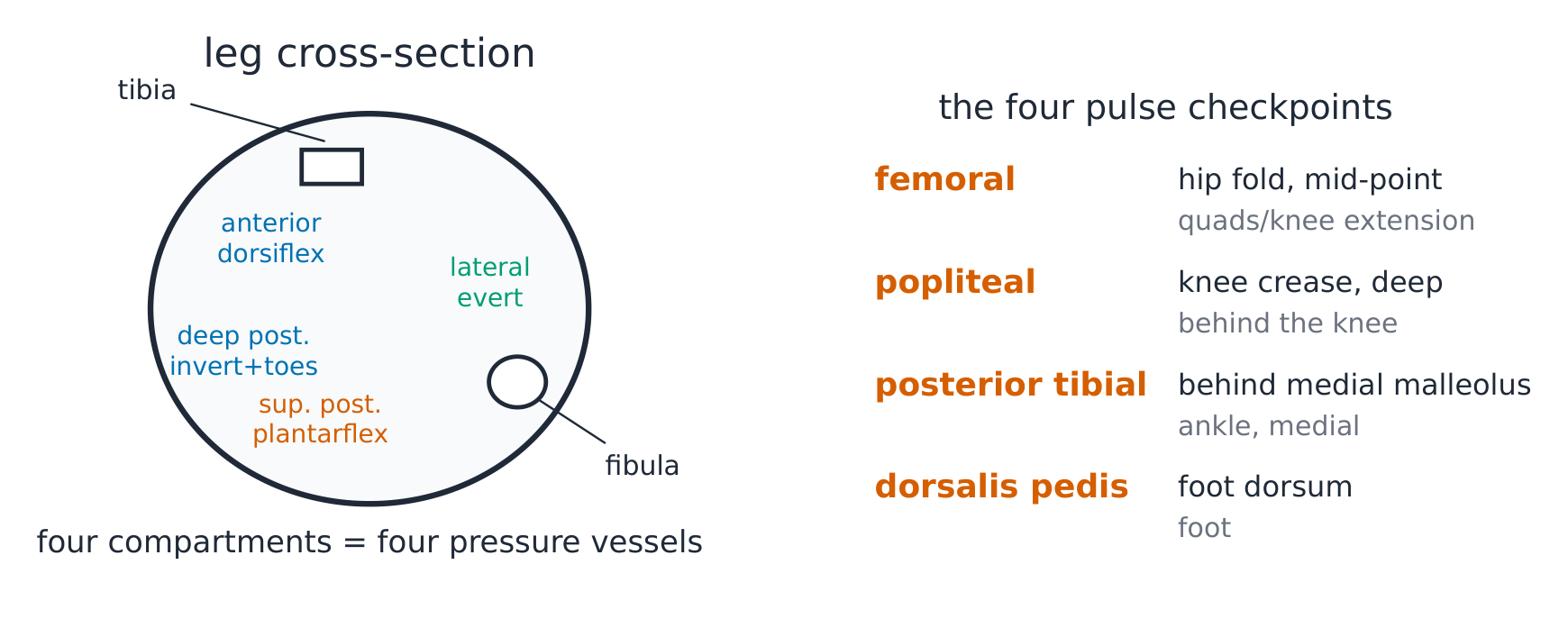
Which leg compartment turns the sole of the foot outwards (eversion)?
الصعوبة 1/5 · 100 عملة + مكافأة صغيرة عند الإنجاز الأول اليوم
The lateral compartment (peroneal muscles, superficial peroneal nerve) everts the foot.
When a sleeve becomes a trap
- Fascia does not stretch. If muscle swells inside it, the pressure rises, and above about 30 mmHg the small vessels stop flowing: compartment syndrome 骨筋膜室综合征.
- The sign is pain far worse than expected, especially when the muscle is passively stretched. Pulses usually remain, because arterial pressure is much higher. Treatment is to open the sleeve.
A patient's diastolic blood pressure is 70 mmHg and the anterior compartment pressure is 45 mmHg. What is the difference (ΔP) in mmHg?
الصعوبة 2/5 · 140 عملة + مكافأة صغيرة عند الإنجاز الأول اليوم
70 − 45 = 25 mmHg. A ΔP below about 30 mmHg means the muscle is not being perfused well: a sign that the compartment needs opening.
If the foot pulses can be felt, compartment syndrome is ruled out.
الصعوبة 1/5 · 100 عملة + مكافأة صغيرة عند الإنجاز الأول اليوم
Arterial pressure is far above the pressure that stops capillary flow, so pulses usually stay until very late.
Worked example: the nerve at the fibular neck
- The common peroneal nerve wraps around the neck of the fibula, just under the skin. Crossed legs or a tight cast can press it there.
- Result: foot drop 足下垂 and weak eversion, but inversion is kept, because the tibial nerve still works. That pattern places the lesion at the fibular neck.
A patient has foot drop after a tight cast below the knee, but can still turn the sole inwards. Where is the lesion?
الصعوبة 1/5 · 100 عملة + مكافأة صغيرة عند الإنجاز الأول اليوم
Foot drop and weak eversion with inversion kept (tibial nerve intact) point to the common peroneal nerve where it wraps the fibular neck.
Worked example: the narrowed artery
- (Fictional patient) Calf pain after 200 m of walking, relieved by standing still for a few minutes. An artery higher up is narrowed, so the calf runs out of blood when it works.
- Examine four pulses from top to bottom: femoral, popliteal, posterior tibial, dorsalis pedis. Where they disappear tells you where the narrowing is.
Put the leg pulses in order from the groin to the foot.
الصعوبة 3/5 · 200 عملة + مكافأة صغيرة عند الإنجاز الأول اليوم
Checking them in order finds the level where blood flow is lost.
Three common slips
- Dermatome map for nerve map. In the limbs, the skin patch of a root and of a nerve differ.
- Mixing up eversion and inversion. Eversion is superficial peroneal; inversion is mainly tibial. The pair locates the lesion.
- "A pulse rules out compartment syndrome." It does not; the key sign is pain on passive stretch.
Recap
- Femoral (front), obturator (inner), sciatic (back, splitting into tibial and common peroneal).
- Four leg compartments, each with a job and a nerve; tight fascia makes swelling dangerous.
- Common peroneal palsy: foot drop with inversion kept. Four named pulses map the arteries.