Process capability: proving the process stays inside
مُقدَّم| English | المعنى |
|---|---|
| tolerance/ˈtɒlərəns/ | The permitted variation from a specified dimension or other measured requirement. |
| process capability | A measure, such as Cp or Cpk, of how well a process's natural spread fits within the tolerance. |
| process plan | The ordered list of operations, machines, tools and checks needed to make a part. |
| datum | A reference feature, such as a surface or axis, from which dimensions and tolerances are measured. |
| fit/fɪt/ | The relation between the sizes of a hole and the shaft in it, which sets whether they clear or interfere. |
| average run length | The average number of samples a control chart takes to signal after a shift in the process. |
A drawing is not proof
- A drawing and a process are not enough. The shop must show that the process keeps making parts inside the tolerance, and process capability gives that proof.
- A process plan lists the operations in order, such as stock, rough turn, heat treat, finish grind and inspect, each with its datum and tolerance.
Two indices
- $C_p = (USL - LSL)/6\sigma$ asks whether the spread fits. $C_{pk} = \min(USL - \mu,\ \mu - LSL)/3\sigma$ also asks whether it is centred.
- The nearer limit is $3C_{pk}$ standard deviations from the mean, so the defect fraction beyond it is $1 - \Phi(3C_{pk})$.
Spread, centring or control?
Decide which quality tool answers each question.
Tolerance 25.00 +/- 0.05 mm, sigma = 0.012 mm: Cp (two decimals)?
الصعوبة 2/5 · 140 عملة + مكافأة صغيرة عند الإنجاز الأول اليوم
0.10 over 0.072.
The bearing seat
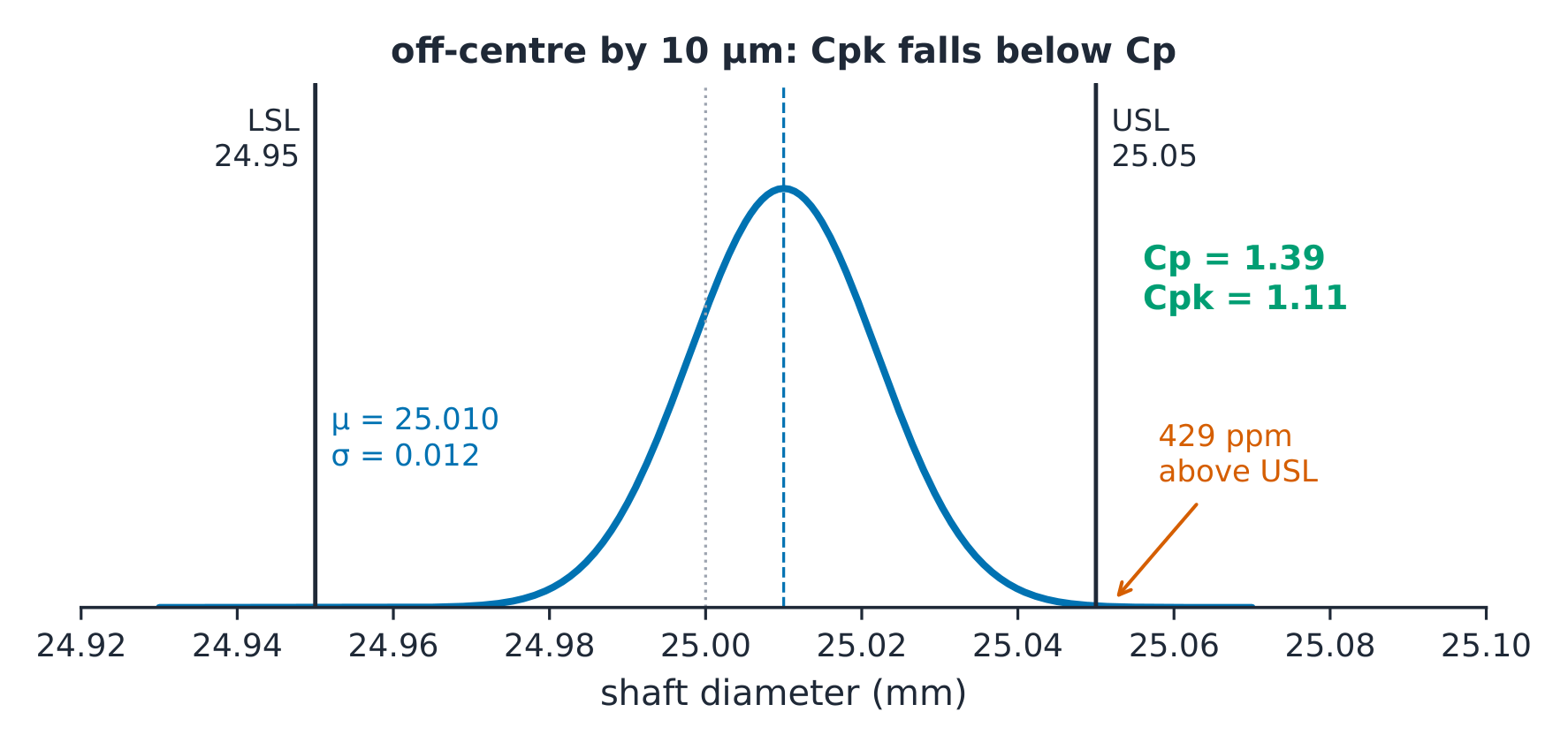
- Specification $25.00 \pm 0.05$ mm; the grinder runs at $\mu = 25.010$, $\sigma = 0.012$ mm.
- $C_p = 0.10/0.072 = \mathbf{1.39}$: the spread fits. $C_{pk} = 0.040/0.036 = \mathbf{1.11}$: the 10 µm offset costs capability, about $\mathbf{429}$ ppm above USL.
- Re-centring to 25.000 gives $C_{pk} = 1.39$ and only $\mathbf{31}$ ppm in total: a set-up fix, not a new machine.
Mean 25.010 mm: Cpk (two decimals)?
الصعوبة 2/5 · 140 عملة + مكافأة صغيرة عند الإنجاز الأول اليوم
0.040 over 0.036.
Re-centring the grinder changes:
الصعوبة 1/5 · 100 عملة + مكافأة صغيرة عند الإنجاز الأول اليوم
Cp depends only on the spread.
The control chart
- Sample $n = 5$ shafts each hour and plot the mean. The limits are $\mu \pm 3\sigma/\sqrt n = 25.010 \pm 0.016$: $\mathbf{24.994}$ to $\mathbf{25.026}$ mm.
- A point outside, or a run of seven on one side, means the process has changed. Stop and find the cause before scrap appears.
Upper limit of the x-bar chart with n = 5 (three decimals, mm)?
الصعوبة 2/5 · 140 عملة + مكافأة صغيرة عند الإنجاز الأول اليوم
25.010 + 3 x 0.012 over root 5.
Lower limit (three decimals, mm)?
الصعوبة 2/5 · 140 عملة + مكافأة صغيرة عند الإنجاز الأول اليوم
25.010 - 0.016.
Specification limits can be used as control-chart limits.
الصعوبة 1/5 · 100 عملة + مكافأة صغيرة عند الإنجاز الأول اليوم
Control limits come from the process; specification limits come from the drawing.
A process at $C_{pk} = 1.33$: parts per million beyond the nearer limit (nearest whole)?
الصعوبة 2/5 · 140 عملة + مكافأة صغيرة عند الإنجاز الأول اليوم
$3 \times 1.33 = 4\sigma$; $1 - \Phi(4) = 3.2 \times 10^{-5}$.
A process with $C_{pk} = 1.00$ makes essentially no defects.
الصعوبة 1/5 · 100 عملة + مكافأة صغيرة عند الإنجاز الأول اليوم
At $3\sigma$ from the nearer limit about 1350 ppm fall beyond it, before any drift.
Why 1.33 is the usual target
- At $C_{pk} = 1.33$ the nearer limit is $4\sigma$ from the mean: $1 - \Phi(4) = \mathbf{32}$ ppm beyond it. At 1.00 it is $3\sigma$ and 1350 ppm.
- Customers ask for 1.33, or 1.67 for safety parts, because the mean drifts between set-ups. The margin above 1.00 is room for that drift.
A 1σ shift watched by an $n = 5$ x-bar chart: average run length (one decimal, samples)?
الصعوبة 2/5 · 140 عملة + مكافأة صغيرة عند الإنجاز الأول اليوم
Shift $\sqrt5 = 2.24$ in chart units; $p = 1 - \Phi(0.76) = 0.222$; $1/0.222 = 4.5$.
Worked example: how fast does the chart notice?
- The grinder's mean jumps by one $\sigma$, 0.012 mm. In units of $\sigma/\sqrt 5$ that is $\sqrt5 = 2.24$, so the new mean sits $3 - 2.24 = 0.76$ below the upper limit.
- Each hourly point falls outside with probability $1 - \Phi(0.76) = 0.22$: the average run length 平均运行长度 is $1/0.22 = \mathbf{4.5}$ samples. Larger samples catch small shifts sooner.
Three quality slips
- $C_p$ for an off-centre process. Quote $C_{pk}$.
- Specification limits as control limits. They answer different questions.
- A coarse gauge. It should resolve a tenth of the tolerance.
Recap
- $C_p = 1.39$, $C_{pk} = 1.11$ (429 ppm); centred, $C_{pk} = 1.39$ (31 ppm).
- Defects $\approx 1 - \Phi(3C_{pk})$.
- $\bar x$ limits $\mu \pm 3\sigma/\sqrt n$: 24.994 to 25.026 mm.