خطة التعلم الخاصة بك · متابعة · مراجعة →
تدريب أذنك — مرة واحدة، التقليد الصوتي، وعادات التدوين
مُقدَّميبقى موقعك المحفوظ في هذا المتصفح. لا يكتمل استئناف الموقع الدرس أو الإجابة على أسئلته.
 17:03
الاستماع: تدريب صفري محلول
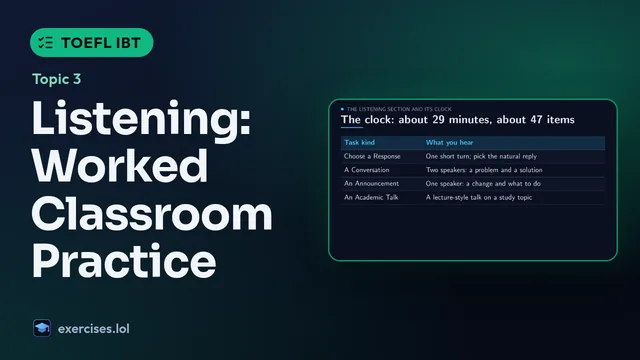
تقدم لك قسم الاستماع حوالي تسعة وعشرين دقيقة وحوالي سبعة وأربعين عنصرًا، في أربعة أنواع من المهام: استمع واختر ردًا، استمع إلى…
سرد باللغة الإنجليزية · ترجمة نصية بالإنجليزية و中文 يمكنك التبديل بينهما
في هذا الدرس
| English | المعنى |
|---|---|
| listen and repeat/ˈlɪsn ænd rɪˈpiːt/ | |
| shadowing/ˈʃædəʊɪŋ/ | Speaking along with a recording, just after the voice. |
| notes/nəʊts/ |
A replay result can't replace the first result
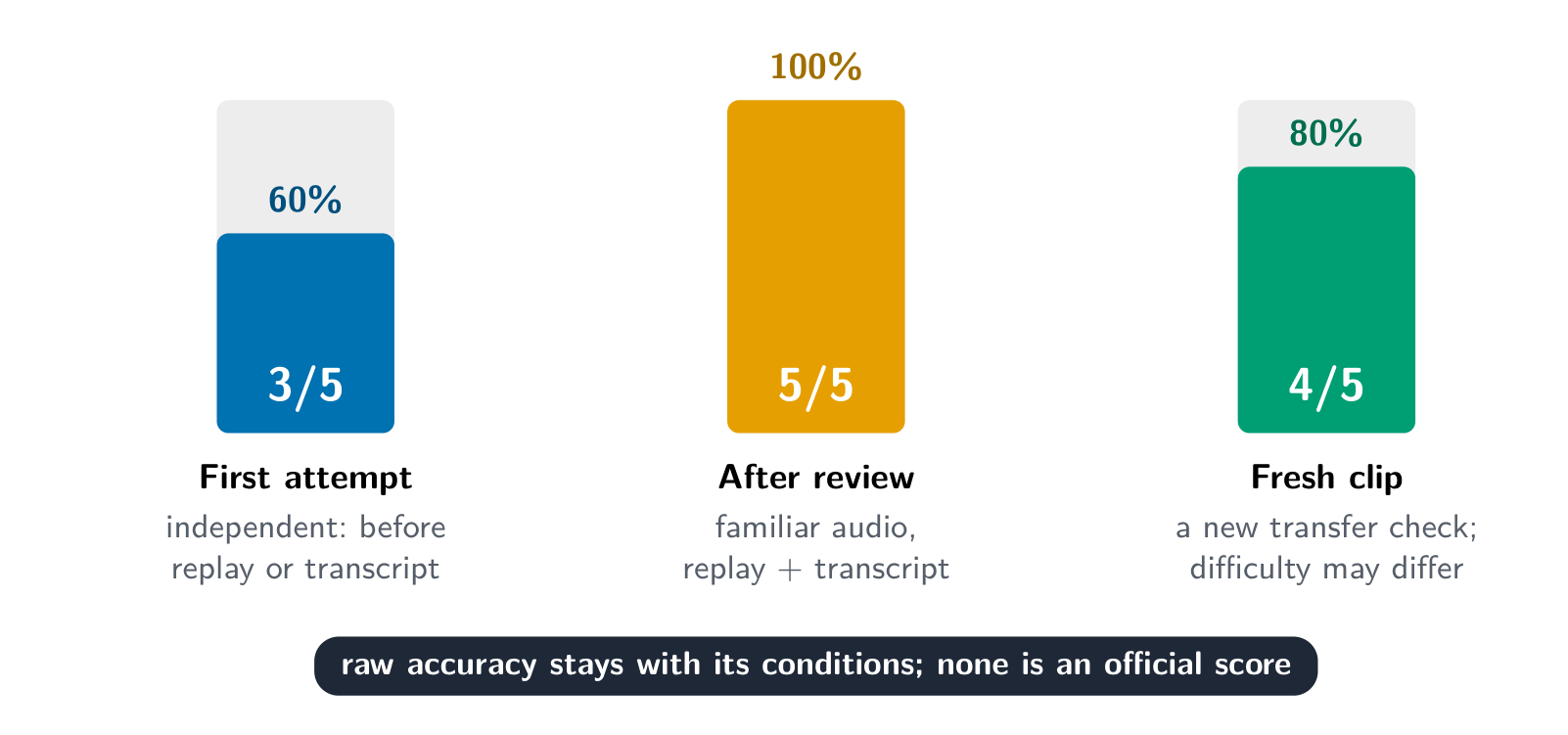
- In an invented study log, a learner gets 3 of 5 on the first attempt, 5 of 5 after replaying and reading the transcript, and 4 of 5 on a new clip. That's 60%, 100% and 80% — under three different conditions.
- The 100% shows success with help on familiar audio; it doesn't turn the first attempt into 100%. The fresh 80% is one more observation, not proof of lasting progress or a band. The replay is a tutor, not a time machine.
What is the right order when you practise a recording?
الصعوبة 1/5 · 100 عملة + مكافأة صغيرة عند الإنجاز الأول اليوم
Use one play for the independent attempt, then replay to locate errors. Later success is evidence for review and learning, kept separate from first-attempt accuracy.
What raw percentage is 3 correct out of 5 on the first attempt?
الصعوبة 2/5 · 140 عملة + مكافأة صغيرة عند الإنجاز الأول اليوم
3 ÷ 5 × 100 = 60% on this first attempt.
What raw percentage is 4 correct out of 5 on the fresh clip?
الصعوبة 2/5 · 140 عملة + مكافأة صغيرة عند الإنجاز الأول اليوم
4 ÷ 5 × 100 = 80%. Different clips may differ in difficulty.
The reviewed 5/5 result changes the original independent 3/5 result to 5/5.
الصعوبة 1/5 · 100 عملة + مكافأة صغيرة عند الإنجاز الأول اليوم
Keep the two results attached to their different conditions.
Find the cause before you choose a drill
- A learner picks Wednesday instead of Thursday. The replay might show a sound confusion — or "Wednesday — sorry, Thursday", a correction they ignored. Compare the audio, the transcript and the chosen answer before you decide.
- Practise that one thing, then test it on a new recording with a different day or sentence. Remembering "Thursday" from the same clip proves nothing. Log the type of error, not just the letters.
Listen-and-repeat and shadowing are different drills
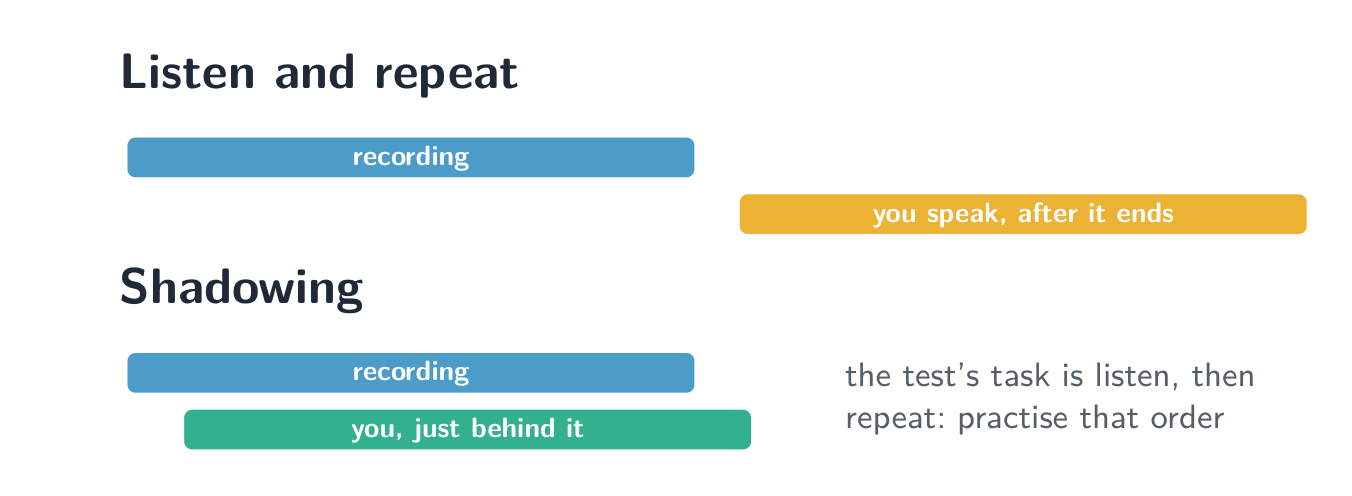
- Listen-and-repeat: hear a sentence, let it finish, then say it back. Shadowing: speak along with the recording, just behind it. Reading a transcript aloud without listening isn't either of these.
- Both can help; neither guarantees progress. For the test's Listen and Repeat task, practise hearing first and speaking afterwards, as the instructions say. Compare your recording with the original: words, endings, clarity.
Which drill or result is this?
A replay result cannot replace a first result; listen-and-repeat and shadowing are different drills.
Which description distinguishes shadowing from listen-and-repeat?
الصعوبة 1/5 · 100 عملة + مكافأة صغيرة عند الإنجاز الأول اليوم
Shadowing follows closely during playback. Listen-and-repeat is sequential: hear the sentence, then respond. They have different timing demands.
Pick a cycle you can keep, with a fresh check
- A short, regular session works well: an independent attempt → focused review → a new check. Fifteen focused minutes a day is one possible plan, not a scientific rule or a promise of faster progress.
- Choose one error to work on and leave time to test it. If you've stopped concentrating, a longer session isn't better. Fit the cycle to your time and the recordings you actually have.
Which schedule offers a regular, manageable practice opportunity?
الصعوبة 1/5 · 100 عملة + مكافأة صغيرة عند الإنجاز الأول اليوم
A short daily session can be easier to sustain. Its effectiveness depends on attention and the work you do; no fixed schedule guarantees faster learning.
Test what your notes cost you
- Practise a few abbreviations before you rely on them under time pressure. Check: does Thu / C / ID keep the facts you need — or does writing make you miss a correction in the next sentence?
- Keep or change your method based on that. Writing everything down may distract you, but not every learner or task needs the same outline. Reading this example tests your choice of notes, not listening and writing at the same time.
It is sensible to practise a note system before relying on it during timed listening.
الصعوبة 1/5 · 100 عملة + مكافأة صغيرة عند الإنجاز الأول اليوم
Use familiar short notes and check on real audio whether writing distracts you from the next point. Improvement takes practice and varies between learners.
Keep each result with its conditions
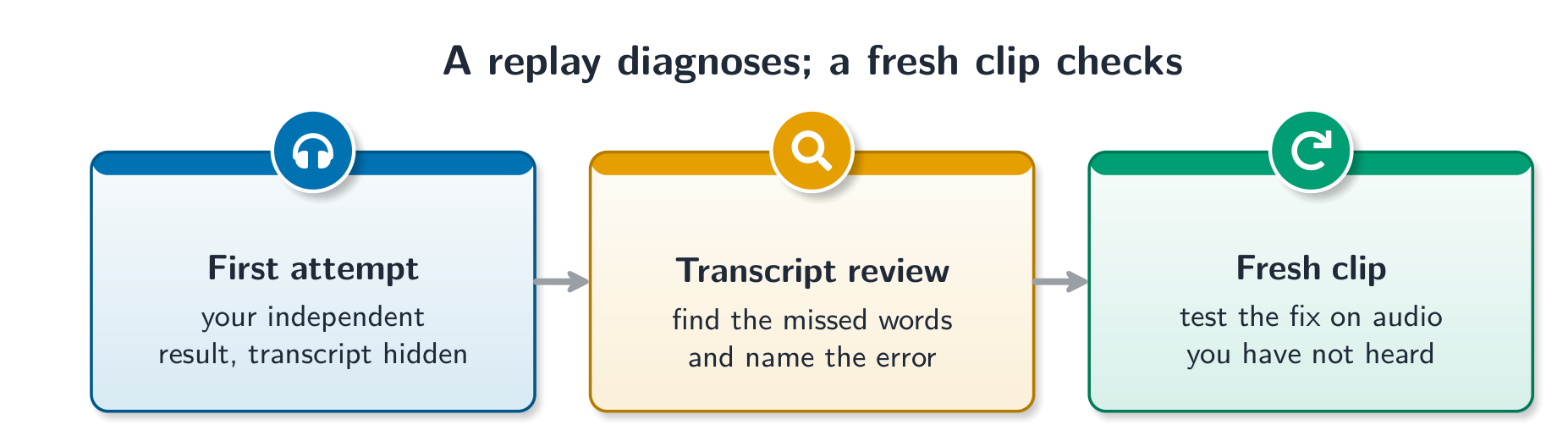
- Log separately: the first-attempt result, the cue you found in review, the fix you chose, and the fresh result. Use a similar new task where you can, and be careful about claiming progress — different clips can differ in difficulty.
- In short: attempt, diagnose, fix, test on something new. Checked on 2 October 2026: ETS Listening overview, ETS preparation. The percentages are invented raw-accuracy examples, not score conversions.
Match the three distinctions from the worked case.
الصعوبة 2/5 · 140 عملة + مكافأة صغيرة عند الإنجاز الأول اليوم
Check the source of the error: confused sounds, lost attention or an ignored correction? Practise that feature with a transcript, then use a fresh clip without text to test transfer.
What is the best use of a replay after answering?
الصعوبة 1/5 · 100 عملة + مكافأة صغيرة عند الإنجاز الأول اليوم
After one audio attempt, a student chooses Wednesday instead of Thursday. On replay, they locate the day correctly. The first attempt shows an error; the replay helps identify and repair it. Check the source of the error: confused sounds, lost attention or an ignored correction? Practise that feature with a transcript, then use a fresh clip without text to test transfer.
Complete the worked-case label: First attempt → ____. Use the phrase in the diagram.
الصعوبة 1/5 · 100 عملة + مكافأة صغيرة عند الإنجاز الأول اليوم
Attempt, diagnose, repair, then transfer to fresh audio. Keep first-attempt and reviewed results separate.