خطة التعلم الخاصة بك · متابعة · مراجعة →
非得 … 不可 (يجب بشدة)
مُقدَّميبقى موقعك المحفوظ في هذا المتصفح. لا يكتمل استئناف الموقع الدرس أو الإجابة على أسئلته.
 6:57
HSK 6 قواعد 7: أنماط متقدمة
岂不是. ميننا تؤمن بالفعل أن تصميماً جديداً الليلة فكرة سيئة. مع 岂不是 تضع هذه الاعتقاد في شكل سؤال وتُشجّع المجموعة على الاتفاق. هي لا تفعل…
شروحات إنجليزية + أمثلة ماندرين · التسميات تتبع النص المنطوق
في هذا الدرس
You have to see a doctor
- Your friend has had a fever for three days but refuses to see a doctor.
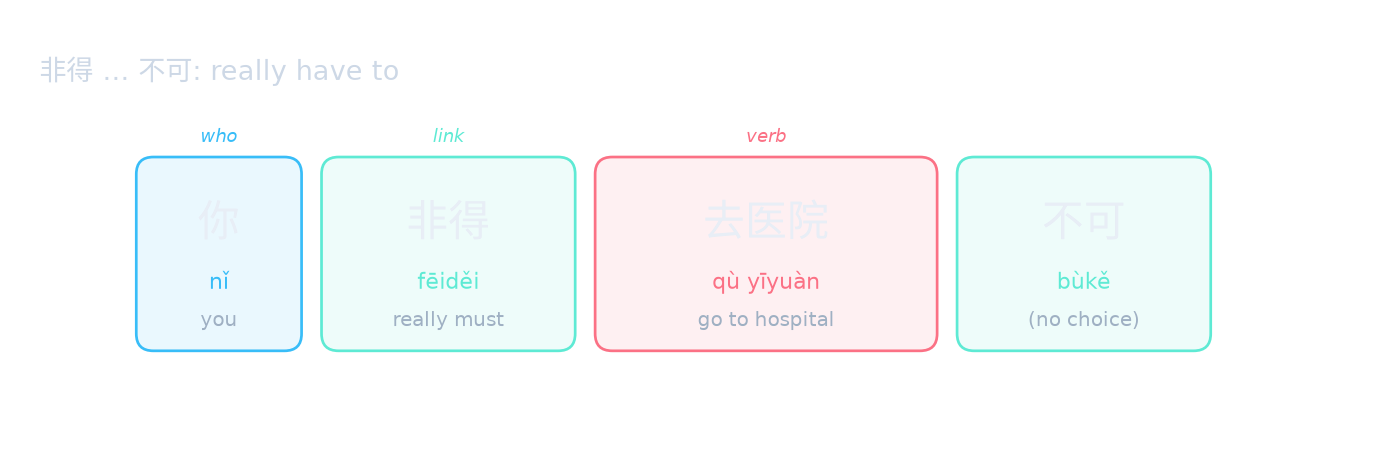
- you你to burn烧(degree marker)得so much这么amazing; severe厉害,must非得go去hospital医院(absolutely)不可。 — "With a fever this bad, you absolutely have to go to hospital."
- Goal: say something absolutely must happen with must非得 … (absolutely)不可.
must非得 + verb (+ (absolutely)不可) = must, have to
- must非得 (fēi děi) = must, absolutely have to; (absolutely)不可 / won't do不行 can close the sentence for extra force.
- In speech, must非得 alone often works: you你must非得today今天go去(yes/no ?)吗? — "Do you have to go today?"
you你must非得today今天go去吗?
Complete: “Do you really have to go today?” 你____今天去吗?
الصعوبة 1/5 · 100 عملة + مكافأة صغيرة عند الإنجاز الأول اليوم
非得 = must (spoken).
Necessity and insistence
- Necessity: this这份report报告must非得today今天be handed in交(absolutely)不可。 — "This report absolutely must be handed in today."
- Insistence: he / him他must非得oneself自己to do; to make做,who谁to help帮忙all / both都don't不要。 — "He insists on doing it himself and won't take help from anyone."
this这份report报告must非得today今天be handed in交(absolutely)不可。
Build: “This report must be handed in today.”
الصعوبة 3/5 · 200 عملة + مكافأة صغيرة عند الإنجاز الأول اليوم
非得 + verb + 不可.
Read it fēi děi
- (degree marker)得 here is děi ("must"), not de.
- must非得 is spoken; in writing, to have to必须 is the neutral choice.
- to have to必须 states a rule; must非得…(absolutely)不可 often shows insistence: according to regulation按规定,you你to have to必须to put on or wear戴helmet头盔。 — "By the rules, you must wear a helmet." he / him他must非得oneself自己to do; to make做(absolutely)不可,who谁to advise; to urge劝all / both都not不to listen to听。 — "He insists on doing it himself; nobody can talk him out of it."
How is 得 read in 非得?
الصعوبة 1/5 · 100 عملة + مكافأة صغيرة عند الإنجاز الأول اليوم
In 非得 (“must, have to”), 得 is read děi, as in 你得去. It is not the structural particle de or dé “obtain”.
must非得 versus (must)非…(absolutely)不可
- (must)非…(absolutely)不可 puts the verb in the middle: (must)非go去(absolutely)不可.
- must非得…((absolutely)不可) is the spoken variant with (degree marker)得: must非得go去 / must非得go去(absolutely)不可 ("I absolutely have to go"). Both are emphatic.
I我(must)非go去(must)不可。
非去不可 and 非得去 are both emphatic.
الصعوبة 1/5 · 100 عملة + مكافأة صغيرة عند الإنجاز الأول اليوم
Both mean “absolutely must go”.
Recap
- must非得 (fēi děi) + verb (+ (absolutely)不可 / won't do不行) = absolutely must / insist on.
- Spoken; (must)非…(absolutely)不可 is the classic form; to have to必须 is neutral.
Read the full reference: HSK 6 grammar — Sentence patterns.
Your friend has had a fever for three days but refuses to see a doctor. Close the examples. Say a Mandarin response, then write it in Chinese. Explain briefly in English what the lesson’s pattern adds. Compare with the model, then change one detail and try again.
This is supported productive practice. Compare meaning and structure; your answer need not copy the model. A partner or teacher must hear the spoken response to comment on pronunciation.
ما المشكلة؟ لا يرى ذلك سوى فريق الموقع.