خطة التعلم الخاصة بك · متابعة · مراجعة →
فعل / صفة + 坏了 (معطل / إلى حد تطرف)
مُقدَّميبقى موقعك المحفوظ في هذا المتصفح. لا يكتمل استئناف الموقع الدرس أو الإجابة على أسئلته.
 5:44
HSK 5 القواعد 18: المكمّلات
صفة يتبعها 得 ثم 很 أو 不得了 أو 要命 أو不行. تعني 不得了 درجة لا تصدق؛ وتعني 要命 حتى الموت (عامية)؛ وتعني 不行 بشكل سيء جداً (عامية). النمط: 形容词…
شروحات إنجليزية + أمثلة ماندرين · التسميات تتبع النص المنطوق
In this lesson
Worn out
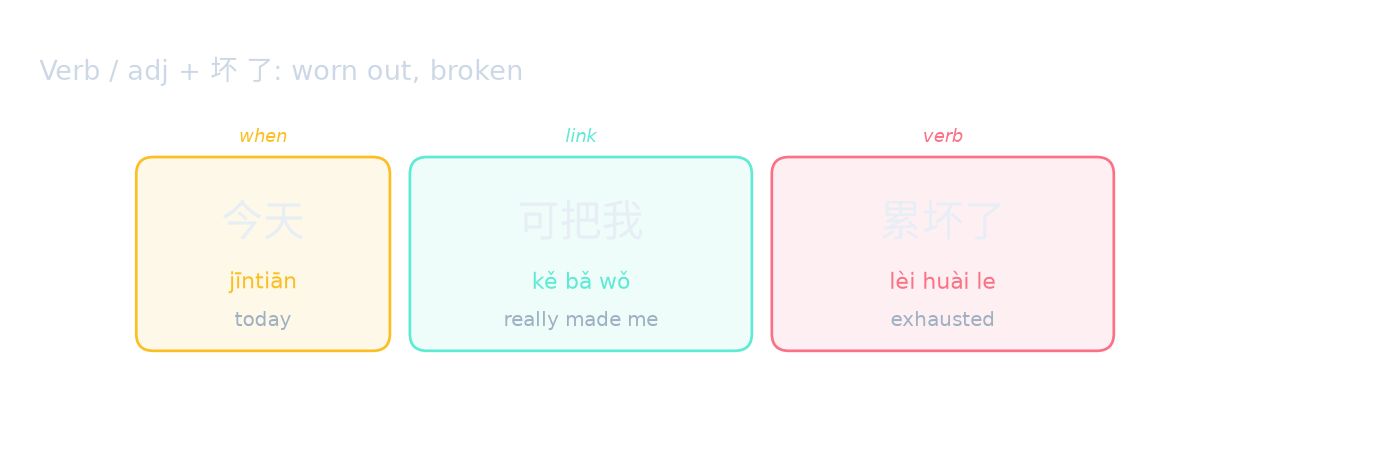
- Your mum comes home after a twelve-hour shift and collapses on the sofa.
- today今天really / can可(把: marks the object)把my我to become exhausted累坏(completed / change)了! — "Today absolutely wore me out!"
- Goal: use broken坏(completed / change)了 for "broken" and for "extremely" (hungry饿broken坏(completed / change)了).
Verb + broken坏 = broken (a result)
- Verb + broken坏((completed / change)了) = the action broke something: to drop and break摔坏 (broke by dropping), to use / with用broken坏 (wore out by using), broke弄坏 (damaged).
- my我(modifier / structural particle)的phone手机to drop and break摔坏(completed / change)了。 — "My phone fell and broke."
my我的phone手机drop摔broken坏了。
Adj / feeling + broken坏(completed / change)了 = extremely
- With feelings and states, broken坏(completed / change)了 means "terribly": to become exhausted累坏(completed / change)了, hungry饿broken坏(completed / change)了, urgent / anxious急broken坏(completed / change)了, happy高兴broken坏(completed / change)了.
- hearing听到this这个news消息,she她happy高兴broken坏(completed / change)了。 — "When she heard the news, she was thrilled."
hearing听到this这个news消息,she她happy高兴extremely坏了。
Complete: “The kids are starving.” 孩子们饿____了。
الصعوبة 1/5 · 100 عملة + مكافأة صغيرة عند الإنجاز الأول اليوم
Feeling / state + 坏了 = extremely.
Which meaning?
- Action verb + broken坏 = something is physically broken: computer电脑to wear out (tools)用坏(completed / change)了 — "The computer broke from use."
- Feeling / state + broken坏(completed / change)了 = an extreme degree, nothing broken: hungry饿broken坏(completed / change)了. (completed / change)了 is usually needed.
- With feelings, broken坏 means "terribly": 这件matter事really / can可(把: marks the object)把my我urgent / anxious急broken坏(completed / change)了。 — "This really had me worried sick."
In 电脑用坏了, what does 坏 express?
الصعوبة 1/5 · 100 عملة + مكافأة صغيرة عند الإنجاز الأول اليوم
Action verb + 坏 = broken by that action.
In 高兴坏了, something is broken.
الصعوبة 1/5 · 100 عملة + مكافأة صغيرة عند الإنجاز الأول اليوم
With feelings, 坏了 just means “extremely”.
With (把: marks the object)把
- broken坏 results often appear in (把: marks the object)把 sentences: my brother弟弟(把: marks the object)把my我(modifier / structural particle)的glasses眼镜broke弄坏(completed / change)了。 — "My brother broke my glasses."
- really / can可(把: marks the object)把…broken坏(completed / change)了 is a common spoken frame: really / can可(把: marks the object)把my我urgent / anxious急broken坏(completed / change)了 — "I was worried sick."
my brother弟弟把my我的glasses眼镜broke弄坏了。
Build: “My brother broke my glasses.”
الصعوبة 3/5 · 200 عملة + مكافأة صغيرة عند الإنجاز الأول اليوم
把 + object + verb + 坏 + 了.
Recap
- Action verb + broken坏((completed / change)了) = broken by that action (to drop and break摔坏, broke弄坏).
- Feeling / state + broken坏(completed / change)了 = extremely (to become exhausted累坏(completed / change)了, happy高兴broken坏(completed / change)了); really / can可(把: marks the object)把my我…broken坏(completed / change)了 is spoken.
Read the full reference: HSK 5 grammar — Complements.
Your mum comes home after a twelve-hour shift and collapses on the sofa. Close the examples. Say a Mandarin response, then write it in Chinese. Explain briefly in English what the lesson’s pattern adds. Compare with the model, then change one detail and try again.
This is supported productive practice. Compare meaning and structure; your answer need not copy the model. A partner or teacher must hear the spoken response to comment on pronunciation.