خطة التعلم الخاصة بك · متابعة · مراجعة →
كلمات الاستفهام بمعنى “بعض- / أي-”
مُقدَّميبقى موقعك المحفوظ في هذا المتصفح. لا يكتمل استئناف الموقع الدرس أو الإجابة على أسئلته.
 4:00
HSK 3 القواعد 6: أنماط الجمل (把 & 被)
يبدأ هذا الموضوع بتركيبين مشهورين. يُستخدم 把 لإجراء فعل على مفعول معين؛ ويُستخدم 被 للإخبار عما حدث له. يحتاج كلاهما إلى أكثر من فعل مجرد. ثم ننتقل إلى…
شروحات إنجليزية + أمثلة ماندرين · التسميات تتبع النص المنطوق
In this lesson
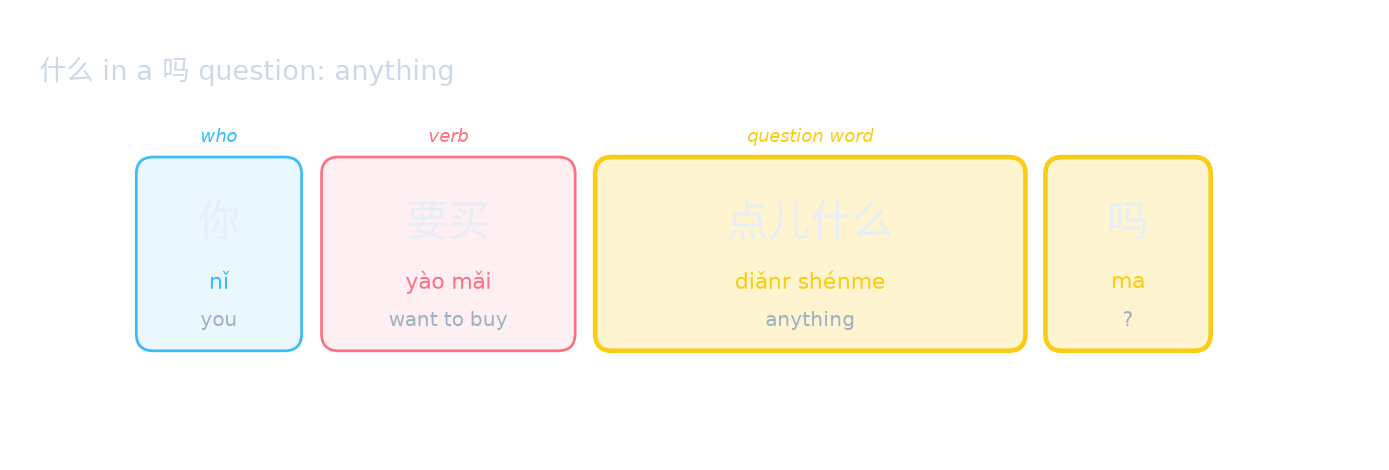
Do you want anything?
- Your friend is going to the shop and offers to bring something back for you.
- you你want / will / need要买点儿anything什么(yes/no ?)吗? Nǐ yào mǎi diǎnr shénme ma? — "Do you want to buy anything?" Here anything什么 means "anything", not "what".
- Goal: read and use anything什么, who谁 and where哪儿 as "something / anything / anyone / anywhere", and tell this apart from a real question.
Question word + (yes/no ?)吗 = something / anything
- In a (yes/no ?)吗 question, a question word becomes indefinite: anything什么 = anything, who谁 = anyone, where哪儿 = anywhere.
- you你to go去where哪儿(completed / change)了(yes/no ?)吗? — "Did you go anywhere?" (compare you你to go去where哪儿(completed / change)了? — "Where did you go?")
you你want想eat吃anything什么吗?
What does 你周末去哪儿了吗? mean?
الصعوبة 1/5 · 100 عملة + مكافأة صغيرة عند الإنجاز الأول اليوم
With 吗, 哪儿 becomes “anywhere”.
Build: “Do you want to eat anything?”
الصعوبة 3/5 · 200 عملة + مكافأة صغيرة عند الإنجاز الأول اليوم
QW + 吗 = anything?
In negatives and guesses
- I我not want to不想eat吃anything什么。 — "I don't really want to eat anything."
- With seems好像 or maybe / possible可能: he他seems好像have有anything什么matter事。 — "He seems to have something on his mind."
he他seems好像have有something什么matter事。
Complete: “Did anyone call me?” 有____给我打电话吗?
الصعوبة 1/5 · 100 عملة + مكافأة صغيرة عند الإنجاز الأول اليوم
In a 吗 question, 谁 = anyone (有人 also works).
(yes/no ?)吗 changes the meaning
- you你to buy买anything什么? asks "What are you buying?"; you你to buy买anything什么(yes/no ?)吗? asks "Are you buying anything?"
- not不 + Verb + anything什么 is a mild "not much / nothing in particular", weaker than anything什么(at all)都not不.
Versus QW + (at all)都
- I我anything什么(at all)都not want to不想eat吃 = "I don't want to eat anything at all" (total).
- I我not want to不想eat吃anything什么 = "I don't feel like eating anything in particular" (softer).
I我anything什么(at all)都not不want想eat吃。
我不想吃什么 is stronger than 我什么都不想吃.
الصعوبة 1/5 · 100 عملة + مكافأة صغيرة عند الإنجاز الأول اليوم
什么都不 is the total negative; 不…什么 is softer.
One anything什么, four meanings
| Sentence | Meaning |
|---|---|
| you你want想eat吃anything什么? | What do you want to eat? (a real question) |
| you你want想eat吃anything什么(yes/no ?)吗? | Do you want to eat anything? (yes / no) |
| I我anything什么(at all)都want想eat吃。 | I want to eat everything. |
| I我not want to不想eat吃anything什么。 | I don't really want to eat anything. (soft) |
- Look at the end and the middle: (yes/no ?)吗 turns it into a yes / no question; (at all)都 turns it into every- / no-.
Match each sentence to its meaning.
الصعوبة 2/5 · 140 عملة + مكافأة صغيرة عند الإنجاز الأول اليوم
吗 makes a yes / no question; 都 makes every- or (with 不) no-.
Recap
- In (yes/no ?)吗 questions, negatives and guesses, a QW = some-/any-: anything什么 = anything, who谁 = anyone.
- not不 + V + anything什么 is soft; anything什么(at all)都not不 is total.
Read the full reference: HSK 3 grammar — Basic sentence patterns.
Your friend is going to the shop and offers to bring something back for you. Close the examples. Say a Mandarin response, then write it in Chinese. Explain briefly in English what the lesson’s pattern adds. Compare with the model, then change one detail and try again.
This is supported productive practice. Compare meaning and structure; your answer need not copy the model. A partner or teacher must hear the spoken response to comment on pronunciation.