خطة التعلم الخاصة بك · متابعة · مراجعة →
رفض دعوة بأدب
مُقدَّميبقى موقعك المحفوظ في هذا المتصفح. لا يكتمل استئناف الموقع الدرس أو الإجابة على أسئلته.
 4:32
HSK 1 · المقدمات، الهوية والتبادلات المهذبة
محاورتك الصينية الأولى. قل من أنت، اسأل عن شخص ما، وتعلم الكلمات الأربعة المهذبة التي تفتح كل تبادل. وتعرّف على كلمة صغيرة جدًا، 吗…
شروحات إنجليزية + أمثلة ماندرين · التسميات تتبع النص المنطوق
في هذا الدرس
You cannot go today
-
you你to go去(yes/no ?)吗? Nǐ qù ma? — Are you going?
-
I / me我not不to go去。 Wǒ bú qù. — I am not going. to go去 qù means go; not不 negates it here.
-
Before you start: Recall final (yes/no ?)吗 from checking an identity and to thank谢谢 from courtesy phrases. This lesson changes the main verb from to be / is是 to to go去.
You hear a question ending in 吗. In the beginner patterns already studied, what is its purpose?
الصعوبة 1/5 · 100 عملة + مكافأة صغيرة عند الإنجاز الأول اليوم
Final 吗 turns the preceding proposition into a yes/no check in these patterns. Here the proposition concerns going, so listen for 去 rather than automatically replying 是.
Put not不 before the action
- For this simple pattern, use person + not不 + verb: I / me我not不to go去. Before the fourth-tone to go去, not不 is pronounced bú.
- A natural short answer to you你to go去(yes/no ?)吗? is to go去 or 不去. Repeating the verb is useful; you do not have to use to be / is是 for every yes/no reply.
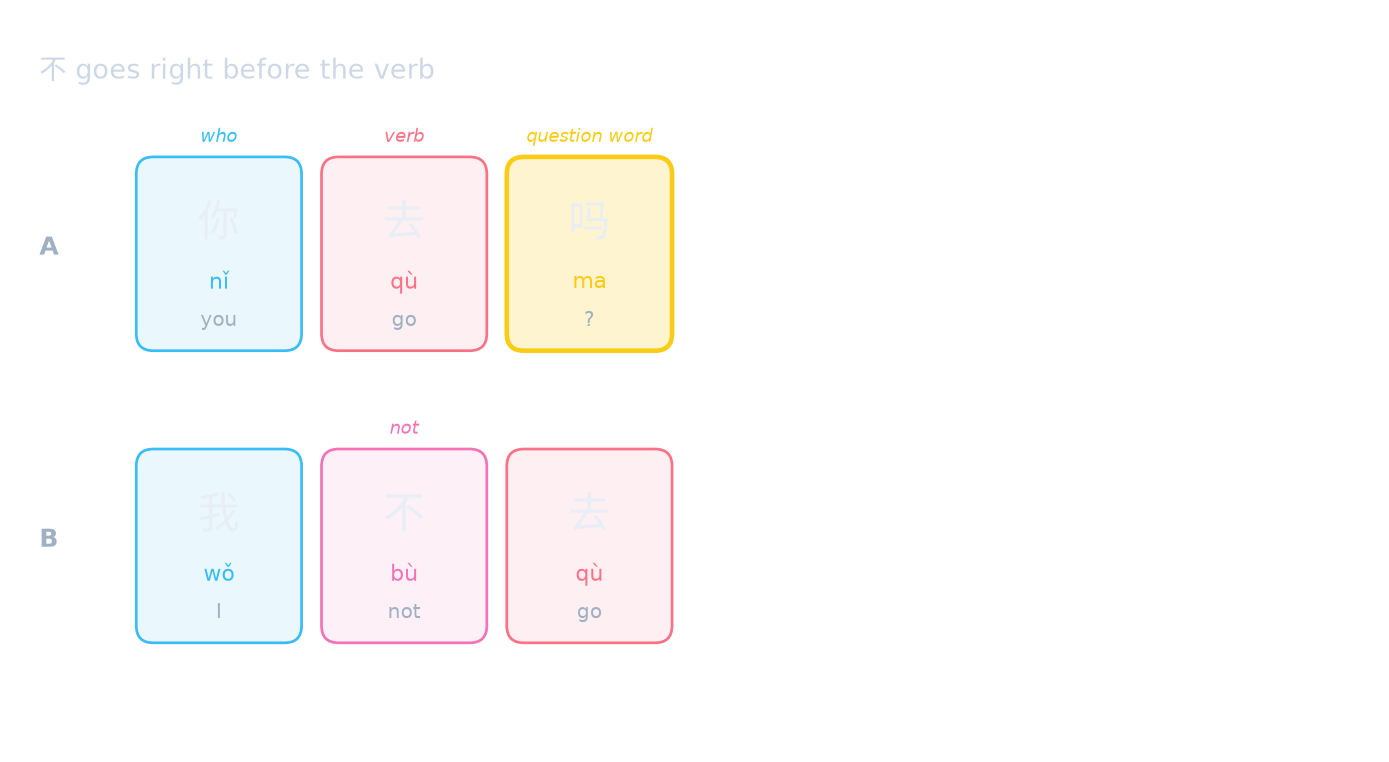
Complete “I am not going”: 我____去。
الصعوبة 1/5 · 100 عملة + مكافأة صغيرة عند الإنجاز الأول اليوم
我不去 is person + 不 + verb.
You will go. Give a short positive reply to 你去吗?
الصعوبة 1/5 · 100 عملة + مكافأة صغيرة عند الإنجاز الأول اليوم
Repeating 去 confirms the action.
Soften the refusal
- sorry; to feel embarrassed不好意思,I / me我not不to go去。 Bù hǎoyìsi, wǒ bú qù. — Sorry, I’m not going.
- Learn sorry; to feel embarrassed不好意思 as a whole courtesy phrase. Add to thank谢谢 if you want to acknowledge the invitation.
A: you你to go去(yes/no ?)吗? B: sorry; to feel embarrassed不好意思,I / me我not不to go去。to thank谢谢。 — Are you going? Sorry, I’m not going. Thank you.
Work through a decision: First identify to go去 as the action being checked in you你to go去(yes/no ?)吗?If you will go, to go去 confirms that action. If you decline, 不去 denies it. sorry; to feel embarrassed不好意思 can soften the refusal, while to thank谢谢 acknowledges the invitation without reversing the decision.
Compare a near miss: is not / no不是 denies an identity in the earlier to be / is是 pattern; it is not the practised reply to you你to go去(yes/no ?)吗?Also, to thank谢谢 after I / me我not不to go去 does not turn the refusal into agreement. Courtesy and the decision to go serve different purposes.
Match the phrases.
الصعوبة 2/5 · 140 عملة + مكافأة صغيرة عند الإنجاز الأول اليوم
Use the whole phrase 不好意思 to soften the refusal.
A friend asks 你去吗? You will not go but want to acknowledge the invitation. Choose a fitting reply.
الصعوبة 1/5 · 100 عملة + مكافأة صغيرة عند الإنجاز الأول اليوم
我不去 states the refusal; 不好意思 softens it and 谢谢 acknowledges the invitation. 我去 would confirm going, and 是,我是学生 answers a different identity question.
Hear the difference
- Which sentence is negative? Play each one:
- Do not worry about every negative form today. For to have / there is有 yǒu — have, the usual negative is not have / haven't没有 méiyǒu — do not have; a later unit practises it.
not不 and not / haven't没 are not interchangeable. not / haven't没 often denies that an action happened, and not have / haven't没有 can deny having something now. Neither is simply an English tense ending.
What is the reply?
الصعوبة 1/5 · 100 عملة + مكافأة صغيرة عند الإنجاز الأول اليوم
不 before 去 makes the reply negative.
没有 can only refer to the past.
الصعوبة 1/5 · 100 عملة + مكافأة صغيرة عند الإنجاز الأول اليوم
没有 can mean do not have now as well as deny that an action happened.
王力说:“我去。”林安说:“谢谢,我不去。”Which account fits these different decisions?
الصعوبة 1/5 · 100 عملة + مكافأة صغيرة عند الإنجاز الأول اليوم
王力 says 我去, so Wang Li will go. 林安 says 我不去, so Lin An declines; 谢谢 adds thanks without cancelling 不. Follow each named speaker and keep the negative attached to 去.
Reply without reading
- Hear you你to go去(yes/no ?)吗? and give a positive reply, then a polite negative reply. Use to go去 / 不去.
- Later today, recall the refusal phrase without reopening this page. A forgotten word is a cue to review, not a failure.
I / me我not不to go去 declines. sorry; to feel embarrassed不好意思 softens it. For a to go去 question, to go去 / 不去 are useful short replies.
Later recall: Tomorrow, answer you你to go去(yes/no ?)吗? positively and negatively without reading. A few days later, mix it with you你to be / is是student学生(yes/no ?)吗? and choose the main verb for each reply. Revisit “Put not不 before the action” if you carry to be / is是 into the going question.
Next: ask what and who.
Apologise, say you are not going, then thank the inviter.
الصعوبة 3/5 · 200 عملة + مكافأة صغيرة عند الإنجاز الأول اليوم
The prompt sets the order of these three courtesy actions.
Write a new Mandarin invitation question with 去 and a polite refusal. Say both roles aloud. Then change the decision: write a short positive reply to the same question. Explain which part changes the decision; English explanation is optional.
Compare and revise your own wording. Written self-review does not assess pronunciation or conversation quality.