تصميم وتطوير حل خدمة مدرسي
مُقدَّم| English | المعنى |
|---|---|
| design brief/dɪˈzaɪn briːf/ | مهمة التصميم |
| deliverable/dɪˈlɪvərəbl/ | المنتج المتسلم |
| prototype/ˈprəʊtəʊtaɪp/ | النموذج الأولي |
| specification/ˌspesɪfɪˈkeɪʃn/ | المواصفات |
| usability test/ˌjuːzəˈbɪlɪti test/ | اختبار قابلية الاستخدام |
| neutral prompt/ˈnjuːtrəl prɒmpt/ | محفز محايد |
| iteration/ˌɪtəˈreɪʃn/ | تكرار |
| observation log/ɒbzəˈveɪʃn lɒɡ/ | سجل الملاحظات |
| sign-off/saɪn ɒf/ | الموافقة النهائية |
| version log/ˈvɜːʃn lɒɡ/ | سجل الإصدارات |
Turn the plan into a design brief
This is original GAC031-aligned practice for unit 3.3, Design and Develop. It continues the fictional library sign project from units 3.1 and 3.2. It is not an ACT assessment.
The team's goal is still to help students find a suitable quiet or discussion area within two minutes. A design brief 设计任务书 tells the makers what the solution must do. It is more useful than “make nice signs.” The team writes four requirements:
- A student can tell which rooms are quiet and which allow discussion.
- A student can follow the route from the entrance without asking a staff member.
- The signs use words and clear shapes, so meaning does not depend on colour alone.
- The librarian approves each location; nothing blocks an exit or covers safety information.
The first two describe a user's task. The last two protect access and safety. The team will check each requirement before deciding that a sign is ready. It does not add an expensive screen merely because a screen looks modern.
User need: “I want to find a discussion room quickly.” Possible deliverable: a set of signs. A sign is only one possible answer to the need. If the first sign fails, the team changes the sign, not the student's need.
“Make nice signs” is a wish, not a brief; the printer cannot read minds.
أي من الخطوط التالية يُعدّ متطلبًا مفيدًا في وثيقة متطلبات تصميم لافتات المكتبة؟
الصعوبة 1/5 · 100 عملة + مكافأة صغيرة عند الإنجاز الأول اليوم
يُسمّي السطر الثاني إجراءً يمكن للمستخدم القيام به والتحقق منه. المظهر وحده والشاشة غير الضرورية لا يثبتان إمكانية العثور على المسار.
Make two prototypes before printing
A prototype 原型 is an early version made to learn from, not a finished product. The team draws two paper options at the same scale. Option A is one room map at the entrance. Option B is a short arrow at each choice point, plus a matching label at the destination door. Both show the words “Quiet study” and “Discussion”; neither relies on blue or orange by itself.
The sketches include the proposed wall positions. This matters because an excellent sign on the wrong wall may appear only after the student has already passed the turn. The team walks both routes and records where a person must choose a direction. The librarian has not approved any wall positions yet, so the sketches remain on paper. No one sticks a trial sign over an existing notice.
The team also writes a small specification 制作规格 for a later version: readable text, strong contrast between text and background, a consistent arrow shape, and material that can be removed without damaging the wall. “Easy to read” is not left as a slogan. The team will ask users to read the wording from the place where they first need it.
ما هما التفصيلان اللذان يجب أن يتضمنهما النموذج الأولي الورقي قبل اختبار المستخدم؟
الصعوبة 2/5 · 140 عملة + مكافأة صغيرة عند الإنجاز الأول اليوم
الكلمات والأشكال لا تعتمد على اللون وحده، والمواقع تتيح للمستخدمين اختبار المسار. الأسماء غير ضرورية؛ ولم تُمنح الموافقة بعد.
Test the task, not the team's favourite drawing
The team runs a usability test 可用性测试 with twelve new volunteers, six for each option. Each volunteer starts at the same entrance and sees only one paper option at its proposed position. A team member says: “Please find a room where you can discuss work. Tell us what you would do next.” This neutral prompt 中立提示 gives the goal without saying where to turn. The team alternates A and B between arriving volunteers, rather than testing everyone with A first.
The observers note the first direction chosen, points of hesitation, and the volunteer's own words. They do not record names. Four of six volunteers choose the right route using A; five of six do so using B. One person following B stops because “Discussion” is small on the door label. Another asks whether the arrow for quiet study also leads to the discussion room. These comments are more useful than a simple vote for the prettier sketch.
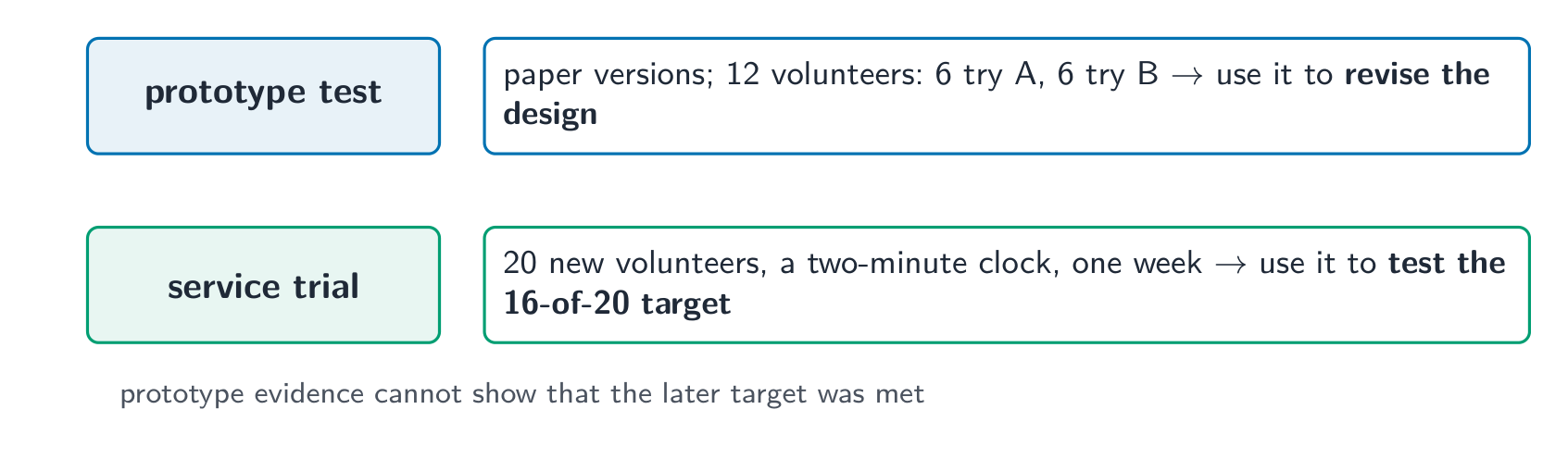
The twelve-person paper test is small. It is not the planned one-week trial with 20 new volunteers and a two-minute clock. The team can use it to improve a prototype; it cannot announce that the original success target of 16 out of 20 has been met.
Do not tell a volunteer, “Most people choose the right arrow.” That sentence gives away the intended route and spoils the test. Ask the same open task question each time.
في الاختبار الورقي، اختار 4 من أصل 6 متطوعين المسار الصحيح مع B، و5 من أصل 6 مع A. كم عدد المتطوعين الإضافيين الذين اختاروا المسار الصحيح مع B؟
الصعوبة 2/5 · 140 عملة + مكافأة صغيرة عند الإنجاز الأول اليوم
5 − 4 = 1. الفرق بشخص واحد بين مجموعتين صغيرتين يساعد في اختيار ما يجب تعديله، لكنه لا يثبت أن B سيعمل لجميع الزوار.
Revise with a reason
The team chooses B for a second iteration 迭代: another version made after reviewing evidence. They enlarge “Discussion” on the door label and change the ambiguous arrow so each destination has its own direction. They keep words beside the shapes. A new drawing is marked B2; the old B1 drawing stays in the folder. The team has an observation log 观察记录 with one line per issue: what happened, which requirement it affects, the proposed change, and what to check next.
| Observed in the paper test | Change in B2 | Check before release |
|---|---|---|
| “Discussion” was hard to read at the door | Enlarge the word | Read it from the decision point |
| Quiet and discussion arrows seemed to share a route | Draw separate arrows | Ask a new user to explain each direction |
The team does not assume that a larger word solves every problem. It asks two new people, who have not seen B1, to follow the B2 sketches. Both choose the intended route in this quick check. That result supports the specific fixes but is too small to predict what all library visitors will do.
ضع إجراءات التصميم التسلسل المستخدم في هذه الحالة.
الصعوبة 3/5 · 200 عملة + مكافأة صغيرة عند الإنجاز الأول اليوم
تؤدي المشكلة المرصودة إلى تعديل الرسم التوضيحي وفحص جديد. يجب أن تسبق موافقة الموقع التركيب.
Get sign-off, then build the trial version
The team gives the librarian the B2 sketches, proposed positions, removable material and observation log. Sign-off 最终批准 means the librarian has accepted the locations and checked that exits and safety notices stay clear. If a location is rejected, the group changes the plan before printing. It records the approved positions and labels the final file B3, so nobody accidentally prints an older version.
Only then are the signs installed for the one-week trial. The next group of 20 volunteers receives the same starting point and instructions used for the baseline, and a timer checks the two-minute target. Their results belong to the later evaluation, not to this prototype lesson. The team saves the baseline, sketches, versions, approval and test notes together. That version log 版本记录 makes the path from a problem to a design decision visible.
Design and develop means: requirement → two prototypes → neutral user task → recorded problem → revision → new check → approval → trial. A finished-looking poster is not evidence that people can use it.
يثبت الاختبار الورقي المكون من 12 شخصًا أن هدف الأسبوع الواحد بأقل من 16 نجاحًا بين 20 متطوعًا جديدًا قد تم تحقيقه بالفعل.
الصعوبة 1/5 · 100 عملة + مكافأة صغيرة عند الإنجاز الأول اليوم
تم التحقق من النماذج الأولية الورقية مع مجموعتين من ستة أشخاص دون قياس تجربة الدقيقتين. يتطلب الهدف تجربة مدتها أسبوع واحد ومُوافَق عليها لاحقًا مع 20 متطوعًا جديدًا.