Listening you can actually do
مُقدَّم 25:58
GAC001 اللغة الإنجليزية الأكاديمية I: مهارات الاستماع والتحدث
تستمع إلى تغيير في موعد اجتماع نادي، أو تشرح خطة لزملائك، أو تساعد مجموعة على اختيار غرفة. في كل موقف، يربط إنجليزي مفيد الرسالة بـ…
سرد باللغة الإنجليزية · ترجمة نصية بالإنجليزية و中文 يمكنك التبديل بينهما
في هذا الدرس
| English | المعنى |
|---|---|
| selection/sɪˈlekʃn/ | الاختيار |
| listening for gist/ˈlɪsənɪŋ fɔː dʒɪst/ | الاستماع للمضمون العام |
| predicting/prɪˈdɪktɪŋ/ | التنبؤ |
| context clues/ˈkɒntekst kluːz/ | أدلة السياق |
Choose what the question needs
- Goal: decide before you listen whether you need the main message (gist) or one detail, predict what you might hear, and keep going when you miss a word.
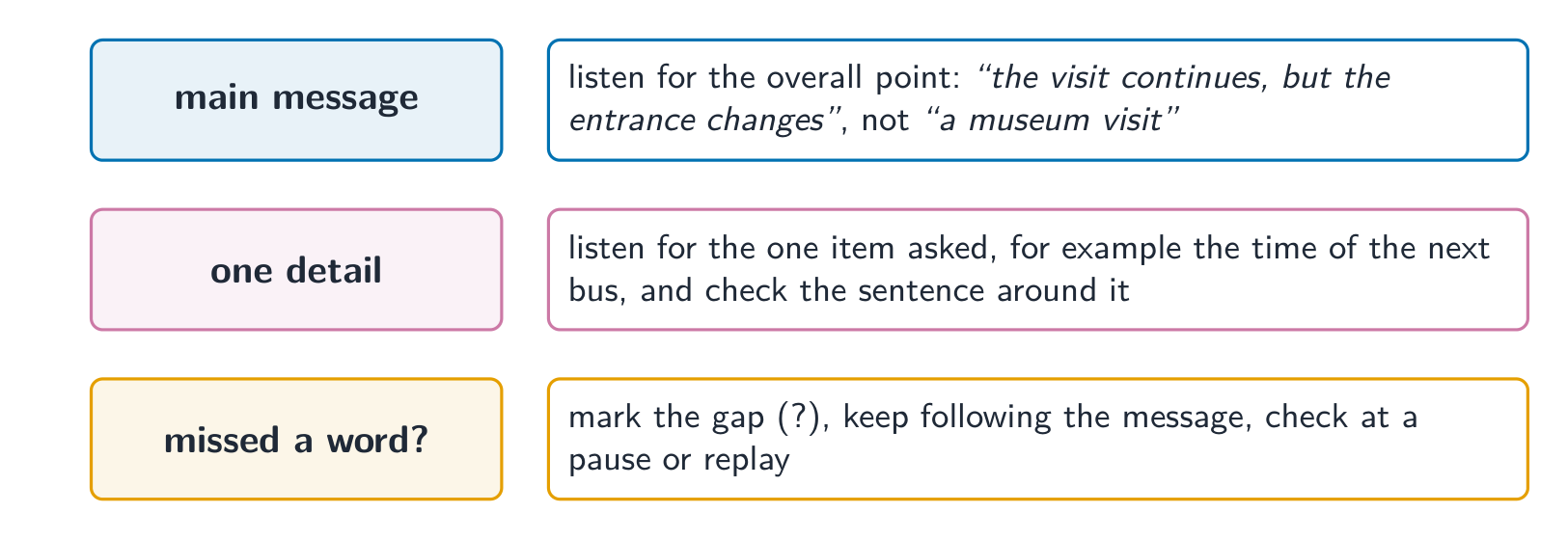
- Selection 取舍 means choosing important information, not deciding to ignore meaning. A question about the main message needs a different focus from a question about a bus time.
- You may miss words during continuous speech. Mark uncertainty and keep following the message; if the missing detail is essential, check it when a pause or replay is available.
Gist is more than a topic label
- Listening for gist 泛听 asks what the message mainly says. “A museum visit” is a topic; “the visit continues but the entrance changes” is a useful gist.
- Listening for detail asks for a particular fact. Decide which task you have before making notes, and return to the surrounding sentence to check a number’s role.
- Try it: play the library announcement from lesson 1.1. First listen: write its gist in one sentence. Second listen: note the new closing time on Friday and how study rooms are now booked.
Model answers — check after you listen
Gist: "The library closes early on Friday, and two services have changed." A topic label such as "the library" is not a gist: it says what the talk is about, not what it says. Details: Friday closing at four o'clock; study rooms are booked online, seven days ahead.
You have one listening and a question asking what the talk is mainly about. Which technique fits?
الصعوبة 1/5 · 100 عملة + مكافأة صغيرة عند الإنجاز الأول اليوم
A main-message question calls for gist: what the talk mainly says. Detail listening has a different target, such as one departure time.
Which sentence is the best gist of the library announcement?
الصعوبة 1/5 · 100 عملة + مكافأة صغيرة عند الإنجاز الأول اليوم
A gist says what the message mainly says. "The library" is only a topic, and the printer is one detail among several.
Predict a possibility, not an answer
- Predicting 预测 uses the title or situation to prepare likely vocabulary. Airport delays may involve a gate, departure time or announcement; prediction is preparation rather than proof.
- Check every predicted answer against what you hear. A title saying “Changes to the visit” does not mean the whole trip is cancelled.
Title: “Changes to Saturday’s visit”. Before listening, predict: cancelled? new time? new meeting place? bring something? You hear: “The visit is still going ahead, but please use the hill entrance, not the main gate.” Result: new meeting place is confirmed; cancelled is wrong. The prediction told you what to listen for, but only the message gave the answer.
Put these in the order that gets the most out of one listening.
الصعوبة 3/5 · 200 عملة + مكافأة صغيرة عند الإنجاز الأول اليوم
Read the task and prepare a focus before playback, follow the message while recording relevant details, then use the permitted follow-up to check gaps. Prediction does not establish an answer.
A talk is announced as being about airport delays. Which words are worth loading in advance? Choose all that apply.
الصعوبة 2/5 · 140 عملة + مكافأة صغيرة عند الإنجاز الأول اليوم
Prepare likely vocabulary related to airport delays. Then verify the actual message; a likely topic word is not a confirmed answer.
Use surrounding evidence
- Context clues 上下文线索 include explanations, contrasts and consequences. In “The train was cancelled, so we took the bus instead”, the alternative transport supports “the train did not run”.
- A clue can narrow a meaning without explaining every unfamiliar word. If more than one interpretation remains possible, keep the uncertainty and seek another clue or clarification.
Recover without losing the next point
- Use a short question mark in your notes for a missed word and continue. A later explanation may help, but it is not guaranteed to repeat the missing information.
- Avoid turning each spoken sentence into a long translation while new speech continues. After the talk, use the permitted transcript, replay or speaker check to repair important gaps.
"The train was cancelled, so we took the bus instead and arrived two hours late." What does cancelled mean here?
الصعوبة 1/5 · 100 عملة + مكافأة صغيرة عند الإنجاز الأول اليوم
The bus was used instead of the train, which supports the meaning that the train did not run. Use the stated consequence rather than inventing another definition.
When you miss a word in a continuous talk, it is better to mark it and keep following the message.
الصعوبة 1/5 · 100 عملة + مكافأة صغيرة عند الإنجاز الأول اليوم
True. Stopping to translate one word loses what comes next. Mark the uncertainty, keep following, and use later context to fill the gap.
Write one English sentence saying what you will do next time you miss a word while listening.
الصعوبة 3/5 · 200 عملة + مكافأة صغيرة عند الإنجاز الأول اليوم
Example: “I will mark the gap and keep following the message, then check an important missing detail afterwards.” A later sentence may help, but it need not repeat the lost word.
Prepare a focus, then verify predictions against the message. Context can help, but missing information may still require a later check.
ما المشكلة؟ لا يرى ذلك سوى فريق الموقع.