Niches, Hardy–Weinberg and conservation
مُقدَّم 9:48
الوحدة 2: الخلايا، التطور، التنوع البيولوجي والحفاظ عليه
بدأت كخلية بيضة واحدة ملقحة. تشرح هذه الوحدة كيف انقسمت تلك الخلية، وكيف تم خلط النسخ وتقليلها إلى نصفين لتكوين الأمشاج، وكيف تتطابق الجينات...
سرد باللغة الإنجليزية · ترجمة نصية بالإنجليزية و中文 يمكنك التبديل بينهما
في هذا الدرس
| English | المعنى |
|---|---|
| niche/niːʃ/ | The role of a species in an ecosystem, including its resource use and interactions with environmental conditions and other organisms. |
| Seed banks/siːd bæŋks/ | |
| Corridors/ˈkɒrɪdɔːz/ |
Two birds on one tree, no competition
- Several species of warbler can feed in the same tree without pushing each other out: one feeds at the top, one in the middle, one near the trunk.
- Each species has its own way of life. This lesson covers niches, how to measure genetic change with Hardy–Weinberg, and how we protect species.
The niche
- A species' niche 生态位 is its role in the habitat: what it eats, where it lives and feeds, and the conditions it can survive.
- Two species cannot share exactly the same niche for long; one will out-compete the other.
Three kinds of adaptation
- Anatomical (body structure): thick fur, a long beak. Physiological (body processes): enzymes that work in the cold, kidneys that save water.
- Behavioural (actions): migration, hunting in groups, being active at night.
Match each adaptation to its type.
الصعوبة 2/5 · 140 عملة + مكافأة صغيرة عند الإنجاز الأول اليوم
Structure, process or action.
The Hardy–Weinberg equations
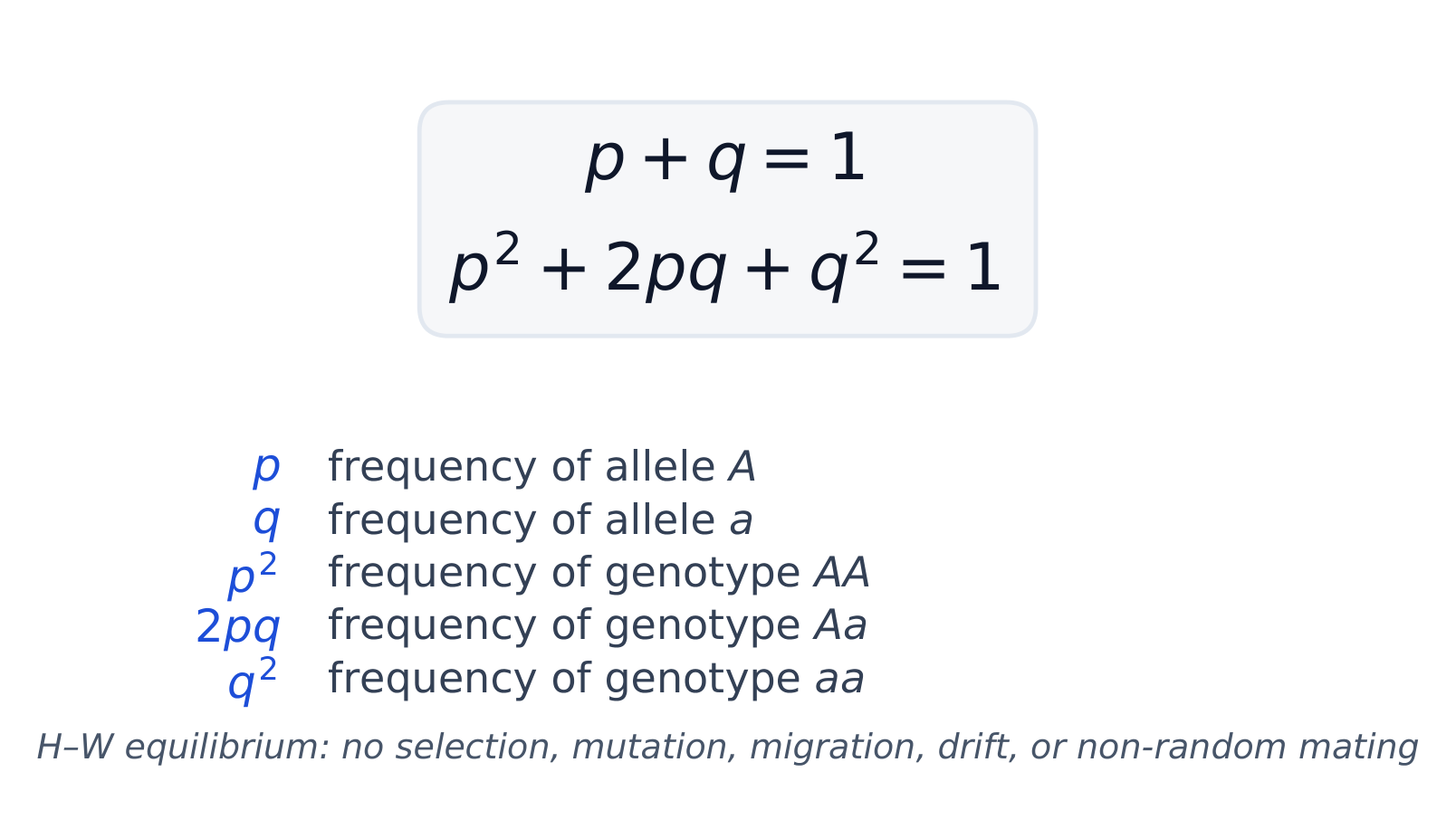
- p is the frequency of the dominant allele and q of the recessive allele, so p + q = 1.
- Genotype frequencies: p² + 2pq + q² = 1, where p² is homozygous dominant, 2pq is heterozygous (carriers) and q² is homozygous recessive.
Match each term to the group it describes.
الصعوبة 2/5 · 140 عملة + مكافأة صغيرة عند الإنجاز الأول اليوم
The three genotype frequencies add up to 1.
Using the equation
- Start from q², the only group you can recognise by its phenotype. Take the square root to find q, then p = 1 − q.
- The equation assumes a large population, random mating, and no selection, migration or mutation. If real frequencies change over generations, one of these is happening — for example selection.
Worked example. Of 500 foxes, 45 show the recessive phenotype. How many are expected to be carriers?
- q² = 45 ÷ 500 = 0.09, so q = 0.3 and p = 1 − 0.3 = 0.7.
- Carriers: 2pq = 2 × 0.7 × 0.3 = 0.42, and 0.42 × 500 = 210 foxes.
16 % of a population shows a recessive phenotype. What is the frequency of the recessive allele, q?
الصعوبة 2/5 · 140 عملة + مكافأة صغيرة عند الإنجاز الأول اليوم
q² = 0.16, so q = 0.4.
In a population of 1000, q = 0.2. How many people are expected to be carriers?
الصعوبة 2/5 · 140 عملة + مكافأة صغيرة عند الإنجاز الأول اليوم
p = 0.8; 2pq = 2 × 0.8 × 0.2 = 0.32; 0.32 × 1000 = 320.
Which does the Hardy–Weinberg equation assume?
الصعوبة 2/5 · 140 عملة + مكافأة صغيرة عند الإنجاز الأول اليوم
If frequencies change, one of the assumptions is broken.
Conserving species: zoos and seed banks
- Zoos run captive breeding programmes, keep records to avoid inbreeding, and can release animals back to the wild. Seed banks 种子库 store seeds cold and dry for many years.
- But captive animals may lose natural behaviour, and only a few individuals and a small part of the gene pool can be kept.
Captive breeding programmes keep records of which animals breed to avoid inbreeding.
الصعوبة 1/5 · 100 عملة + مكافأة صغيرة عند الإنجاز الأول اليوم
This keeps as much genetic diversity as possible.
Conserving habitats
- Protecting habitats keeps whole communities and their interactions. Corridors 走廊 of habitat link separated areas so animals can move and populations can breed with each other.
- This needs land, money and agreement between governments and local people.
Do not start from p² or 2pq. You cannot tell homozygous dominant individuals from carriers by looking at them. Always begin with q², the recessive phenotype.
A niche is a species' role and needs; adaptations are anatomical, physiological or behavioural. Hardy–Weinberg: p + q = 1 and p² + 2pq + q² = 1; start from q² (recessive phenotype). It assumes no selection, migration or mutation. Zoos and seed banks protect species directly; habitat protection and corridors protect whole ecosystems.
Evaluate the use of seed banks to conserve plant species.
Evaluate means both sides.
ما المشكلة؟ لا يرى ذلك سوى فريق الموقع.