Productivity and energy transfer
مُقدَّم 10:46
الوحدة 4: الطاقة، البيئة، علم الأحياء الدقيقة والمناعة
حقل القمح ي intercept ضوء الشمس، ويثبت الكربون، ويغذي سلسلة غذائية - ويفقد الطاقة في كل مرحلة. تتبع هذه الوحدة الطاقة من الفوتون إلى النظام البيئي...
سرد باللغة الإنجليزية · ترجمة نصية بالإنجليزية و中文 يمكنك التبديل بينهما
في هذا الدرس
| English | المعنى |
|---|---|
| net primary productivity/net ˈpraɪməri ˌprɒdəkˈtɪvɪti/ | The rate of energy storage or biomass production by producers after subtracting their respiratory losses from gross primary productivity. |
| Gross primary productivity/ɡrəʊs ˈpraɪməri ˌprɒdəkˈtɪvɪti/ | The total rate at which producers capture energy or fix carbon before their respiratory losses are subtracted. |
Why a field of wheat feeds more people than the same field of cattle
- The same field can feed about ten times more people if they eat the crop than if the crop is fed to animals first.
- The reason is how energy flows through a food chain, and how much is lost at each step.
Gross and net primary productivity
- Gross primary productivity 总初级生产力 (GPP) is the energy plants fix in photosynthesis, per area per year, in kJ/(m² yr).
- Plants use part of it in their own respiration (R). What is left for growth, and for animals to eat, is net primary productivity 净初级生产力: NPP = GPP − R.
A forest has GPP of 30 000 kJ/(m² yr) and plant respiration of 12 000 kJ/(m² yr). What is its NPP in kJ/(m² yr)?
الصعوبة 2/5 · 140 عملة + مكافأة صغيرة عند الإنجاز الأول اليوم
NPP = GPP − R = 30 000 − 12 000 = 18 000.
Energy lost along the chain
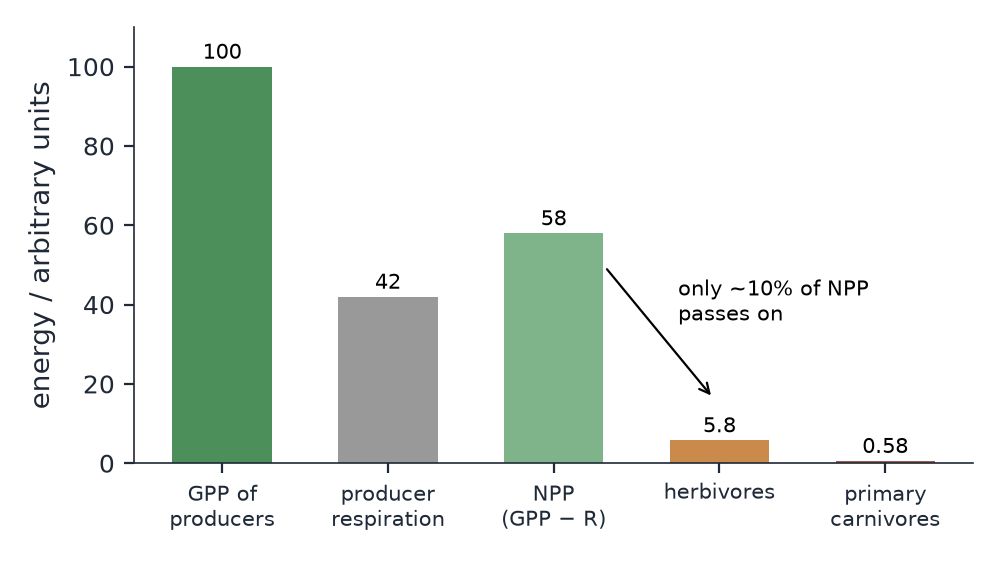
- Only about 10 % of the energy at one trophic level reaches the next. Energy is lost as heat from respiration, in faeces and urine, and in parts that are not eaten, such as roots and bones.
- So food chains rarely have more than four or five levels, and top predators are few.
Which are ways energy is lost between trophic levels?
الصعوبة 2/5 · 140 عملة + مكافأة صغيرة عند الإنجاز الأول اليوم
Energy is transferred, never destroyed.
Food chains are short because so much energy is lost at each step.
الصعوبة 1/5 · 100 عملة + مكافأة صغيرة عند الإنجاز الأول اليوم
After four or five steps, too little energy is left to support another level.
Calculating efficiency
- Efficiency of transfer = energy in the next level ÷ energy in this level × 100 %.
- For an animal, net production = energy in food eaten − energy in faeces and urine − energy used in respiration.
Worked example. A grassland has GPP 45 000 kJ/(m² yr) and plant respiration 19 000 kJ/(m² yr). Cattle that eat the grass gain 2 600 kJ/(m² yr).
- NPP = 45 000 − 19 000 = 26 000 kJ/(m² yr).
- Efficiency from grass to cattle = 2 600 ÷ 26 000 × 100 = 10 %.
Rabbits take in 1 200 kJ and foxes gain 96 kJ from eating them. What is the efficiency of transfer as a percentage?
الصعوبة 2/5 · 140 عملة + مكافأة صغيرة عند الإنجاز الأول اليوم
96 ÷ 1200 × 100 = 8 %.
Why farm animals are kept warm and still
- Farmers can make animals more efficient by keeping them indoors and warm and limiting their movement, so less energy is used in respiration.
- This raises ethical questions about animal welfare, which you may be asked to weigh against the higher yield.
Why does keeping farm animals warm and limiting their movement raise efficiency?
الصعوبة 1/5 · 100 عملة + مكافأة صغيرة عند الإنجاز الأول اليوم
Less heat lost and less movement means less respiration.
Energy is not "used up" or destroyed. It is transferred to the surroundings, mostly as heat from respiration, and cannot be passed on to the next level.
GPP is the energy fixed by photosynthesis; NPP = GPP − plant respiration. Only about 10 % of the energy passes to each next level, because energy is lost as heat from respiration, in waste and in uneaten parts. Efficiency = energy in next level ÷ energy in this level × 100 %. Eating lower down the chain feeds more people from the same area.
Explain why eating crops rather than meat can feed more people from the same area of land.
Link the number to the reasons.
ما المشكلة؟ لا يرى ذلك سوى فريق الموقع.